
May in Minsk, Part I
Monkeys and Misery in Cinemas,
Spartak Closes Its Doors
In January 1923, six cinemas in Minsk advertised in the local newspaper, Zvezda: the Grotesk, Internatsional, Kultura, Red Builder, Red Star, Spartak. By May 16, only two cinemas still advertised.
The Red Builder had stopped advertising by February. The Kultura never advertised in May. On May 2, Zvezda reported the Spartak (one of the two cinemas operated by the Red Army) would be handed over to the Rabis (The Art Trade Workers Union) “for the summer months.” 1
May began with job loss. On May 1, the Gorono (The Minsk City Department of Public Education), which now controlled the cinemas, dismissed 6 musicians, and 3 other staff from the Red Star, and three musicians and a cashier from the Internatsional. The Kultura dismissed one musician and four other staff members because it was closed for major repairs.2 Later, it was reported that another employee from the Internatsional was dismissed.3
On May 4, the Grotesk apparently tried to lift audience spirits with a film about a chimpanzee, Velikodushnyy Zhak (Generous Jacques).4 In January 1924, Ogonyok, a weekly illustrated journal, ran an article it titled Zveri na Ekrane (Beasts on the Screen), describing a number of films about two monkeys.5 The described plots indicate that they were the Dippy-Doo-Dad series about animals dressed as people, made by American producer Hal Roach beginning in 1923. None was named Generous Jacques.
On the other hand, there were the Napoleon and Sally films, starring two chimpanzees. This is a Dutch version (the intertitles), from Uit het leven van twee chimpansees (The Life of Two Chimpanzees).
Uit het leven van twee chimpansees (The Life of Two Chimpanzees).
Before Napoleon and Sally, there was Joe Martin the organgutan starring in films in the 1910s.
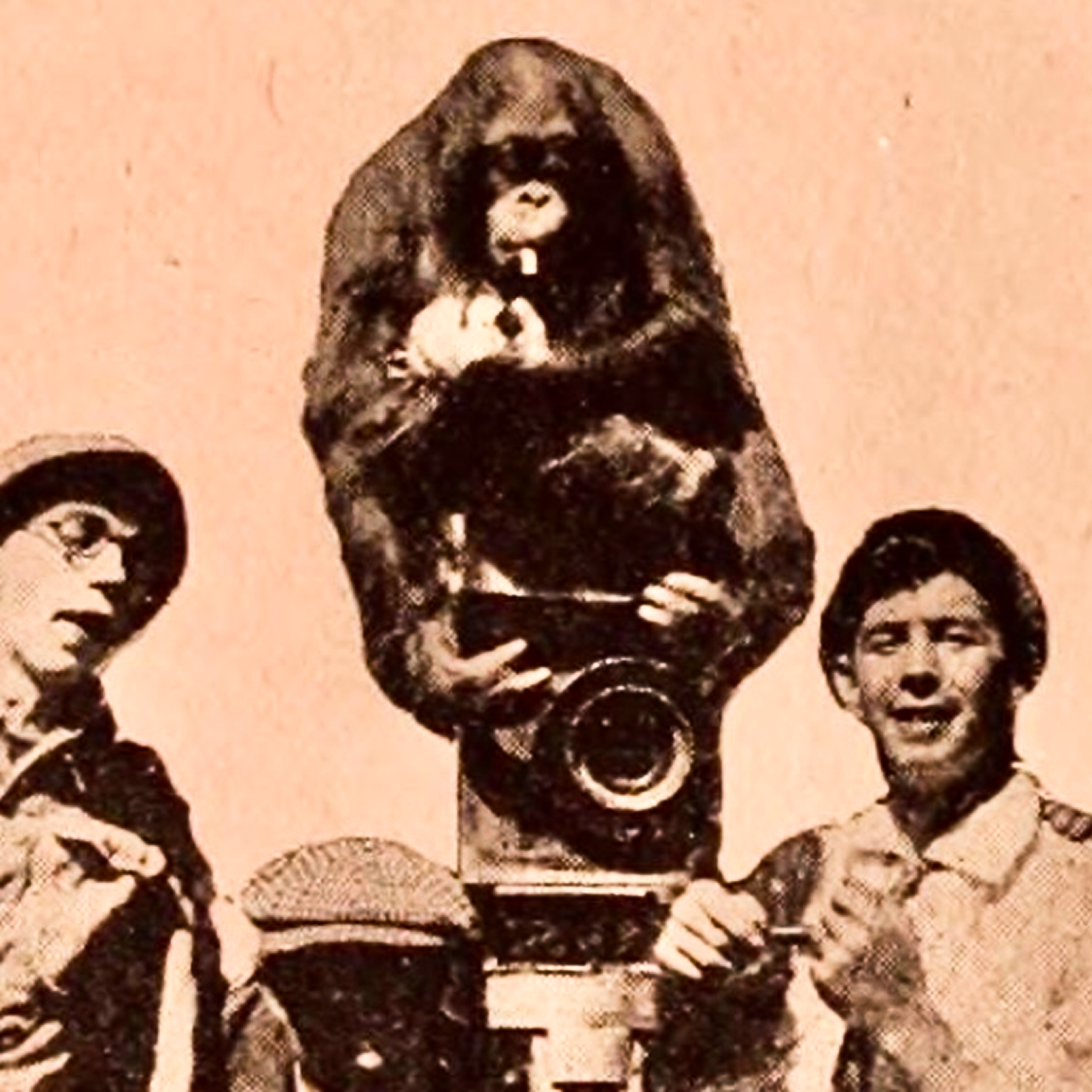
Joe Martin, the organgutan.
Source: Moving Picture Weekly, July 15, 1916.
Public domain, via Wikimedia Commons.
On May 4, the Spartak advertised Zhizn' Ugryumoye More [Life is a Gloomy Sea] and advertised it in Zvezda as American.6 We have been unable to trace any films with that name. No matter, it did not last long. On May 5, Generous Jacques had replaced it and so Jacques was showing at both the Grotesk and Spartak at the same time.7
American pictures were apparently very popular in Minsk. Sometimes pictures that were not even American were advertised as such. The Red Star advertised Gashish (Ray v Adu) (Hashish [Heaven in Hell]) as an American picture starring the then very popular Priscilla Dean.8 The film was actually German, entitled Haschisch, das Paradies der Hölle (Hashish, the Paradise of Hell) (1921) and starring Tilla Durieux.9
Sticking with the dark theme, the Internatsional screened Vo Mrake Bezumiya (In the Darkness of Madness).10 We could not find a direct correlation to this film but given the popularity of Conrad Veidt and the lack of films with the term “madness” in the title, we will guess that this was actually the German film Wahnsinn (Madness) (1919).11
On May 9, the Red Star advertised the new American film with the Russian title of Chelovek s Katorgi (The Ex-Convict).12 We believe that this was the 1922 version of the American film Kick In, based upon the story of a reformed convict. It was reported in 2010 that the Russian film archive Gosfilmofund provided the U.S. with a digital copy of the film.13 It turns Gosfilmofund actually provided a different film called Lights Out (1923). No print of Kick In has yet been found.14
At the same time, the Internatsional advertised the American movie, Iz Tumana (Out of the Fog) (1919), which starred Russian born Alla Nazimova.15
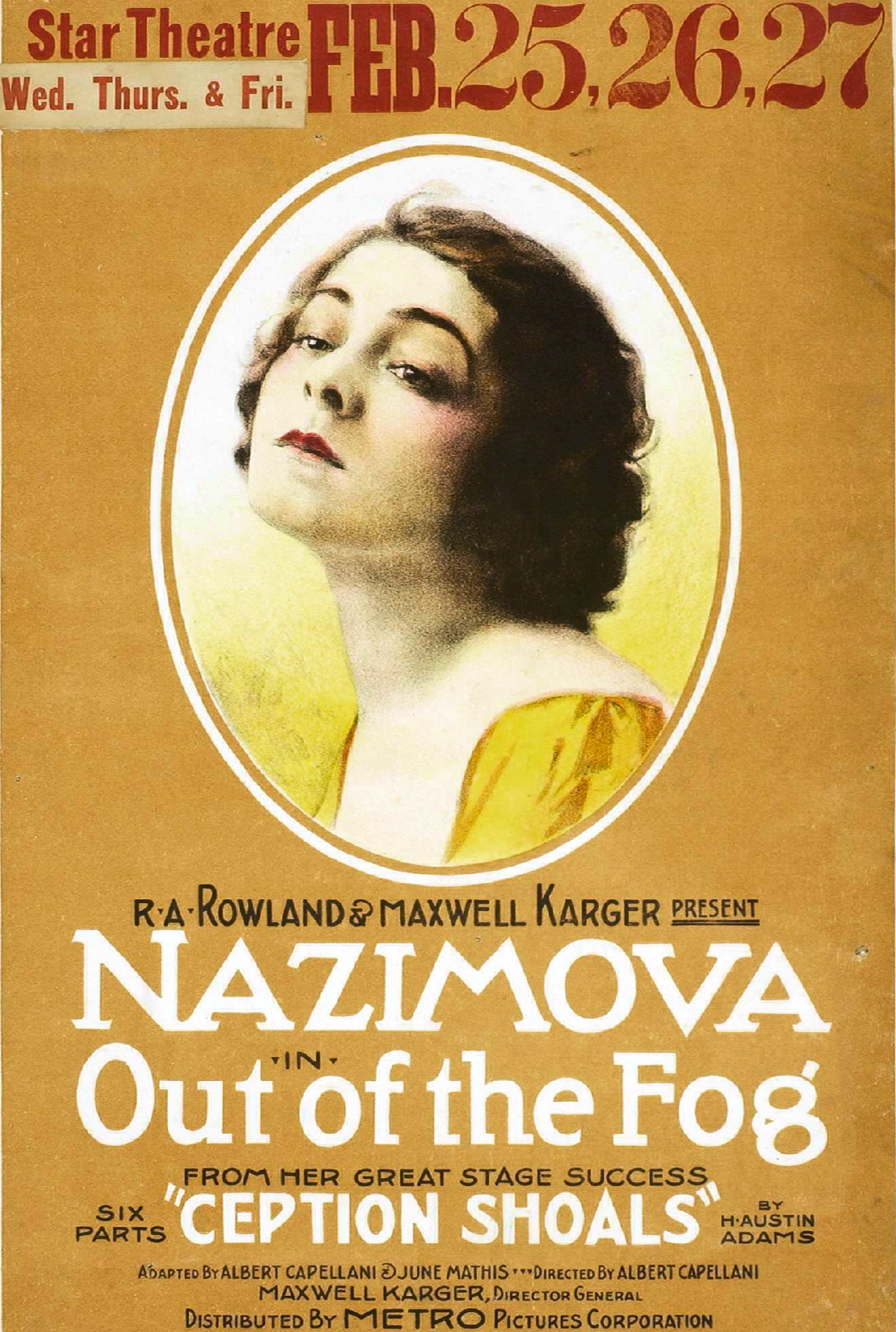
Poster for the movie “Out of the Fog”.
Source: Public domain, via Wikimedia Commons.
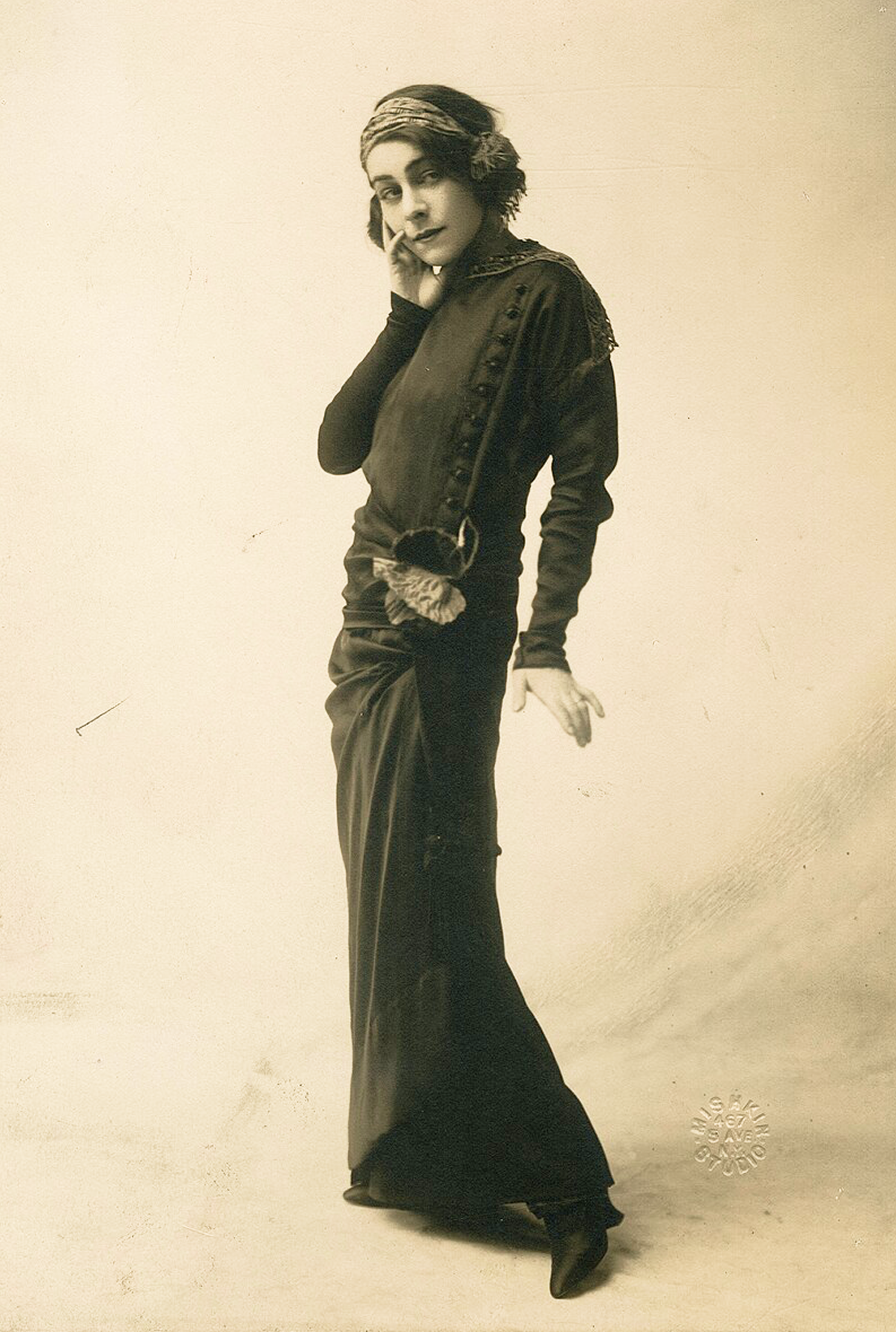
Alla Nazimova, 1913.
Source: Mishkin Studio, Public domain, via Wikimedia Commons.
The Grotesk apparently did not want to miss out on the “movies of misery.” It showed Dnevnik Zhizni Razbitoy (Diary of a Broken Life) with Italian actress Pina Minachelli.16
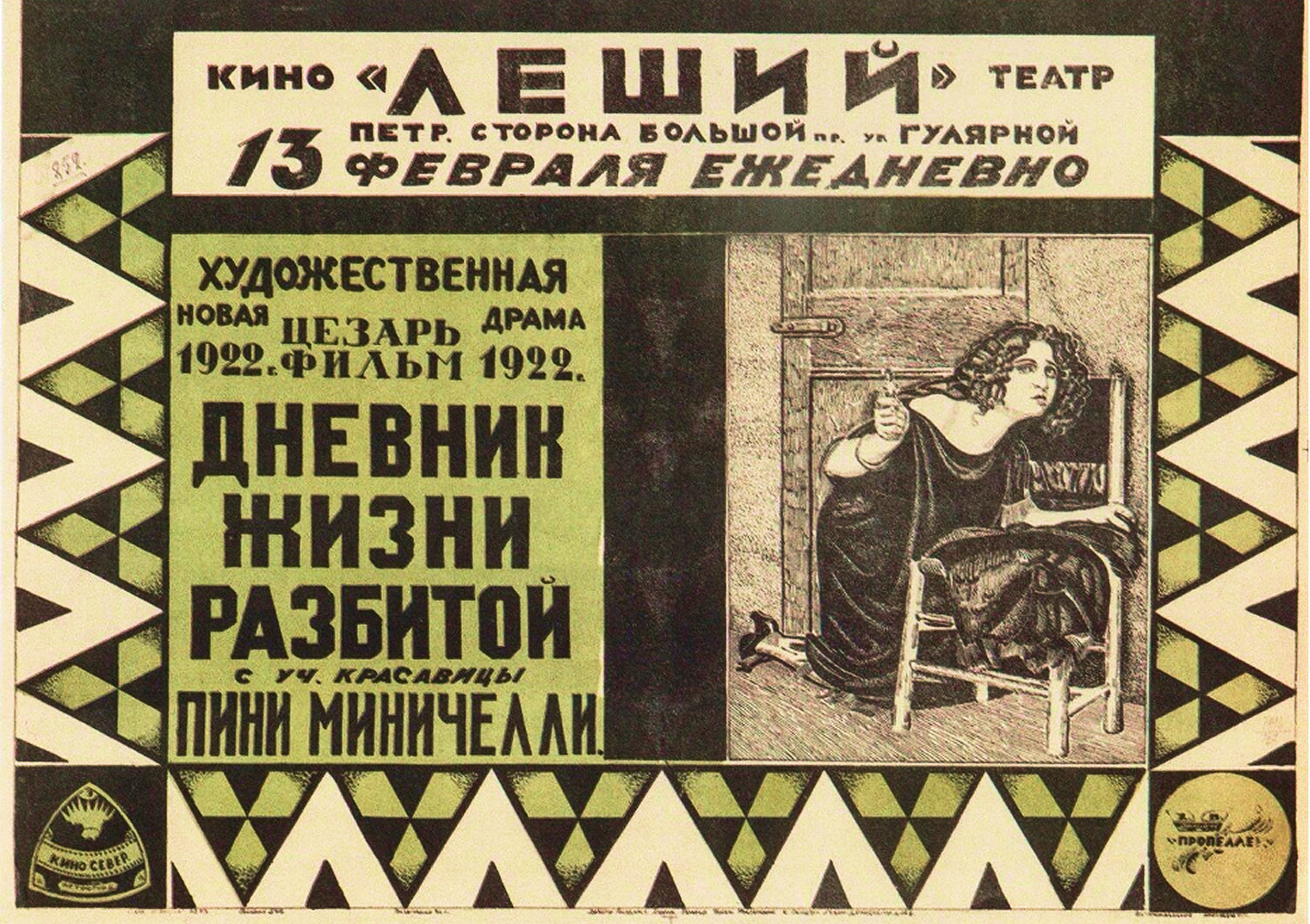
Poster for the movie “Diary of a Broken Life”.
Source: https://humus.livejournal.com/5597479.html

Pina Menichelli.
Source: https://www.imdb.com/name/nm0579618/
The Spartak countered with Prestupleniye v Muzeye (Crime in the Museum), advertised as an American picture. It may have been American but we have been unable to find any information about it.17
On May 12, Zvezda published news of a big change in Soviet cinema. Nikolai Lebedev, who later became a film historian, wrote a special article promoting the new Soviet film organization, Proletkino.18 He pointed out that Goskino, the Moscow-based main Soviet film organization, was “unable to satisfy the entire demand for film.” Thus, Proletkino would aim to supply “workers’ and the Red Army organizations with a consistent, cultured, and revolutionary picture.”
Lebedev continued, “According to the charter, ‘all party, professional and Soviet organizations’ that have contributed one or more shares (150 rubles in gold) have the right to be members of the shareholders of Proletkino.’” Soon enough, the cities of Vitebsk and Minsk would try to organize their own Proletkinos.
In the meantime, the first Proletkino film, a short directed by Sergei Eisenstein that was presented as part of a stage play, was released. Glumov’s Diary was first screened either in late April or early May.19
Glumov’s Diary, 1923.
On May 15, the Red Star advertised Grafinya Valevskaya (Countess Walewska) (1914), a Polish film with Stephan Jaracz and Maria Dulęba. 20
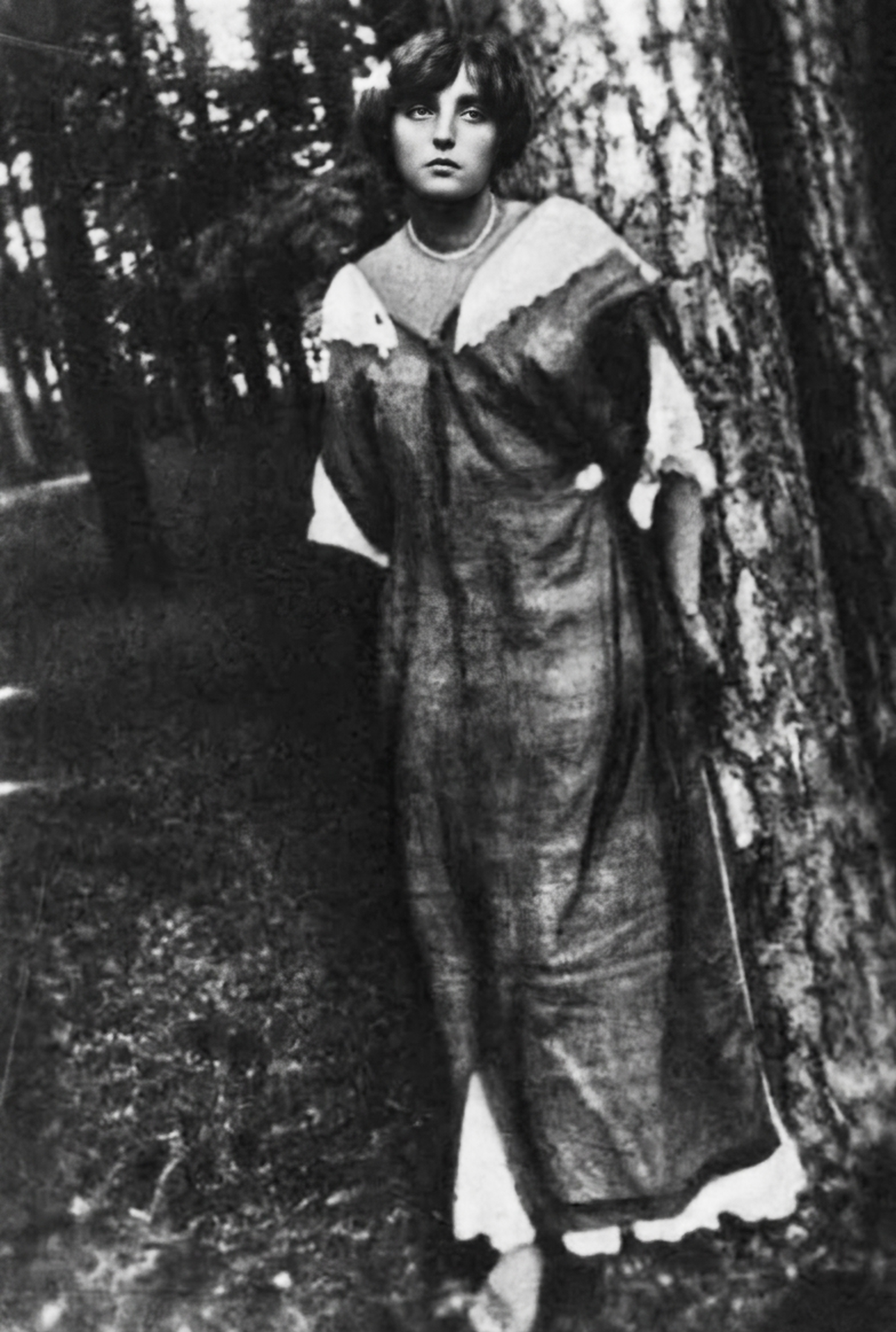
Maria Dulęba.
Source: Encyklopedia Teatru Polskiego. https://encyklopediateatru.pl/osoby/15665/maria-duleba
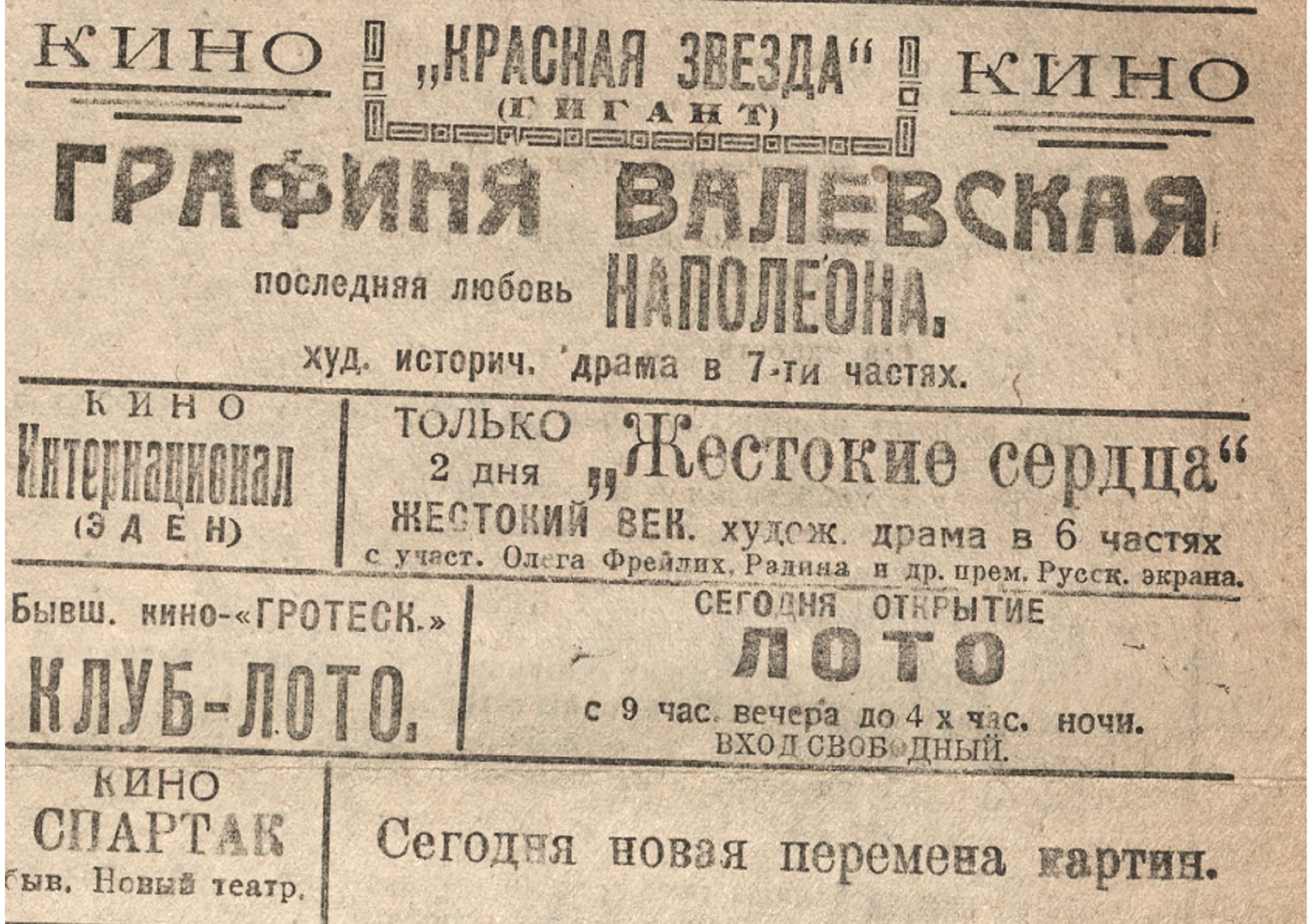
Zvezda. May 16, 1923.
Second from the bottom is the “Lotto” (ЛОТО) club announcement.
At the same time, the Internatsional advertised for its film Zhestokiye Serdtsa (Cruel Hearts), purportedly starring Oleg Frelich.21 However, there are no films with him listed under that title.
And the Grotesk announced it was opening as the Lotto Club. This was the same day that the Spartak (on the last line of the ad above) said it would have a new picture.22 It did not advertise the rest of the month.
With that, the first half of May came to a close.
1 Zvezda [Звезда; Star], 118 (1420), 2 May 1923.
2 Prikaz no. 77 po Minskomu Gorodskomu Otdelu Narodnogo Obrazovaniya [Приказ №.77 По Минскому Городскому Отделу Народного Образования; Order no. 77 of the Minsk City Department of Public Education]. 15 May 1923, NARB, Fond 42m, Opis’ 1, Delo 224, p. 75.
3 Prikaz no. 90 po Minskomu Gorodskomu Otdelu Narodnogo Obrazovaniya [Приказ №.90 По Минскому Городскому Отделу Народного Образования; Order no. 90 of the Minsk City Department of Public Education]. 25 May 1923, NARB, Fond 42m, Opis’ 1, Delo 224, p. 75.
4 Velikodushnyy Zhak [Великодушный Жак; Generous Jacques]. Zvezda, 102 (1404), 4 May 1923.
5 Zver’ na Ekrane [Зверь на экране; Beast on the Screen]. Ogonek [Огонёк; Twinkle], no. 1 (40) 1 Jan. 1924, p 15.
6 Zhizn' Ugryumoye More [Жизнь угрюмое море; Life is a Gloomy Sea], Zvezda, 102 (1404) 4 May 1923.
7 Zvezda, 103 (1405) 5 May 1923.
8 Gashish (Ray v adu) [Гашиш (Рай в аду); Hashish (Paradise of Hell)]. Zvezda, 102 (1404) 4 May 1923.
9 Haschisch, das Paradies der Hölle (Hashish, the Paradise of Hell), filmportal.de https://www.filmportal.de/en/movie/haschisch-das-paradies-der-holle_ea43d4a70f655006e03053d50b37753d Accessed 5 Aug. 2026.
10 Vo Mrake Bezumiya [Во мраке безумия; In the Darkness of Madness]. Zvezda, 102 (1404) 4 May 1923.
11 Wahsinn Lost Media Wiki https://lostmediawiki.com/Wahnsinn_(lost_German_horror_film;_1919) Accessed 2 Aug. 2026.
12 Chelovek s Katorgi [Человек с каторги; The Ex-Convict]. Zvezda, 104 (1408), 9 May 1923.
13 Russia Presents Library of Congress with Digital Copies of Lost U.S. Silent Film, Library of Congress https://www.loc.gov/item/prn-10-239/russia-presents-digital-copies-of-silent-films/2010-10-21 21 Oct. 2010. Accessed 2 Aug. 2026.
14 Kick In. IMDB https://www.imdb.com/title/tt0013289/ Accessed 6 Aug. 2026.
15 Iz Tumana [Из тумана; Out of the Fog]. Zvezda, 104 (1408), 9 May 1923.
16 Dnevnik Zhizni Razbitoy [Дневник жизни разбитой; Diary of a Broken Life]. Zvezda 104 (1408), 9 May 1923.
17 Prestupleniye v Muzeye [Prestupleniye v muzeye; Crime in the Museum]. Zvezda, 104 (1408), 9 May 1923.
18 Zvezda, 109 (1411), 12 May 1923. Supplement.
19 Cavendish, Phil. From “Lost” to “Found”: the “Rediscovery of Sergei Eisenstein’s Glumov’s Diary and its avant-garde context. Kinokultura, Issue 41 (2013) https://www.kinokultura.com/2013/41-cavendish.shtml/ Accessed 2 Aug. 2026.
20 Grafinya Valevskaya [Графиня Валевская; Countess Walewska]. Zvezda, 111 (1413), 15 May 1923.
21 Zhestokiye Serdtsa [Жестокие сердца; Cruel Hearts]. Zvezda, 112 (1414), 16 May 1923.
22 Zvezda, 112 (1414), 16 May 1923.