
1924 would prove to be a momentous year for the Soviet Union, and for Belarus. The major events were the January death of Lenin, the March decision to add territory to the Belarusian Soviet Socialist Republic (see the discrepancies between this name and the still official Belarusian Socialist Soviet Republic here), and the creation of the Belarusian State Film Trust, known as Belgoskino, in December.
On January 6, the Minsk-based newspaper Zvezda reported on the technical efforts around the world to create talking pictures.1 These efforts would not become commercially viable until 1927, when the American film company, Warner Brothers, release The Jazz Singer, generally recognized as the first “talking picture.” The picture starred Asa Yoelson, better known as Al Jolson, born in the city known today as Seredžius, in Lithuania. When Jolson was born in 1886, it was called Srednicki and was part of the Russian Empire. The Warner Brothers are also from Eastern Europe, in this case from Poland. The older three, commonly known as Harry, Albert, and Sam, were born in Krasnosielc, Poland. The youngest, Jack, was born in Canada.2
The Jazz Singer
On January 15, Zvezda reported on the coming re-opening of the Spartak as an operating cinema. The mutual aid fund of the Belarusian Workers Technical School had leased it.3 This would presumably end the dispute between the Rabis, which had been trying to operate it, but failed, and Podiv 4, the Political Department of the 4th Smolensk Rifle Division, which controlled it.4
In the same issue, the paper reported that the famous movie Krasnyye d'yavolyata (Red Devils, sometimes called Little Red Devils). But where? The Red Builder (formerly the Lux) was a bakery. The Spartak was closed. There were no reports on the fate of the Grotesk, a one-time lotto club. There had not been reports on the Red Star. That left the Internatsional and the Kultura. Zvezda ran stories on the film, but it was few days until the locations of the screenings were reported. The first report praised the film as beautiful, witty, and with wonderful actors. The review also said that the picture will “undoubtedly go beyond 5
Red Devils
On January 17, there was an article in Zvezda calling for workers to have their own theater boxes, because they would not otherwise be able to attend live production.6 On January 19, Zvezda announced that there would be special screenings of Krasnyye d'yavolyata for workers. It was to be shown in the House of Culture. (This was the former Choral Synagogue, see here).7
Just two days later, and three weeks into the New Year, on January 21, 1924, the Soviet Union was shaken by the death of Vladimir Lenin.8 The news was late getting to Minsk, so Zvezda only ran the announcement the next day.
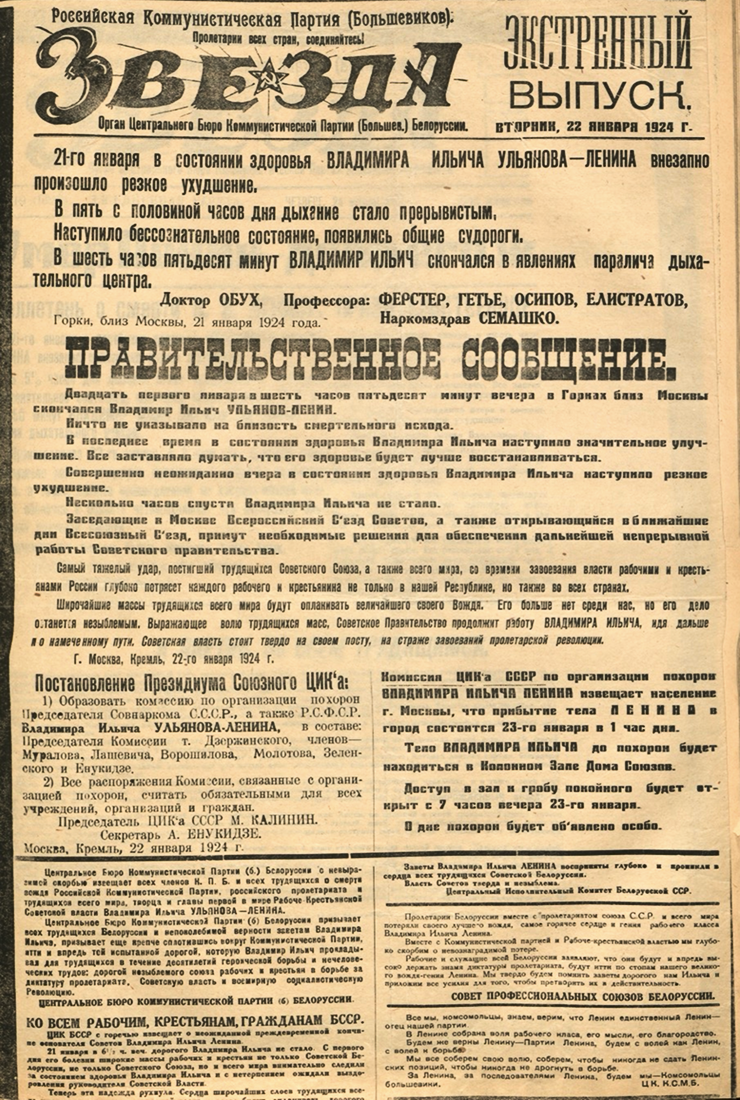
Zvezda, 22 Jan. 1924.
GOVERNMENT ANNOUNCEMENT
On the 21st of January at 6:50 in the evening in Gorki near Moscow, Validimir Ilyich ULYANOV-LENIN passed away.
Lenin’s death did not stop film criticism. A Zvezda article that also ran on January 22 severely criticized the film and included a long list of shortcomings, from an actor who did not look enough like Makhno (the villain of the piece) to the director choosing “the wrong place of action.”9
In the same issue of the paper, a letter from someone identified only as “M” called the film “new and fresh.”10
The end of the month brought the return of cinema advertisements. Not surprisingly, the films were not new. That would change as 1924 progressed, as Sovkino had made a commitment to bring in more foreign films while the Soviet film industry rebuilt itself. 11
Then cinema advertisements reappeared. One of the first showed the reappearance of the Red Star cinema. It was running Zhenshchina s milliardami (The Woman with Billions). Other ads showed the Internatsional and Kultura both running Krasnyye d'yavolyata.12
There were also live theater advertisements. Perhaps most interesting was for the play Kastus' Kalinovskiy (Kastus Kalinovsky),13 the self-identified Belarusian revolutionary who helped lead the failed 1863 uprising in Poland against Russia. He would later be the subject of a highly contentious film.
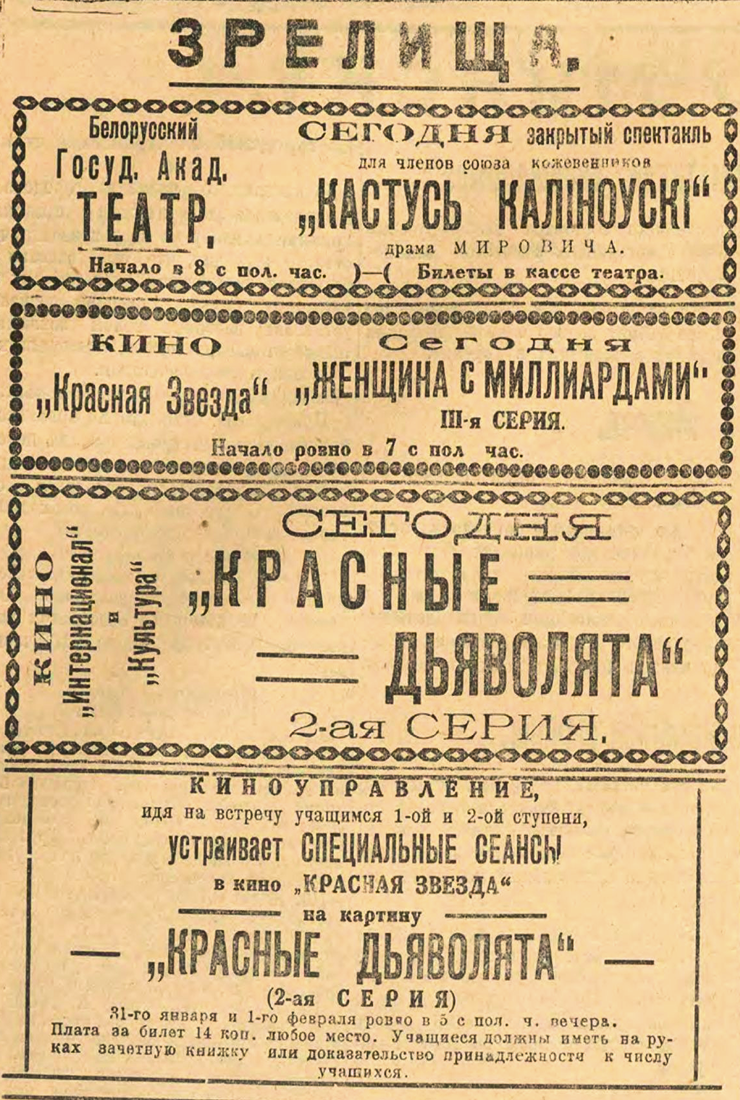
Zvezda, No. 4 (1631), 30 Jan. 1924.
Red Star: The Woman With Billions
Internatsional and Kultura: Red Devils
Special Showing for Workers at the Red Star:
Red Devils
As the month came to an end, the January 31, 1924, edition of Zvezda was filled with reaction from those who had gone to see Krasnyye d'yavolyata. One frustrated viewer went to see the movie twice, once at the Internatsional and the second time at the House of Culture. But in one of the theaters (the writer did not say which), the reels were shown out of order. For this writer “the whole impression was spoiled.”14
And that was not all. Another person had also gone to both the Internatsional and Kultura cinemas. This writer decried “cobwebs in the ceiling, torn wallpaper, broken glass, and dirty curtains.” As the writer stated: “it is time to clean and repair our cinemas.”15
1 Govoryashchiy fil'm [Говорящий фильм; A Talking Film]. Zvezda [Звезда; Star], No. 5 (1612), 6 Jan. 1924.
2 Sinclair, Doug "The Family of Benjamin and Pearl Leah (Eichelbaum) Warner: Early Primary Records," (2008), published at Doug Sinclair's Archives https://web.archive.org/web/20190908233632/http:/dougsinclairsarchives.com/benjaminwarnerfamily.htm Archived 2019-09-08 at the Wayback Machine>
3 Arenda kino “Spartak” [Аренда кино «Спартак»; Renting the cinema "Spartak"]. Zvezda, No. 12 (1619), 15 Jan. 1924.
4 V Minskiy gorispolkom [В Минский горисполком; To the Minsk City Executive Committee]. Undated, probably late October, early November 1922. Gosudarstvenny arkhiv Minskoy oblasti [Государственный архив Минской области; State Archive of Minsk Region GAMn]. Fond 322, Opis 1, Delo 89, p. 284.
5 Krasnyye d'yavolyata [Красные дьяволята; Red Devils]. Zvezda, No. 12 (1619), 15 Jan. 1924.
6 Rabochiye dolzhny imet' svoi lozhi [Рабочие должны иметь свои ложи; Workers should have their own loges]. Zvezda, No. 14 (1621), 17 Jan. 1924.
7 Kartina „Krasnyye d'yavolyata” dlya rabochikh [Картина «Красные дьяволята» для рабочих; The film “The Red Devils” for workers]. Zvezda, No. 16 (1623), 19 Jan. 1924.
8 Pravitel'stvennoye soobshcheniye [Правительственное сообщение; Government Announcement]. Zvezda, 22 Jan. 1924.
9 Khoroshi li „Krasnyye d'yavolyata“? Yest' nedochety [Хороши ли «Красные дьяволята»? Есть недочеты; Is "Red Devils" any good? There are some shortcomings]. Zvezda, No. 18 (1625), 22 Jan. 1924.
10 Novoye i svezheye [Новое и свежее; New and Fresh]. Zvezda, No. 18 (1625), 22 Jan. 1924.
11 Yusupova, Galina «Vvoz zagranichnykh kartin po etim prichinam krayne neobkhodim»: zarubezhnyye fil'my v sovetskom prokate 1920-kh godov [«Ввоз заграничных картин по этим причинам крайне необходим»: зарубежные фильмы в советском прокате 1920-х годов; "Importing foreign films is essential for these reasons": foreign films in Soviet distribution in the 1920s]. kinoart.ru https://kinoart.ru/texts/vvoz-zagranichnyh-kartin-po-etim-prichinam-krayne-neobhodim-zarubezhnye-filmy-v-sovetskom-prokate-1920-h-godov%2012%20Apr.%202022 Accessed 25 Aug. 2026.
12 Zrelishcha [Зрелища; Spectacles]. Zvezda, No. 24 (1631), 30 Jan. 1924.
13 Zrelishcha [Зрелища; Spectacles]. Zvezda, No. 24 (1631), 30 Jan. 1924.
14 Pereputali [Перепутали; Mixed Up]. Zvezda, No. 25 (1630), 31 Jan. 1924.
15 Vpechatleniye portitsya [Впечатление портится; Spoiled Impression]. Zvezda, No. 25 (1630), 31 Jan. 1924.