
On March 3, 1924, Belarus grew eastward. On that day, the Presidium of the All-Russian Central Executive Committee passed a resolution on the transfer of districts with a predominantly Belarusian population out of the Russian Soviet Federated Socialist Republic to the BSSR. March 7, 1924, the Central Executive Committee of the USSR issued a decree.1 The website Kommersant has a more thorough telling of this complicated story.2
It took a few days, but the Minsk-based newspaper Zvezda, on March 12, 1924, put the story in a banner headline on the front page.
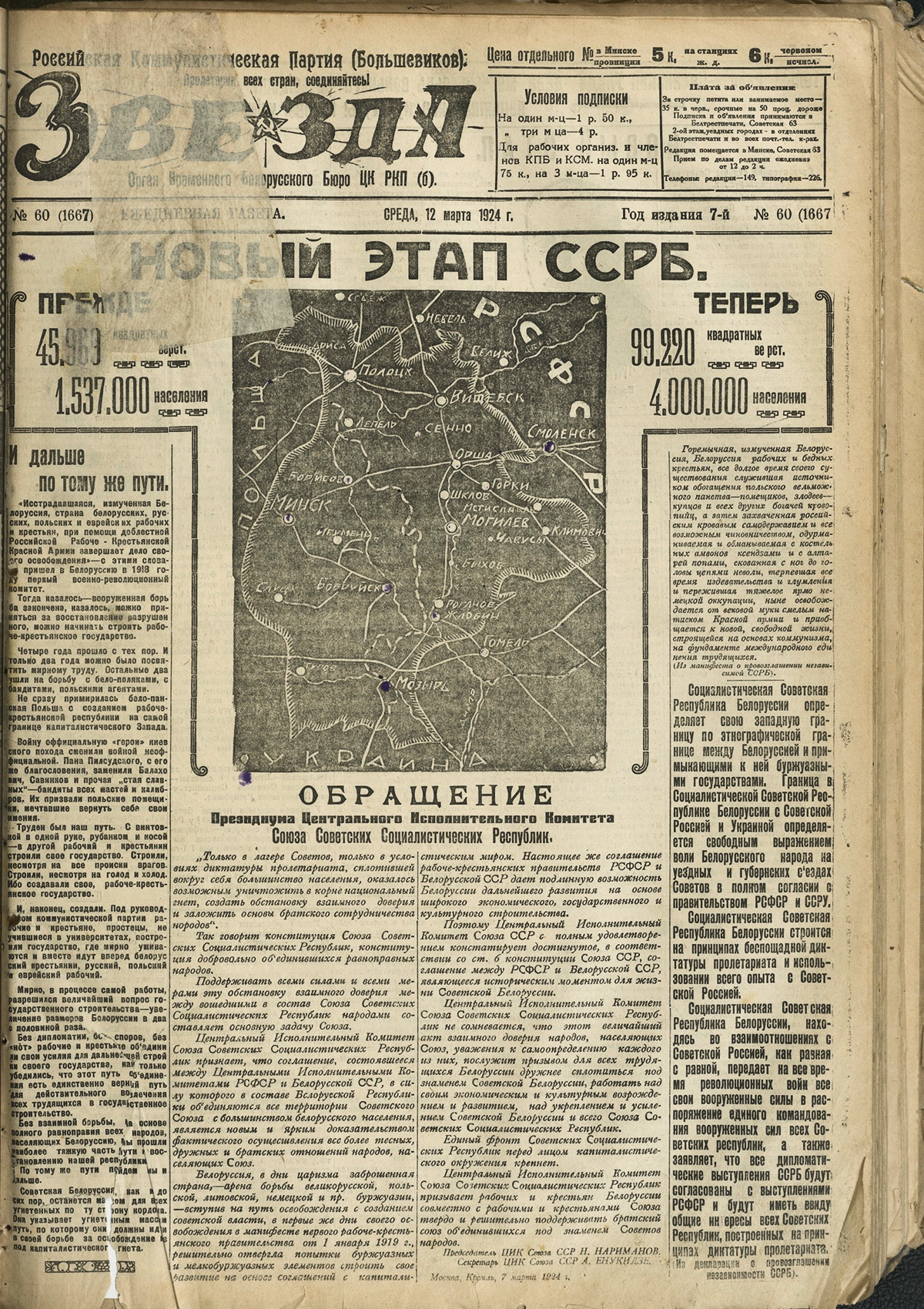
The main headline says “A New Stage for the BSSR”
The various articles praise the Soviet government for uniting the territories, omitting the fact that it was the Soviet government that took them apart in the first place.
Zvezda, 12 Mar. 1924.
Inside, the newspaper also had headlines in Belarusian, Yiddish, and Polish. This foretold the upcoming official policy in which all documents would have to be in those three languages as well as Russian.



All from Zvezda, 12 Mar. 1924. Pp. 2, 3, and 4.
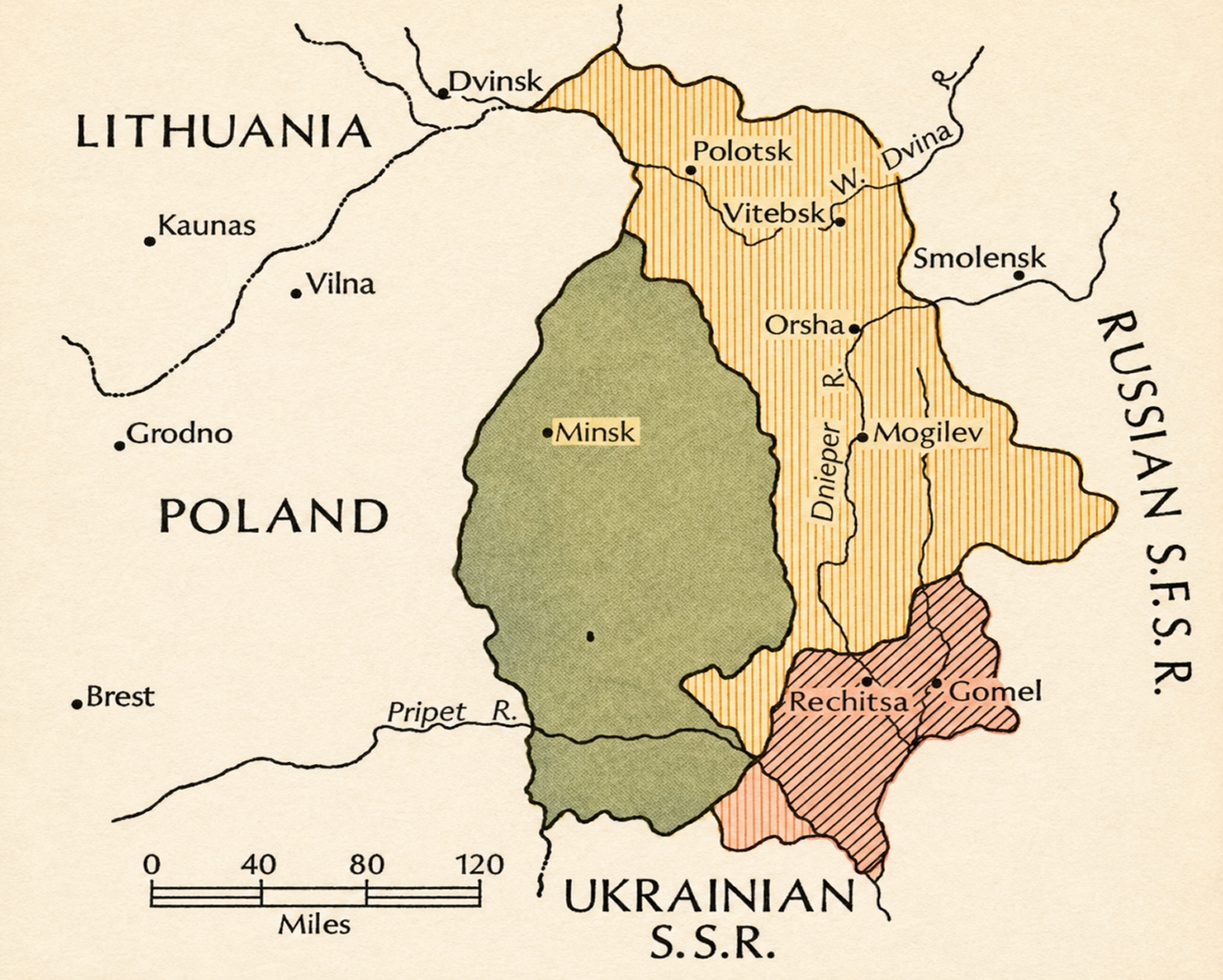
Green is the BSSR after the Treaty of Riga. Yellow is the area transferred to the BSSR in 1924. Red is the area that will be transferred to the BSSR in 1926.
This map is based upon the map in Lubachko, Ivan S. Belorussia Under Soviet Rule, 1917-1957. 1972. University Press of Kentucky. p. 65.
You can see from the map above in the yellow striped area just how much territory was added. The area more than doubled from 20,310 miles to 43,000 square miles. The population grew from 1,500,000 to 4,172,000.3
That’s a lot more movie goers, but not a lot more cinemas.
Fortunately, there were a lot more films coming in... some were several years old, but many were newer. Historian Galiya Yusupova says the imports were the product of Goskino’s new import plan, to purchase and import foreign films on a large scale.4
The March films were again a mixture of new and old. All the names of the films we have come from advertisements in Zvezda, the main newspaper in Minsk. They played at the four main cinemas: the Red Star, the Kultura, the Internatsional, and the Spartak.
Антанта и Kо. (Entente and Co.) was a Soviet movie advertised as a “satire in 2 parts.” It ran with Лев особого назначения (A Lion of Special Purpose).5 This could be A Lion Special, a 1919 American comedy, which seems to be one of the few films in which a lion played a major role.6
Vozmezdiye (Retribution) and Zhenschina s milliardami (A Woman with Billions), which was Mistress of the World continued to play for a short time. It came to an end with episode 7. The American film, Geroy Alaski (The Hero of Alaska), continued its run for a short time.7 (More here
On March 5, the Spartak ran Podlost (Infamy).8 We believe it is the German film Infamy.9
One of the big new films coming in was Feodora, Tsaritsa Vizantiyskaya. Kurtizanka na trone (Theodora, Queen of Byzantium. Courtesan on the Throne).10 This film was famous for, among other things, starring Rita Jolivet, who survived the sinking of the Lusitania.11
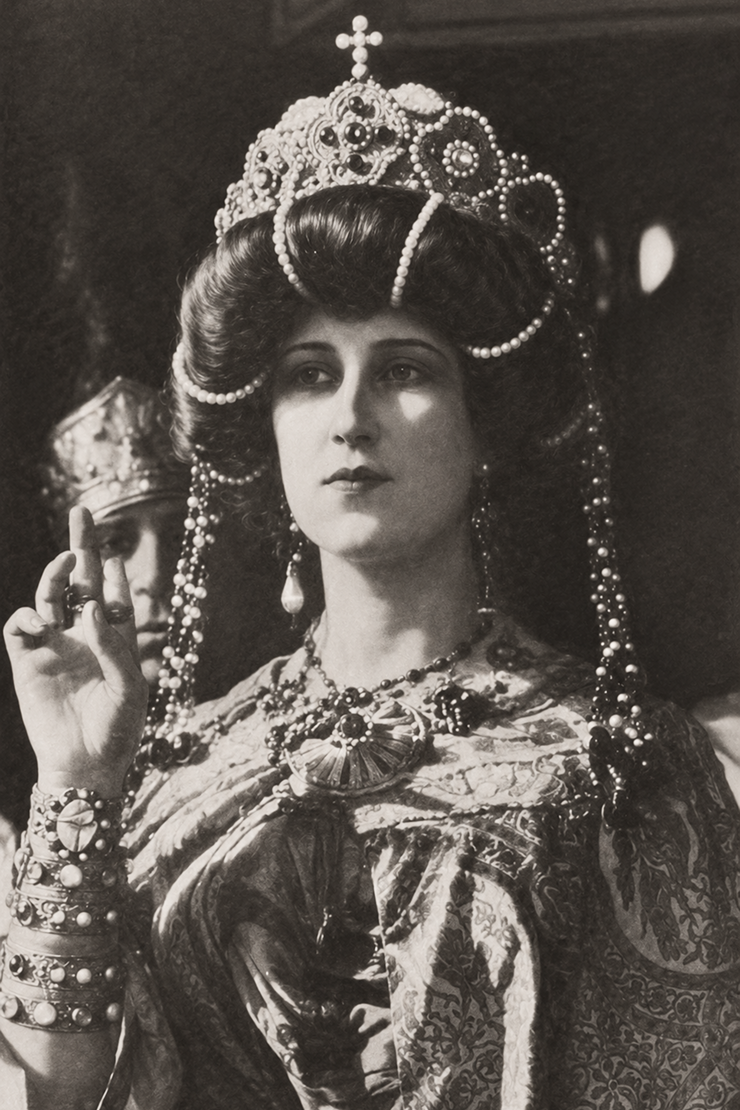
Rita Jolivet as Theodora.
Source: By Ambrosio-Zanotta / Goldwyn Pictures (U.S. Distribution) — Exhibitors Herald (Oct. - Dec. 1921) on the Internet Archive, Public Domain.
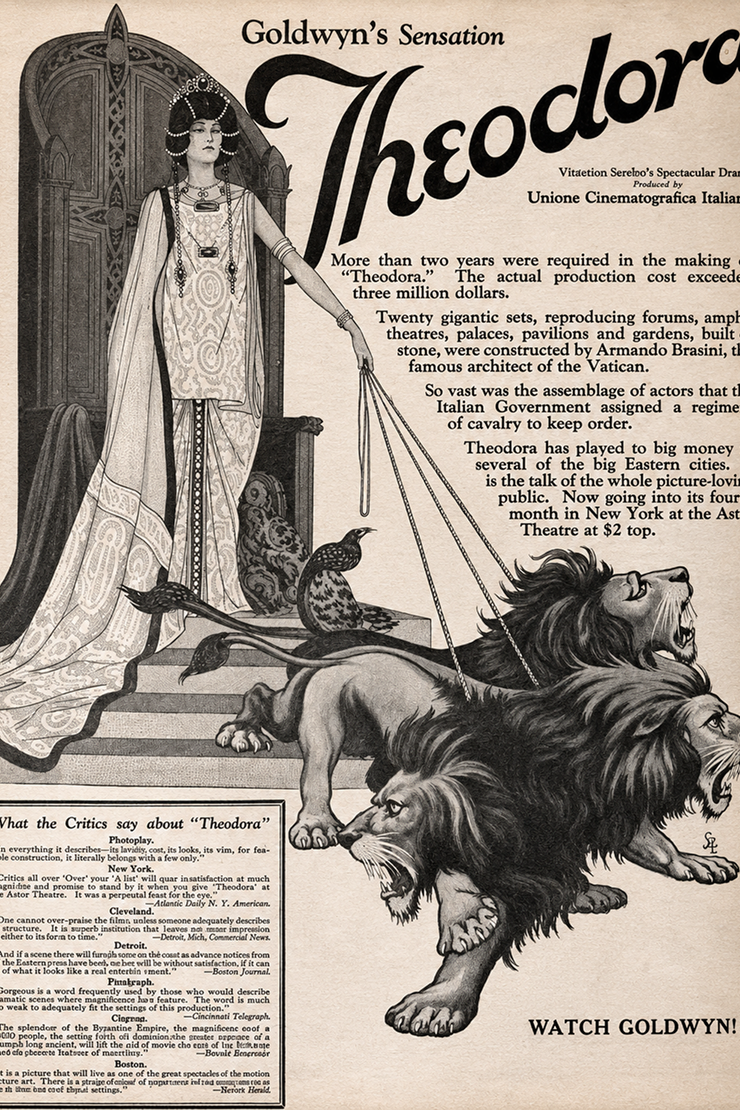
American advertisement for Theodora.
Source: Public Domain via Wikimedia Commons.
There must have been something special about Queen Theodora. On March 20, Zvezda ran an announcement that said there would be a special screening that evening at 6 o’clock at the Red Star cinema. “Representatives of the press, trade union organizations and workers".12
A Priscilla Dean film returned: Nishchaya iz Stambula (The Begger from Istanbul)13 (see here).
One of the best titled films was the Italian import Zhokey smerti (The Jockey of Death).14 Take a look.
The Jockey of Death, 1915.
Letters kept coming into Zvezda. One, written March 7, complained that the Western Railway Cultural Department had equipped a magnificent new cinema. “The best in Minsk.” It apparently only served railway workers, and, of course, the Red Army.15
As the month was coming to a close, another letter writer to Zvezda brought up the Lenin Club. The appreciative writer noted “good furniture, chairs, tables” and a nice library. There were movies on Sundays, accompanied by a piano. But “the piano makes such sounds that you want to cover your ears.”16
1 Abetsedarskii, L. S., et al., editors. "Belorusskii narod v bor'be za vosstanovlenie narodnogo khoziaistva (1921-1925 gg.)" ["Белорусский народ в борьбе за восстановление народного хозяйства (1921-1925 гг.)"; "The Belarusian People in the Struggle for the Restoration of the National Economy (1921-1925)"]. Istoriia Belorusskoi SSR v dvukh tomakh [История Белорусской ССР в двух томах; History of the Belorussian SSR in Two Volumes], 2nd, expanded ed., vol. 2, Izdatel'stvo Akademii nauk Belorusskoi SSR [Издательство Академии наук Белорусской ССР; Publishing House of the Academy of Sciences of the Belorussian SSR], 1961, ch. 3, p. 198.
2 Zhirnov, Yevgeny. "Otnosheniye k belorusizatsii so storony otritsatel'noye" [«Отношение к белорусизации со стороны отрицательное»; "The population’s attitude toward Belarusization is negative"]. Kommersant, 8 Mar. 2019. www.kommersant.ru/doc/3906827/
3 Lubachko, Ivan S. Belorussia Under Soviet Rule, 1917-1957. University Press of Kentucky, 1972. p. 66.
4 Yusupova, Galiya. “Kassovyye fenomeny kinematografa 1920-kh i legenda o «novom zritele»” [«Кассовые феномены кинематографа 1920-х и легенда о «новом зрителе»; “Box-office phenomena of 1920s cinema and the legend of the “new spectator”]. Kinovedcheskiye zapiski [Киноведческие записки; Film Studies Notes], no. 102–103, 2013, pp. 151–67.
5 Zvezda [Звезда; Star]. No. 51 (1658), 1 March 1924.
6 “A Lion Special.” IMDB https://www.imdb.com/title/tt0410238/ Accessed 8 Nov. 2026.
7 Zvezda, no. 51 (1658), 1 March 1924.
8 Zvezda, no. 54 (1661), 5 March 1924.
9 “Infamy” Filmportal.de https://www.filmportal.de/film/infamie_3befdb280a33430fb381c7b1680fa8f2. Accessed 18 Nov. 2026.
10 Zvezda, no. 55 (1662), 6 March 1924.
11 “Rita Joliver, Unsinkable”. 11 East 14th Street https://11east14thstreet.com/2013/09/30/rita-jolivet-unsinkable/ Accessed 18 Nov. 2024.
12 Zvezda, no. 65 (1672), 20 March 1924.
13 Zvezda, no. 56 (1663), 7 March 1924.
14 Zvezda, no. 53 (1660), 4 March 1924.
15 Zvezda, no. 56 (1663), 7 March 1924.
16 Zvezda, no. 69 (1676), 25 March 1924.