
Dinershtein Pens Farewell Note
As Kinoresbel dissolved and the Minsk Gorono (City Department of Education) took over, the Socialist Soviet Republic of Belarus (SSRB) was rapidly changing on both the cinematic and political fronts. In a farewell note from his position as head of Kinoresbel, Moise Dinershtein laid out what he saw as issues still facing cinema management in Belarus and what he saw as positive steps.1 The note could also be read as a final rebuke to the audit conducted on behalf of the Workers’ and Peasants’ Inspection Organization which led to the demise of Kinoresbel.
Dinershtein described the “Western Region” as Minsk, Smolensk, Vitebsk and Gomel provinces, and the city of Mogilev. At the time he wrote only Minsk was part of the SSRB. Vitebsk and Gomel provinces would soon be added, or returned, if you would like, to Belarus. The city of Mogilev would also soon (re)join Belarus. Smolensk has remained part of Russia.
Dinershtein claimed in the note that there was no office of significant size capable of meeting the cinematic needs of a single district, let along the entire region. As a result, he said, middlemen flourished. He also said that attracting private capital into the cinema business would only be possible if the State began independent operations. This, he said would prove the State was engaged in action, not just projects.
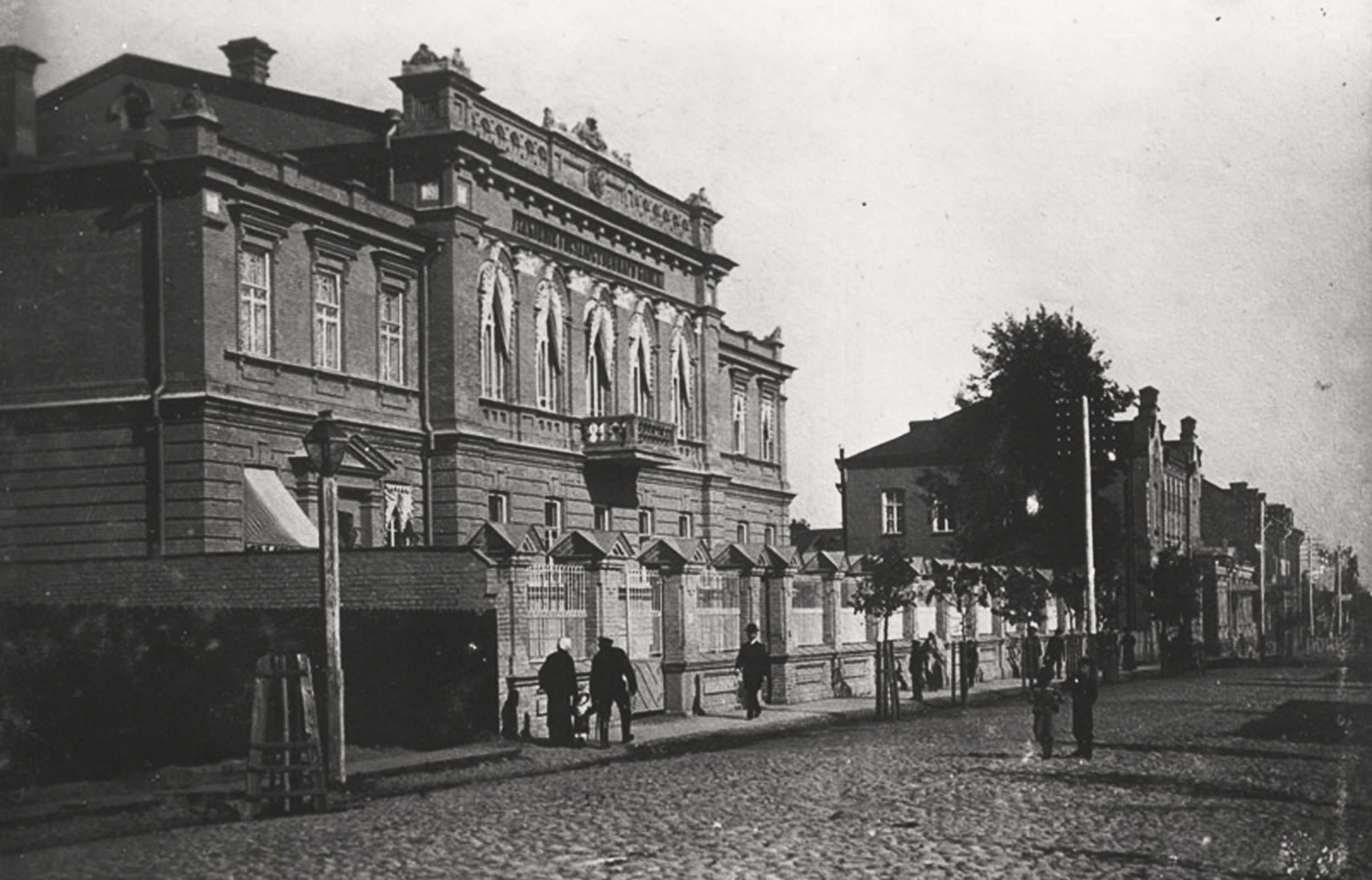
Mogilev, Bolshaya Sadovaya street. State Bank, 1918.
Source: https://masheka.by/history_mogilev/1818-istoriya-mogileva-may-1918-goda.html
The number of theaters was interesting, too. Dinershtein claimed there were 19 cinemas in the Western Region, which would indicate more cinemas than those for which we have previously found records.
He suggested that the purchase of 40 films: 10 of the highest quality; 20 of medium quality; and 10 also of medium quality but cheaper, would be sufficient for the entire year in the Western Region.
One of the films that the Kinoresbel representative Tsibart had mentioned in his letter from Berlin was Princess Borgia. We do not know where it fit in the classification of highest, medium quality medium price, or medium quality cheap price. We do know that it was released as Lukretsiya Bordzhia хLucrezia Borgiaъ. We showed you one poster previously (see here), here is one in Russian, and it has a decidedly different feel to it.
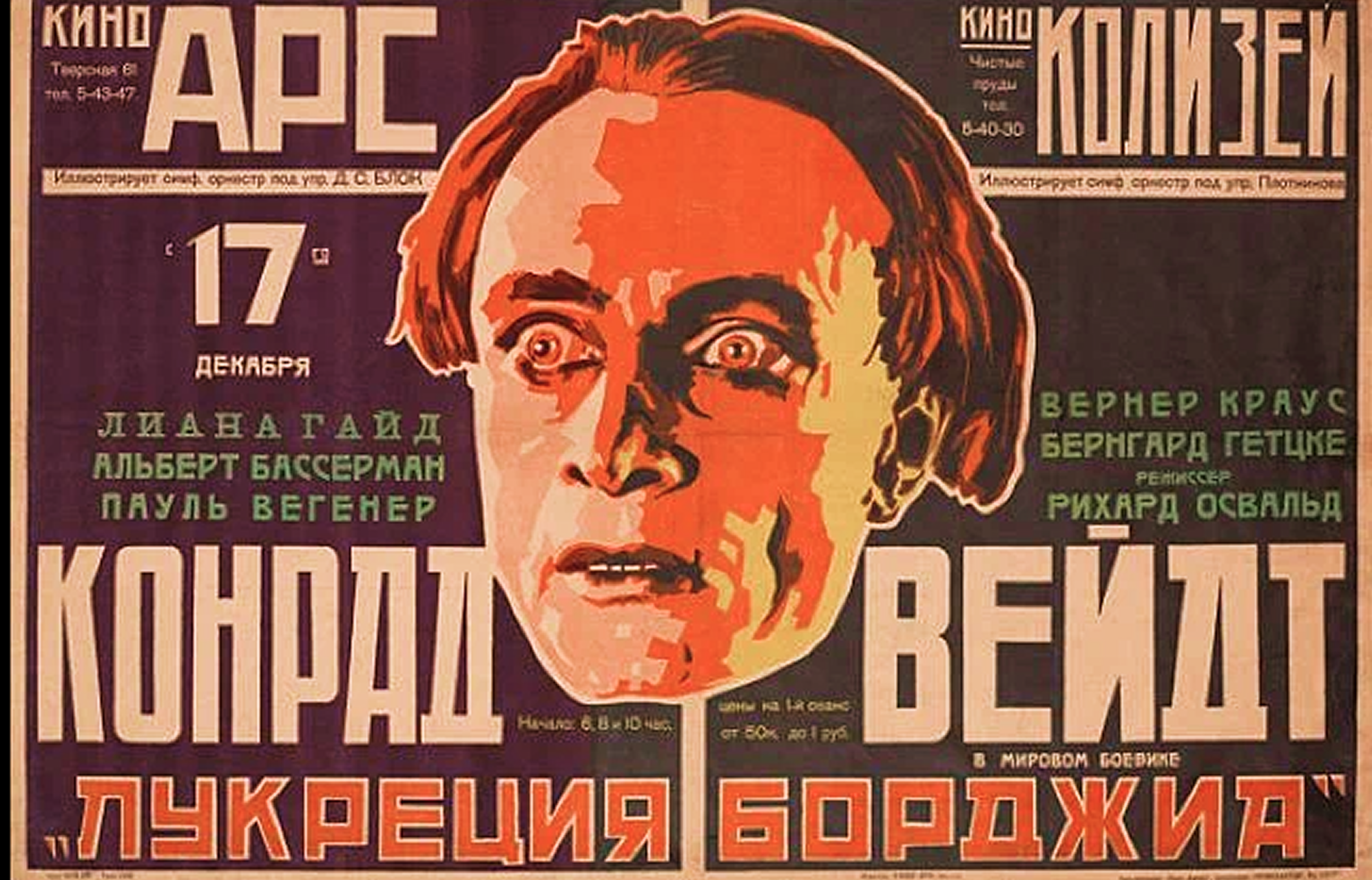
Lucrezia Borgia poster.
Source: https://www.kinopoisk.ru/picture/2202739/
And here is the film itself.
Lucrezia Borgia, 1922.
Dinershtein closed his farewell note by stating that concentration of film distribution in the hands of the proletarian state would combine the healthy (implementing proletarian ideology) and the useful (an established profitable business).
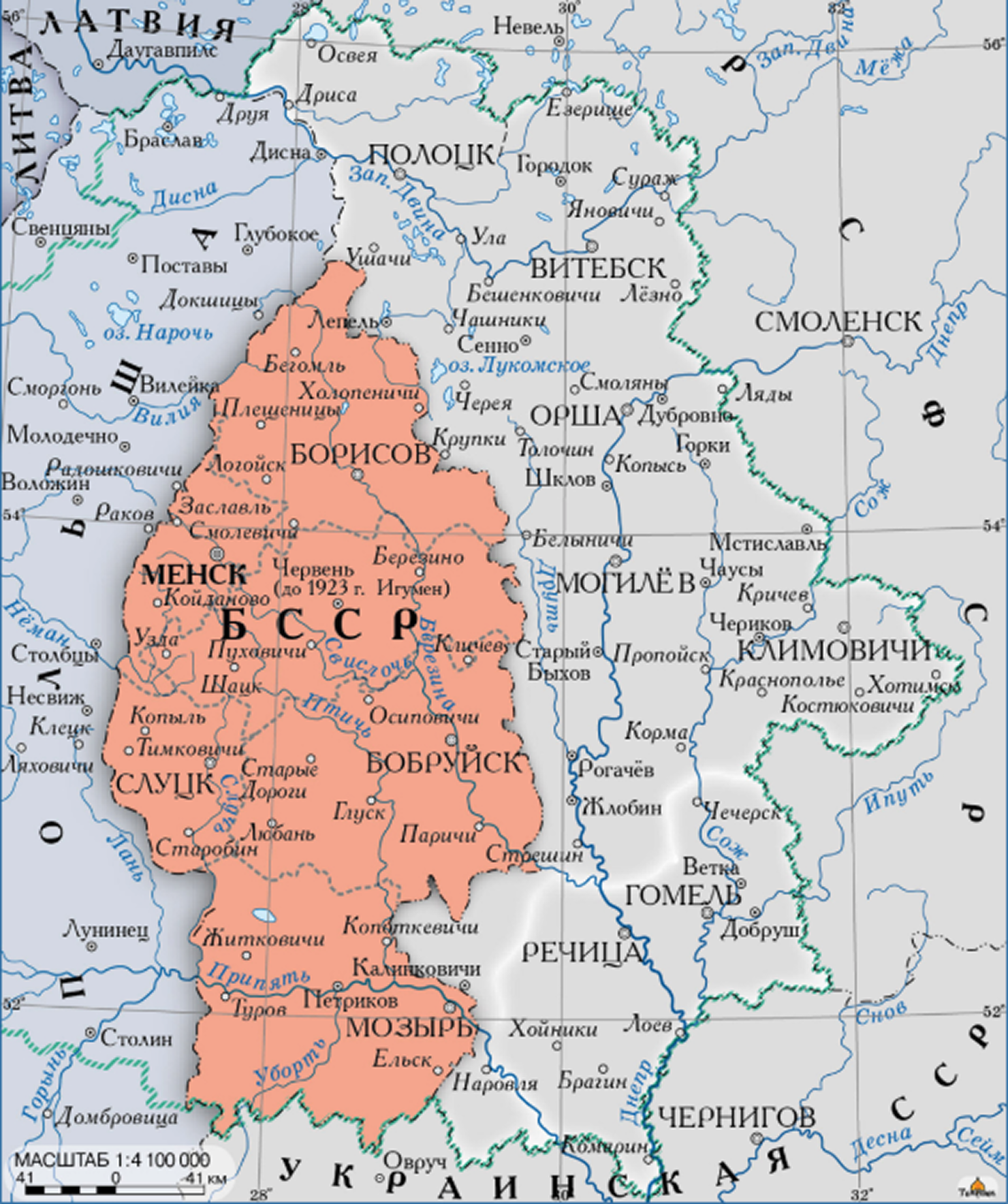
Minsk (МЕНСК) is in the pink area. Smolensk (Смоленск), Vitebsk (Витебск), Gomel (Гомель), and Mogilev (Могилёв) are in the gray.
Source: https://boxapps.adu.by/public/game/902
Lenin had nationalized cinema in Russia in 1919. Since then, Vserossiyskiy foto kinematograficheskiy otdel Narkomprosa (All-Russian Photographic and Cinematographic Section of the Narkompros) or V.F.K.O. had controlled cinema in the soviet republics. Now, at the end of 1922, following long dissatisfaction with the V.F.K.O., Moscow created Tsentral'noye gosudarstvennoye foto i kino predpriyatiye (Central State Photographic and Cinematographic Enterprise) better known as Goskino. It was the beginning for a more centralized film organization for Russia and the pending Soviet Union.
On the political side, in October of 1922 Lenin had proposed the creation of the Union of Soviet Socialist Republics, which became known as the Soviet Union. On December 14, 1922, the Fourth Congress of Soviets of Belarus adopted a declaration on “the need to form the USSR.”2 On December 30, 1922, the First Congress of Soviets of the USSR was held in Moscow and adopted a declaration on the formation of the USSR, uniting the Soviet republics of Russia, Belarus, Ukraine, and the Caucasus (today’s Armenia, Azerbaijan, and Georgia) into one country.3
According to the online Archives of Belarus, the name of the country was still the Socialist Soviet Republic of Belarus,4 although historian Per Anders Rudling says the abbreviation of the country was changed to BSSR.5
1 Dokladnaya Zapiska [Докладная Запискаж Memorandum to the File]. 9 Dec. 1922. Natsional'nyy arkhiv Respubliki Belarus' (NARB) [Национальный архив Республики Беларусь (НАРБ); National Archives of the Republic of Belarus (NARB)], fond 6, inv. 1, file 123, p. 102-103.
2 Abetsedarsry, L.S. and others. Istoriya Belorusskoy SSR v dvukh tomakh, tom 2 [История Белорусской ССР в двух томах, т. 2; History of the Belarusian SSR in Two Volumes, Vol. 2]. Belarusian Academy of Sciences, Institute of History Minsk, 1961, p. 196.
3 History of the Belarusian SSR in Two Volumes, Vol. 2
4 “The formation of Belarusian statehood in the 1918-1920s: a chronology of events”. Archives of Belarus (English page). https://archives.gov.by/home/tematicheskie-razrabotki-arhivnyh-dokumentov-i-bazy-dannyh/istoricheskie-sobytiya/arhivnye-dokumenty-i-materialy-4/stanovlenie-belorusskoj-gosudarstvennosti-v-1918-1920-h-godah-hronologiya-sobytij#:~:text=В%2520апреле%25201927%2520г.,Советскую%2520Социалистическую%2520Республику%2505 Accessed 26 Dec. 2025.
5 Rudling, Per Anders. The Rise and Fall of Belarusian Nationalism, 1906-1931. University of Pittsburgh Press, 2014, p. 131.