
Changes to Belarusian Cinema Management
More Changes on the Horizon in Moscow,
Sep. – Nov. 1922
In September 1922, the Sovnarkom (Council of Ministers), the highest political body in the Socialist Soviet Republic of Belarus, made a drastic change to Kinoresbel. It took away jurisdiction over the cinemas and gave it to the government of the city of Minsk where the movie theaters were all located.1 The number two man of Kinoresbel, Samuel Rakhlin, either left or was removed from his position and convicted on embezzlement charges, although he was not imprisoned because of his service in the Red Army.
On November 1 1922, the Minsk Gorono (City Department of Education. Sometimes the term Gornarobraz was used. There is a slight difference in terms, but the meaning is essentially the same) issued its Regulations Regarding the Administration of Cinemas in the City of Minsk. Number 1 said that the cinemas would be converted to operating on the principles of commercial accounting, what was known as khozrachët. Lenin’s New Economic Program had called for that earlier and was presumably the principle under which Kinoresbel worked. (see here).
Regulation 3 stated there was a primary task at hand and then named two of them. The first task was to improve the ideological and artistic value of the movies, and the second was to transfer any revenue to the city executive committee and the Gorono. It did not name which percentage each would get. In number 5, the Gorono had the right to enter into contracts with film distribution offices, both state and private. Number 8 called for programming to be completed six months in advance.2
On November 9, 1922, the Minsk-based newspaper Zvezda reported on what was probably the last gasp of Kinoresbel. It had organized a filming of the October Revolution celebrations in Minsk, to be shown later in the cinemas.3 Keep in mind that the revolution took place on October 25, 1917, under the old (Justinian) calendar. The Bolsheviks adopted the Gregorian calendar in 1918, and the October Revolution may have been celebrated then on November 7, the day it took place in the west.
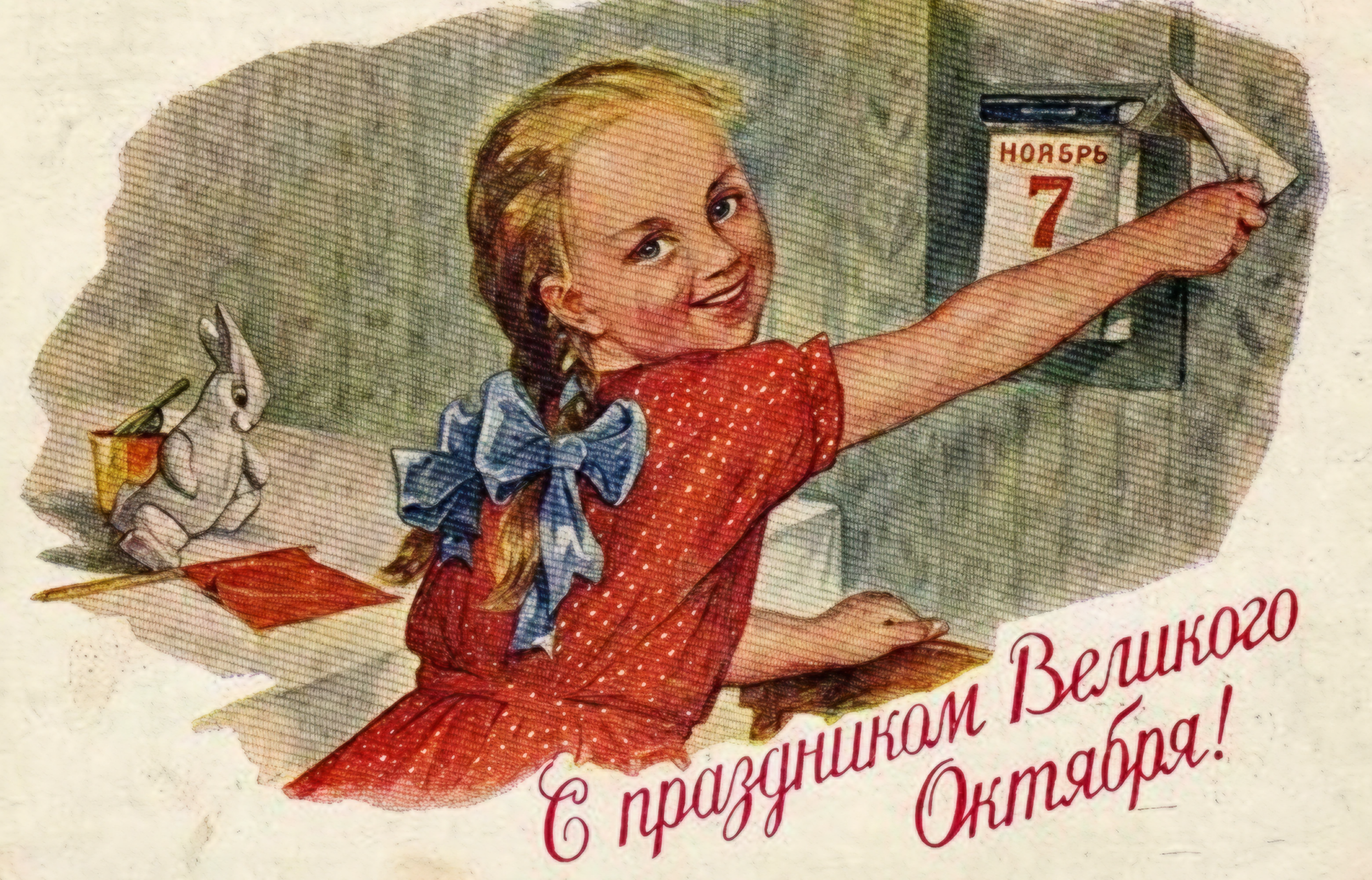
Poster “Happy Great October Holiday!”. Notice that the girl is tearing off a calendar page showing the month of November.
Source: https://www.maximonline.ru/longreads/otkrytki-i-plakaty-iz-sovetskogo-detstva-k-prazdniku-7-noyabrya-id689713/
On November 15, 1922, Order No. 128 from the Gorono put an end to Kinoresbel: “As of this date, the Kinoresbel Administration is abolished. All of its functions will go directly to the City.”4 The head of Kinoresbel, Moise Dinershtein, kept the same job with the new cinema department.5 Kinoresbel had lasted less than six months.
The Gorono faced the same dilemma faced by Kinoresbel and its predecessor, the Photo-Kino Department. It had to determine what was more important: filling the movie theaters with “appropriate” films or with paying customers. It made no immediate change to policies.
Kinoresbel had already dispatched a man named Tsibart to Germany to try and round up some films. In his Nov. 15, 1922 report Tsibart wrote that the Belarusian Trade Delegation in Berlin advised him to contact the Komitee der Internationalen Arbeitshilfe [Committee for International Workers' Aid], known in Russian as Mezhdunarodnaya rabochaya pomoshch − Mezhrabpom and in English as the Workers International Relief. The organization had been founded in August 1921 by the Communist International (a.k.a. the Comintern, a transnational group of communist parties run by the Russian Communists6 ) and led by Willi Münzenberg,7 who would, along with Mezhrapom, go on to play a significant role in Soviet films in a few years.
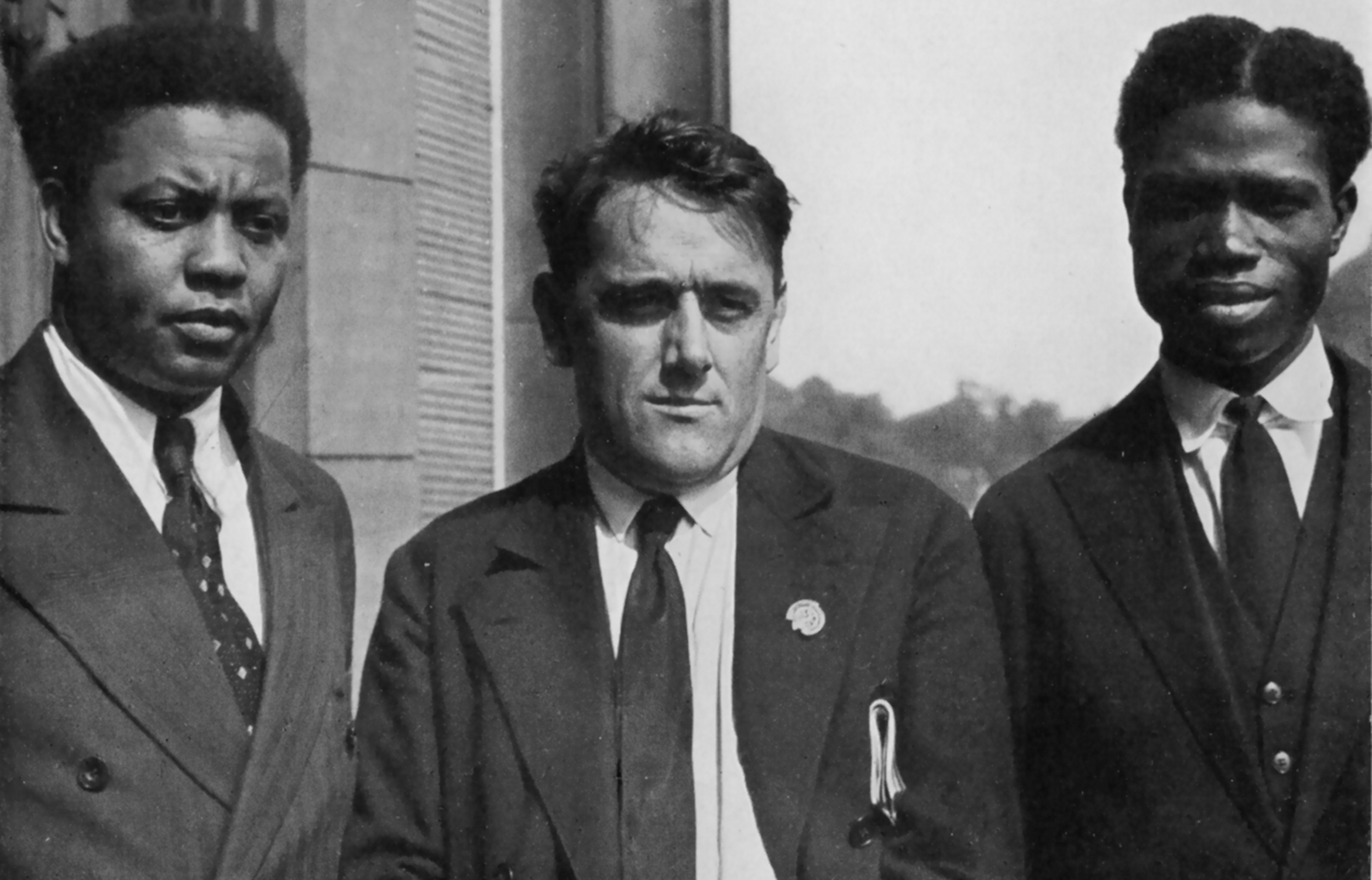
In Frankfurt, American Politician James W. Ford (left), Willi Münzenberg (middle), and Malian activist Garan Kouyaté (right) at the 1929 Second LAI (League Against Imperialism) Congress
Source: Adolf Ehrt, Der Weltbolschewismus. Ein internationales Gemeinschaftswerk über die bolschewistische Wühlarbeit und die Umsturzversuche der Komintern in allen Ländern (Berlin, 1936)., Public domain, via Wikimedia Commons.
Tsibart writes that the Trade Delegation advised him to deal “exclusively” with Mezhrapom. Tsibart then advised the audience for his letter, which was presumably the Gorono and perhaps the Narkompros (The People’s Commissariat of Education) to approve the deal.
This agreement would exclusively supply the “Western Region” (Minsk, Bobruisk, Gomel, Vitebsk, and Smolensk, even though the last three were not part of the SSRB) with all newly released films Mezhrapom believed would be suitable for Russia.
In the meantime, Tsibart offered a list of four films that were “highly artistic historical” and “socially themed” films.
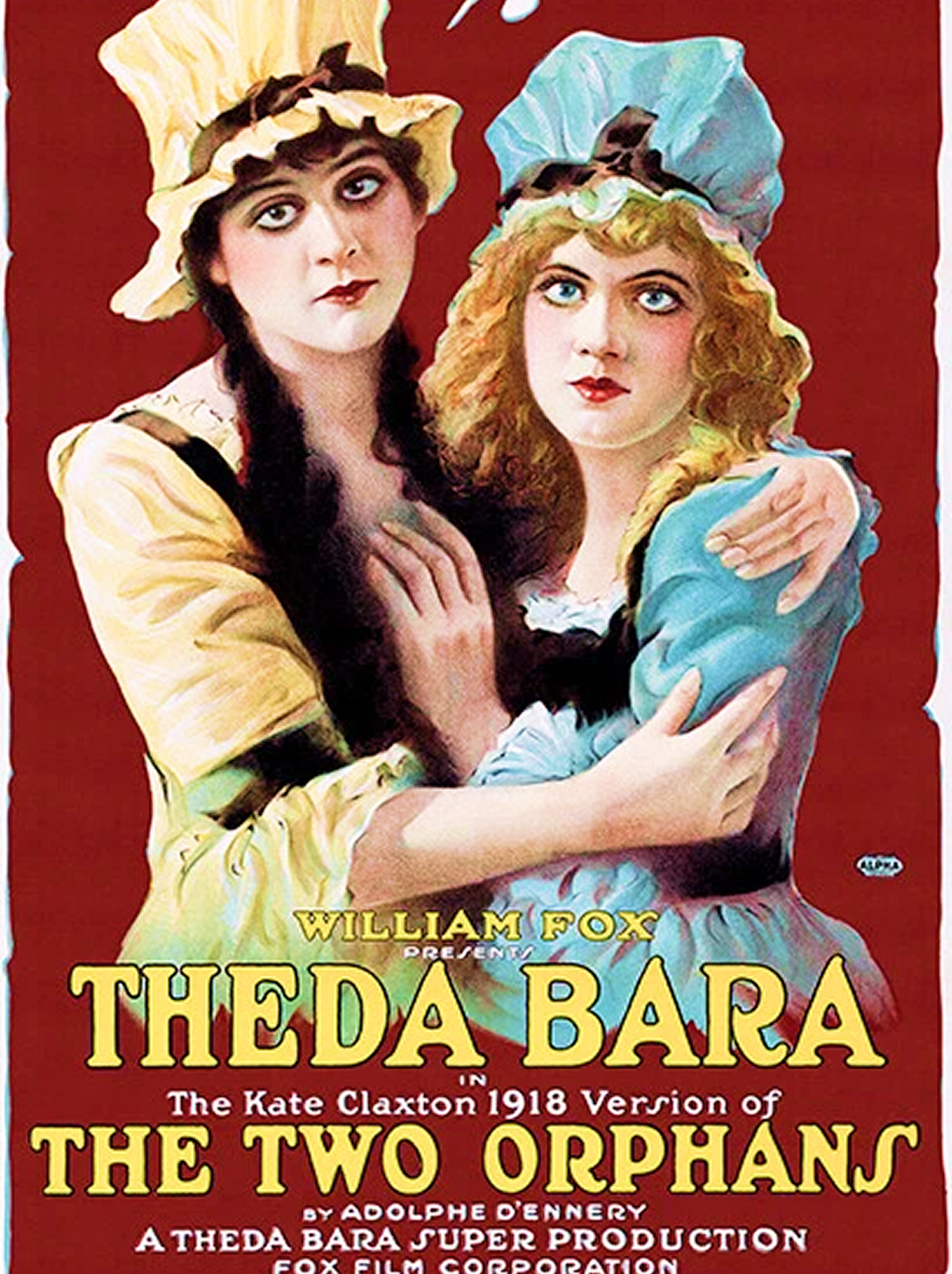
- The Two Orphans (from the time of the French Revolution)
- Napoleon’s Daughter
- The Pharaoh’s Wife (directed by Ernst Lubitsch)
- Pope Borgia, and others.
The Loves of Pharoah, 1922.

The Loves of Pharoah poster.
Source: https://www.posterazzi.com/the-loves-of-pharaoh-still-item-varevcmsdloofec115/?srsltid=AfmBOooxM7cs-YpU3wnN6tpEgtHuuSSmEaGA8IYdcjYHX6e_hYZ6JCyQ
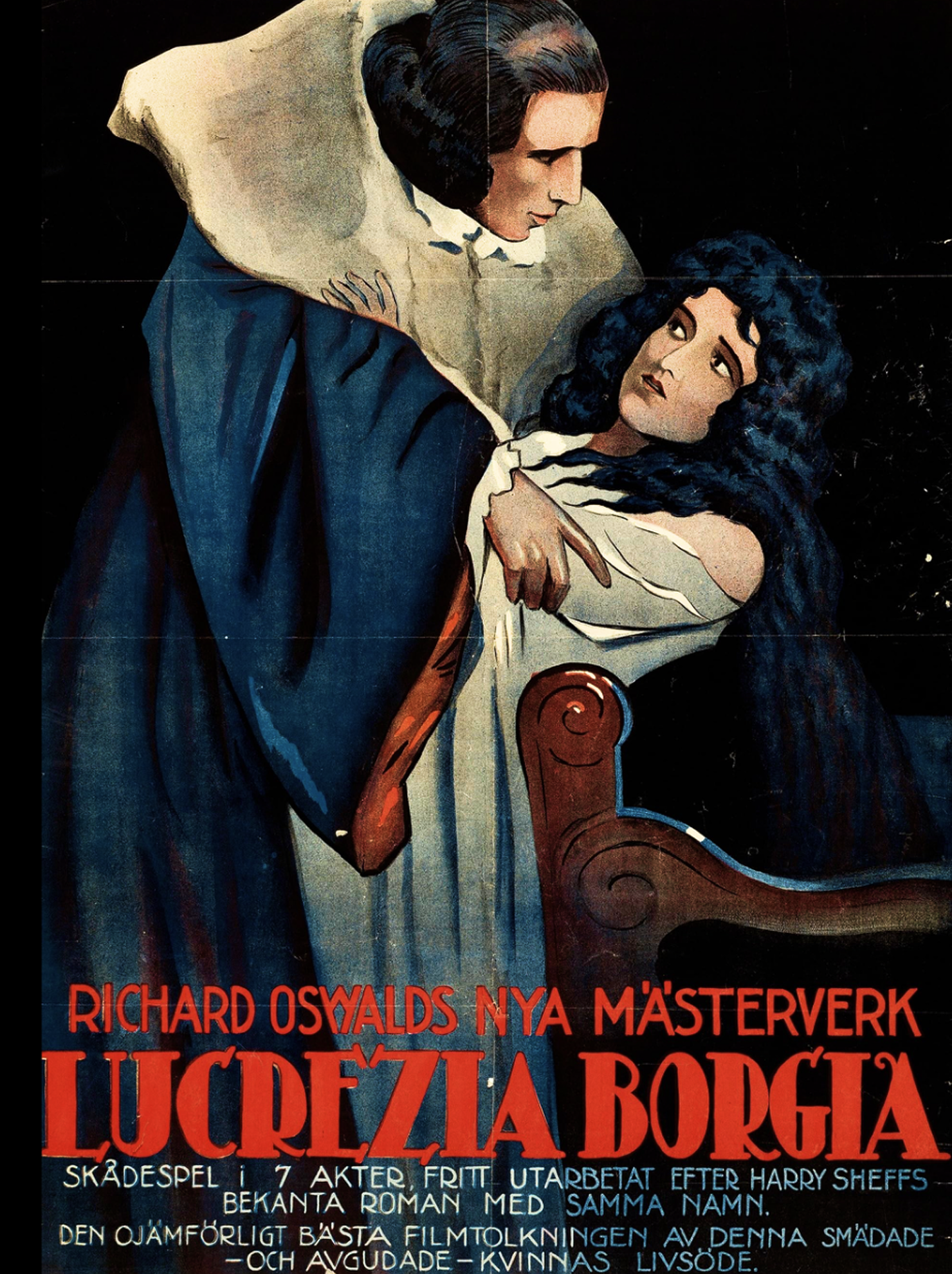
Lucrezia Borzia poster.
Source: https://www.imdb.com/title/tt0013342/mediaviewer/rm1722232832/

Tsibart also suggested a second Ernst Lubitsch film, Madame DuBarry. 8
Madame DuBarry, 1919.
1 «Protokol no. 25» [«Протокол no. 25»; Protocol No. 25], 15 Sep. 1922. Natsional'nyy arkhiv Respubliki Belarus' (NARB) [Национальный архив Республики Беларусь (НАРБ); National Archives of the Republic of Belarus (NARB)]. Fond 15, Opis' 1, Delo 28, pp. 73-73b.
2 Polozheniye ob Upravlenii Kinoteatrami gor. Minska [Положение об Управлении Кинотеатрами гор. Минска; Regulation regarding the Administration of Cinemas in the City of Minsk], 1 Nov. 1922. Gosudarstvennyy arkhiv Minskoy oblasti (GAMO) [Государственный архив Минской области (ГАМО); State Archive of Minsk Region (GAMO)], Fond 322, Opos' 1, Delo 89 pp. 301-301b.
3 «Prazdnestvo na ekrane» [«Празднество на экране»; Celebration on the Screen]. Zvezda [Звезда; Star], No. 265 (1266), 9 Nov. 1922.
4 Prikaz no. 128 (Приказ no. 128; Order No. 128). 15 Nov. 1922, NARB, Fond 42, Opis' 1, Delo 116, p. 103.
5 «Shtat kinoteatrov i samogo upravleniya» [«Штат кинотеатров и самого управления»; Staff and Management of Cinemas]. 17 Nov. 1922. GAMO Fond 322, Opis' 1, Delo 89, p. 292.
6 Countries were not members, but “sections” of the Comintern. They included Algeria, Australia, Britain, Bulgaria, Canada, China, France, India, Indonesia, Italy, Japan, Portugal, South Africa, the U.S., and, of course, the USSR. “The Sections of the Communist International” Marxist Internet Archive. https://www.marxists.org/history/international/comintern/sections/index.htm. Accessed 4 Jan. 2025.
7 Keply, Vance Jr. “The Workers’ International Relief and the Cinema of the Left 1921-1935”. Cinema Journal. vol. 23, no. 1, 1983, p. 7-23, JSTOR https://doi.org/10.2307/1225069 Stable URL: https://www.jstor.org/stable/1225069
8 Vypiska iz Pis'ma tov. Tsibarta ot 15-go Noyabrya 1922 goda za № 144 g. Varshchava [Выписка из Письма тов. Цибарта от 15-го Ноября 1922 года за № 144 г. ВарщаваExcerpt from the Letter of Comrade Tsibart Dated November 15, 1922, No. 144, Warsaw]. 15 Nov. 1922, NARB. Fond 6, Opis' 1, Delo 124, p. 107.