
Cost Accounting and Private Film Dealers
1921-1922
Things became very busy both in Soviet Russia and Soviet Belarus as the year 1921 came to a close. In December of 1921, Moscow ordered the VFKO (Vserossiiskii Foto-Kino-Otdel, the All-Union Photo and Film Section) and POFKO (Petrogradski Oblastnoi Fotokino-Otdel, the Petrograd Photo and Film Section) to change over from their old financial systems, which they had used for years, to a system, known as khozraschet.1 Film historian Vance Kepley, Jr. says this is “roughly translated as ‘cost-accounting’ or ‘self financing.’”2 This clearly was part of the implementation of Lenin’s New Economic Program for these two organizations. The order only applied to these Russian organizations, but it showed the prescience of Minsk in trying to make its Photo-Kino Department self-financing the previous summer.
The other important event came in January 1922, with Lenin’s Directives on the Film Business.3 He dictated, but did not write down himself, the order on January 17, ordering the Narkompros (People’s Commissariat of Education) to “organize the supervison of all film showings and systematize the [cinema] business. The order also specifically called for entertainment films to be part of cinema programs and that there should be films on the lives “of peoples of all countries.” It added that privately owned cinemas should pay rent and owners should be allowed to increase the number of films and present new ones.”4
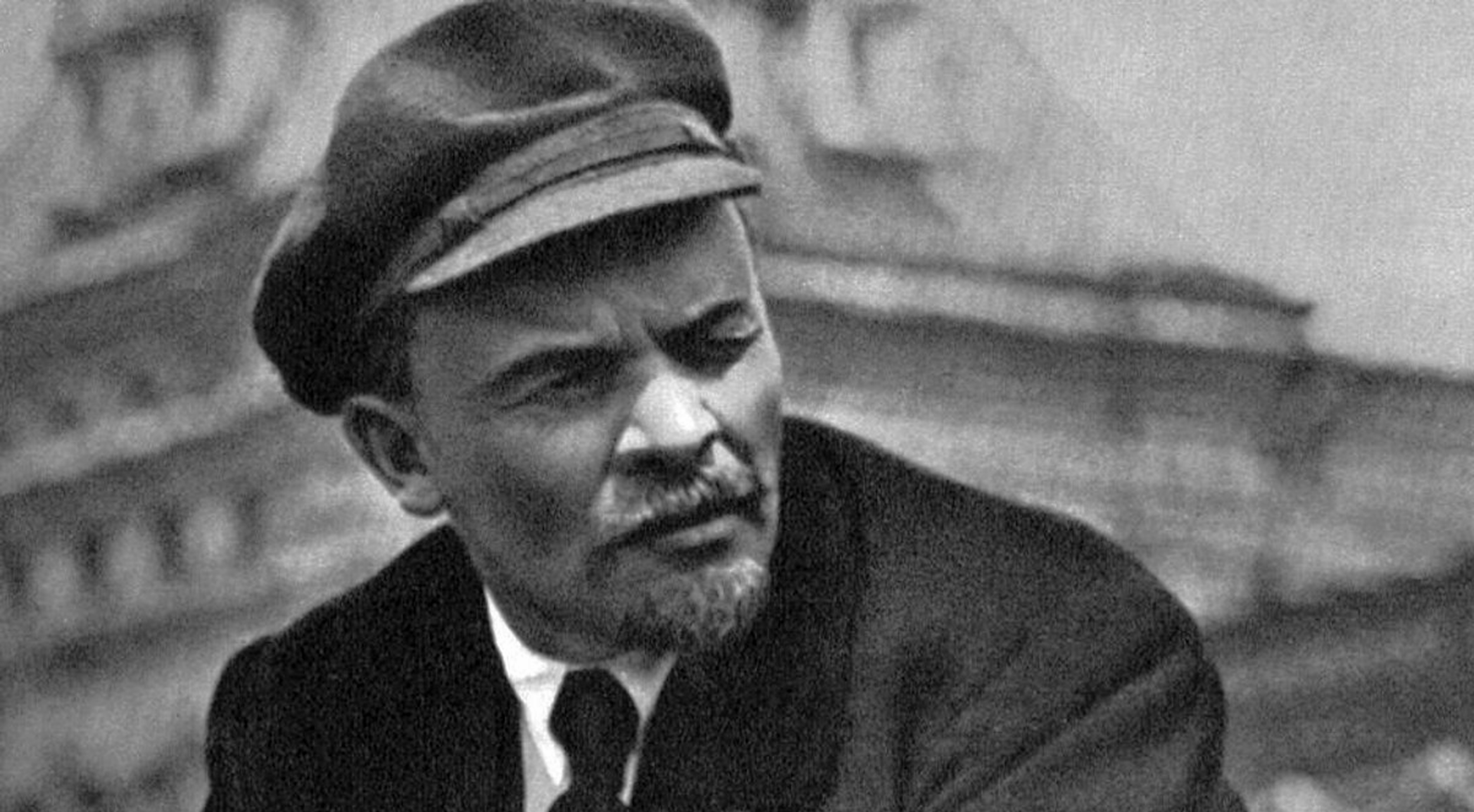
Vladimir Lenin.
Source: Foto: East News / East News
In Belarus, the Photo-Kino Department went to work. Court proceedings laid out how Abram Liftshitz, a former cinema operator and first head of the Photo-Kino Department, and Schlomo Schnittman, who had operated a cinema in Minsk before the communists took over, took advantage of the communists’ inexperience and trust and siphoned off a great deal of money before being caught at the end of 1921.
In January of 1922, after Lenin's orders came out, the Photo-Kino Department turned again to private dealers despite its bad experience with them. The Department still needed their experience and understanding, so it is not surprising to find that Zvezda reported in January of 1922 that the Photo-Kino Department signed a deal with Marcus Mnushkin. He received a two-year contract to allow him to rent the Artistic theater in Bobruisk to show films. A Pre-revolutionary film journal report said that Mnushkin had once run the Eden in Bobruisk but had to give it up because he stopped paying “anyone.” (Click here to see more) Yet, in the new contract, he promised to pay 25 gold roubles a month in rental.5 Kinoresbel would be stuck with this contract which, given Mnushkin’s previous troubles, was a questionable investment.
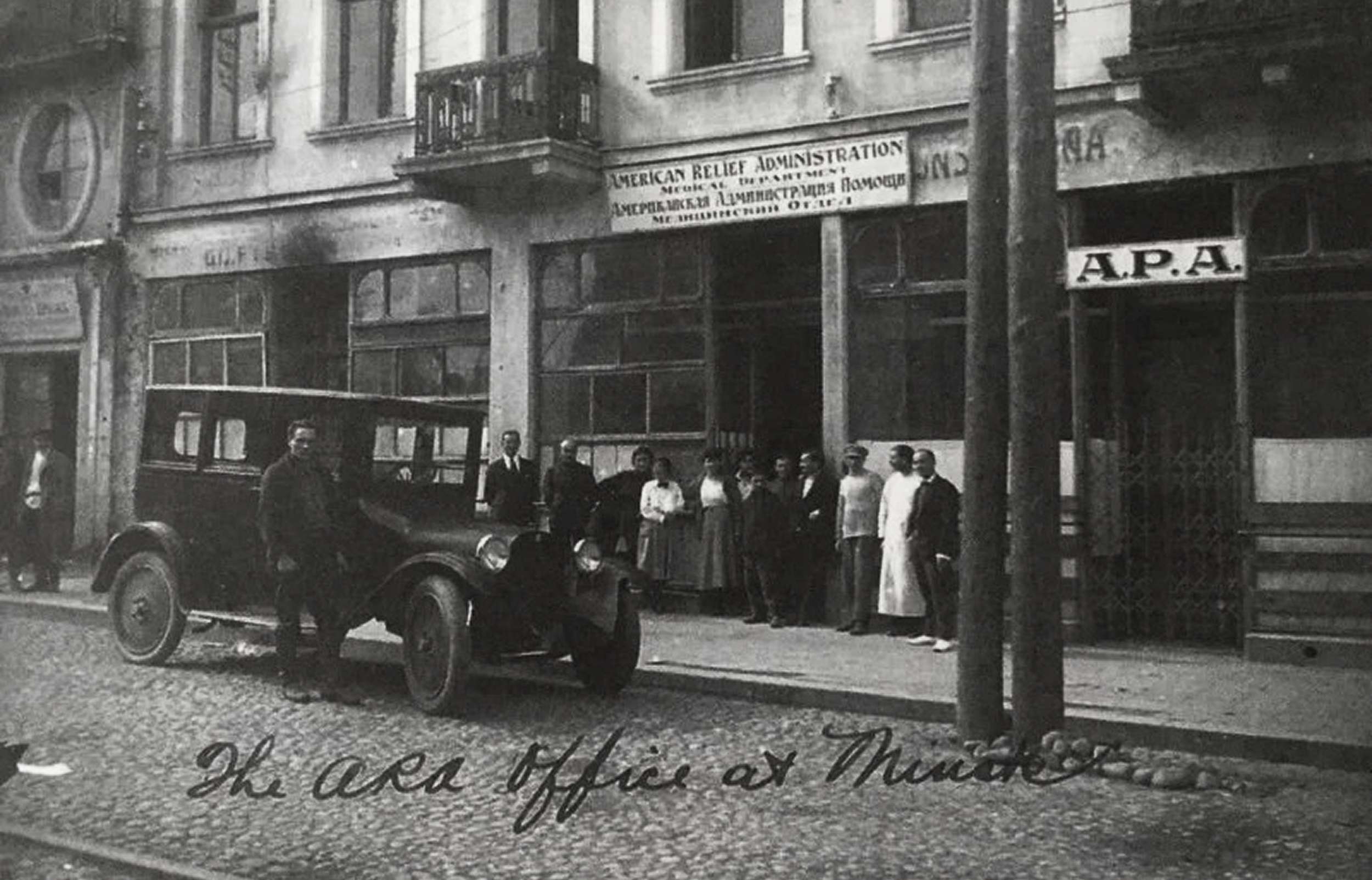
Minsk. Sovetskaya Street at the intersection with Voldarsky Street.
American Relief Administration office, 1922.
Source: https://www.facebook.com/MinskPhotoHistoryNews
The Photo-Kino Department then enlisted another pre-revolutionary film figure. Zvezda reported that at the beginning of March the Photo-Kino Department signed a contract with Mark Aronov from Polotsk. He was to provide three “programs” (presumably several films) every six days. The films would run at the Minsk theaters Red Star (formerly the Giant), International (formerly the Eden), and Culture (formerly the Modern).6 (to see more about Aronov, click here.) Kinoresbel would be stuck with this contract, too.
Most notable, though, was that in February of 1922, Belarusian authorities began to discuss setting up a new organization for film distribution. This organization was originally going to only handle obtaining films and distributing them. It might have lasted, except that it also ended up with jurisdiction over the actual movie theaters. This brought out its enemies. But that is for later articles. As the year 1922 began, Russia had begun to organize the cinema business. By the end of the year, the Soviet Union would have come into existence, and the organizations set up in Moscow gained more control over the film organizations of the USSR constituent republics, whether or not it was official.
In the meantime, perhaps in response to the film directive, battles exploded over what entertainment was appropriate for Belarusians.
1 Taylor, Richard. The Politics of Soviet Cinema, 1917-1929. 2008, Cambridge University Press, P. 69
2 Kepley, Vance Jr. “’Cinefication’: Soviet Film Exhibition in the 1920s.” Film History, Vol. 6, No. 2, Exhbition (Summer 1994) p. 262-277. Indiana University Press. https://www.jstor.org/stable/3814971 Accessed 3 Dec. 2025.
3 "Directives on the Film Business." 17 Jan. 1922. Marxists Internet Archive https://www.marxists.org/archive/lenin/works/1922/jan/17.htm#:~:text=Dictated%3A%20Dictated%20January%2017%2C%201922,Translated%3A%20Bernard%20Isaacs English Page. Accessed 16 Feb. 2026.
4 "Directives on the Film Business."
5 Договор [Agreement]. 19 January 1922. Natsional’nyi arkhiv Respubliki Belarus (NARB) [Национальный архив Республики Беларусь (НАРБ); National Archives of Belarus (NARB)]. Fond 42, Opis' 1, Delo 1057, pp. 7-7b.
6 Договор [Agreement]. 7 March 1922 NARB Fond 42, Opis' 1, Delo 1057, pp. 9-9b.