
A Deadly Fire:
The End of Stremer in Belarus
Part I
In the early years, cinemas could be dangerous places. The lamps used to light up the screen were powered by a chemical mixture that was flammable.
Sine-Fono reported on a near disaster in Orsha in which a cinema owner named Simkhovich, and his clerk, a man named Dombrovsky, were hurt when an iron vessel holding the chemicals exploded while they were working. Dombrovsky got metal shards in his legs, and Simkhovich had wounds to his face and eyes. 1

Orsha, Peterburgskaya street, beginning of the XXth century.
Source: https://smolbattle.ru/threads/Орша-путешествие-в-прошлое.51461
Riga
The worst theater fire in the history of early Belarusian cinemas took place in Minsk in October of 1909 and burned down the theater of Richard Stremer, the film entrepreneur who had opened up the first permanent cinema in Minsk. (see here)
Several years earlier, in Riga, Stremer and his then partner lost a theater to a fire at the 700th anniversary celebration for that city. The two were showing movies uz Putnu pļavas dzīvu fotogrāfiju paviljonā [at the “Bird Meadow”living photography pavillion].
“… due to carelessness a fire broke out at the Birds Meadow Living Photography Pavillion owned by the citizen Richard Eichtal and the citizen of Prussia Richard Stremer. The cinematograph burned down, including the pictures and a wooden box/closet" 2
Riga City Police Paper
Special thanks to the Latvian Film Museum for finding this.
As we noted in a previous article Stremer had theater locations throughout the Russian Empire (see here). When he opened a “permanent theater” in Minsk in 1907 at the commercial building known as Rakovschick House, he found that the city could not provide either sufficient or consistent enough electric power for him.
To solve the problem, he purchased his own gasoline engine. That meant that both he and his neighbor, a man named Kaplan, who had a printing business in the huge Rakovschick House, had a gasoline engine. For several months in 1908 people complained about the gasoline smell, apparently from the gasoline engine Stremer used to generate electricity for his theater.3
In May of 1908, he was “struggling to manage the smoke emitted by that motor.”4 The smoke was still a problem in July of 1908.5 We have found no more newspaper references to the problem after that.
The following photo shows the Rakovshick House, a complex of connected commercial buildings at the corner of Gubernatorskaya and Zacharevskaya Streets.
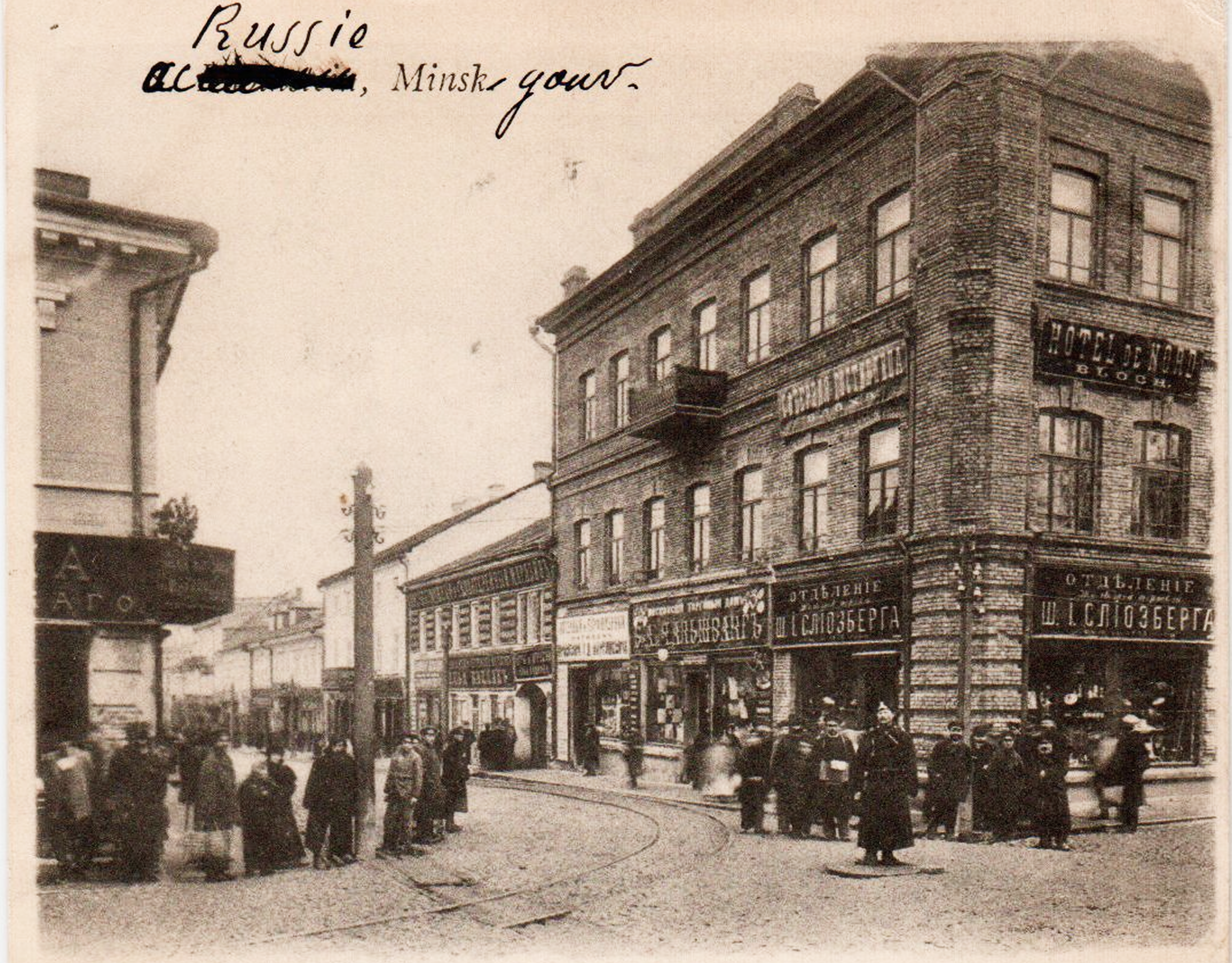
Source: Public Domain. Wikimedia Commons.
You can see just past the three-story building that there is an arch where a two-story building joins it.
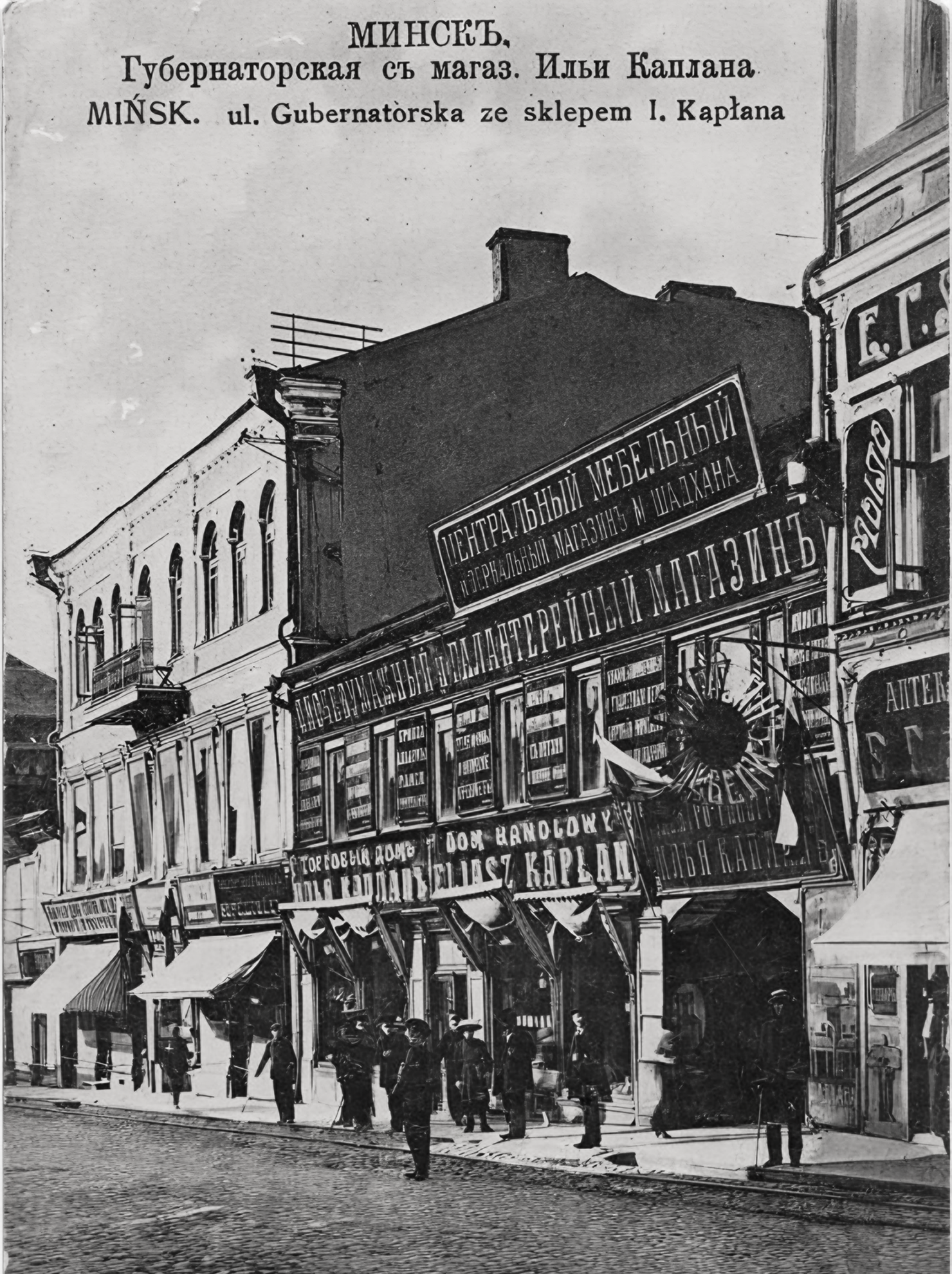
Source: Public Domain. Wikimedia Commons.
Below is a layout plan for the Rakovschick House from 1897, which you can find in Leanid Marakov’s book Haloŭnaja vulica Minska [The Main Streets of Minsk, 1880 to 1940.] Here is the original, from page 86 of the book.6 The two red lines show the arch.
This image takes you closer. You can see the sign identifying Kaplan’s “Commercial Establishment” on the two story building.
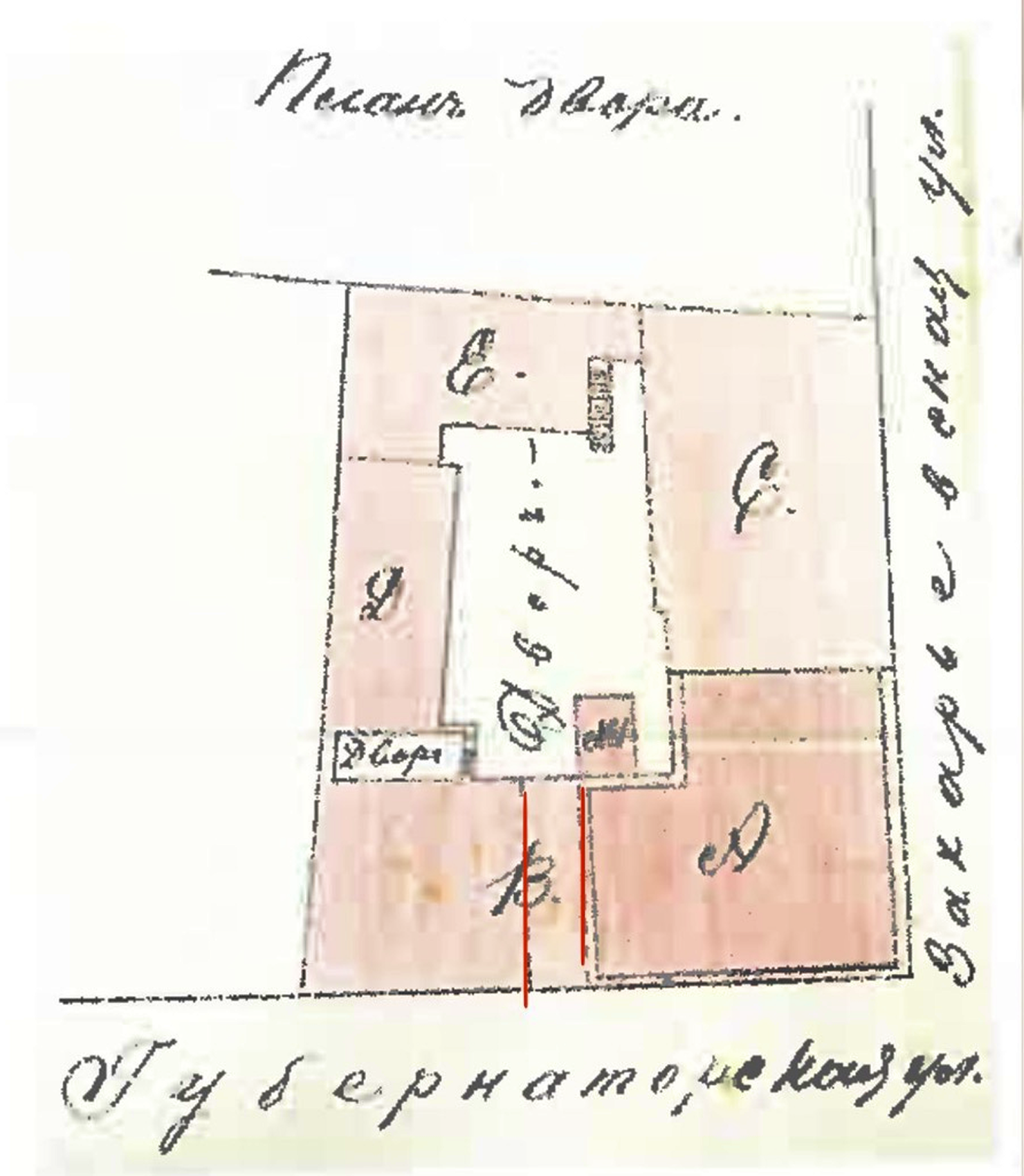
Original image.
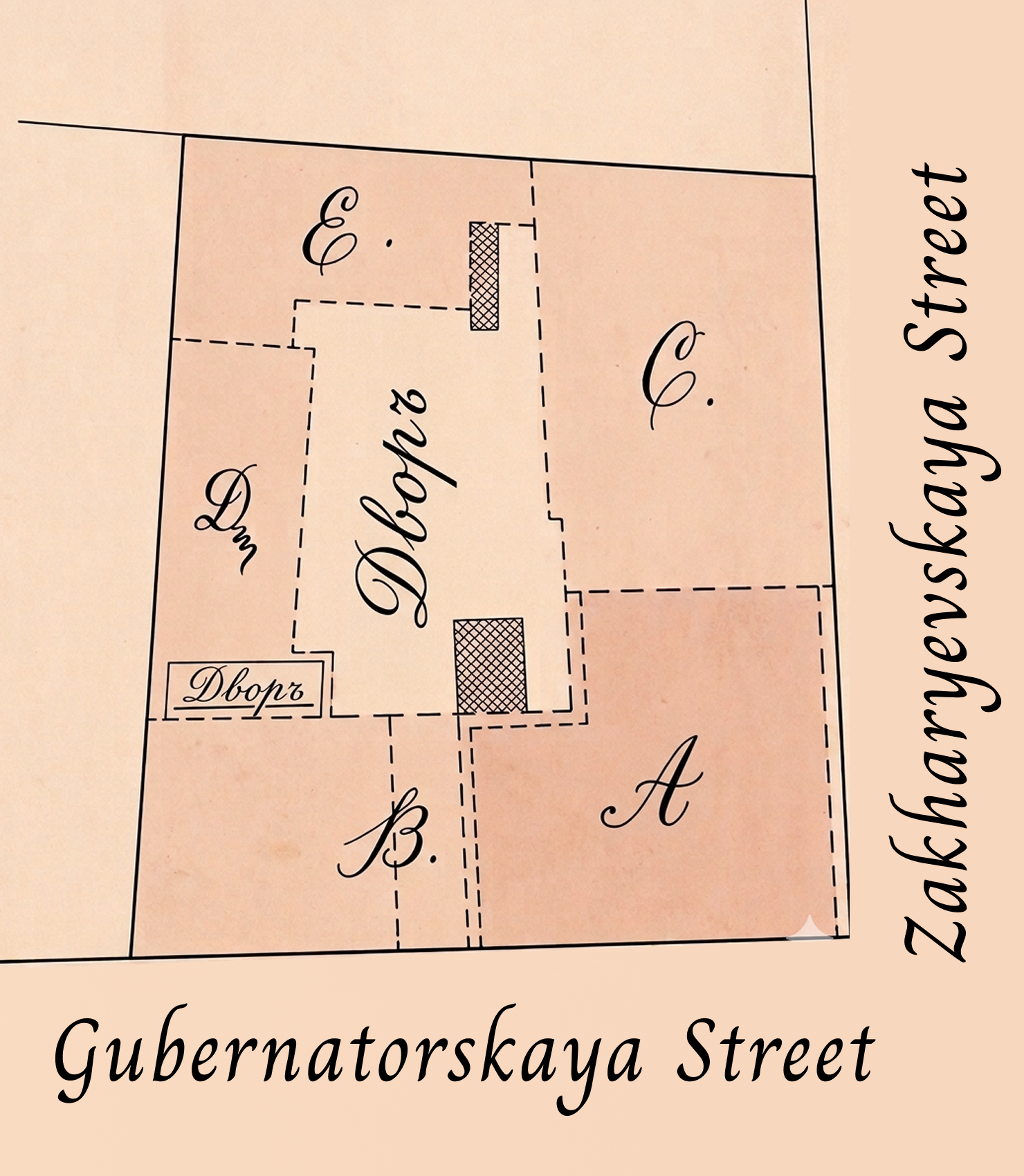
Here is an AI enhanced version of the plan.
The word in the middle is dvor, meaning “courtyard.”
The letters explain the areas:
June–Nov. 1897 A — A 2-story brick/stone house with a cellar, with plans for the addition of a 3rd floor;
B — A 2-story brick/stone house;
C — A 2-story brick/stone house;
D, E — 2-story brick/stone wings.
In this layout, the sign for Kaplan’s printing house was on building B, facing Gubernatorskaya. The arch is represented by a dotted line. We believe Kaplan’s printing business was in building D and that Stremer used E for his theater. Somewhere in here, by 1909, was a pharmacy in which the proprietor, Levitan, stored gasoline, presumably for the two engines.7
By September 1909, Stremer seemed to be on top of the world. He had his own company, which he advertised in the local papers.
Here is the logo he used several times in ads in two of the major papers in Vilnius, the Vilenski Vestnik and the Goniec Wileński.
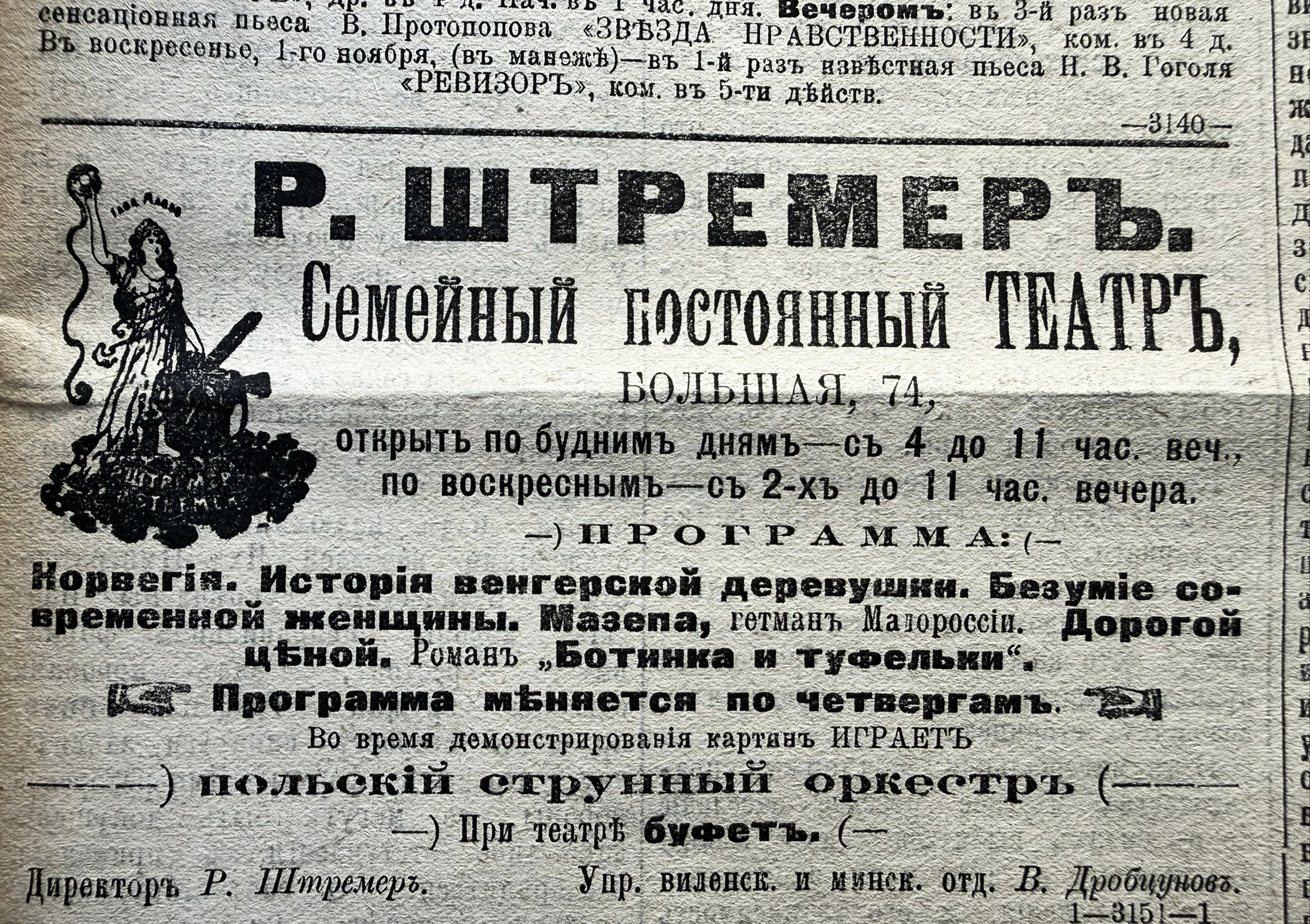
Source: Vilneskij Vestnik [Vilnius Messenger], November 20, 1909.
Thanks to Vilnius University Library
Here it is in the Goniec Wileński [Vilnius Messenger] on October 11, 1909.8
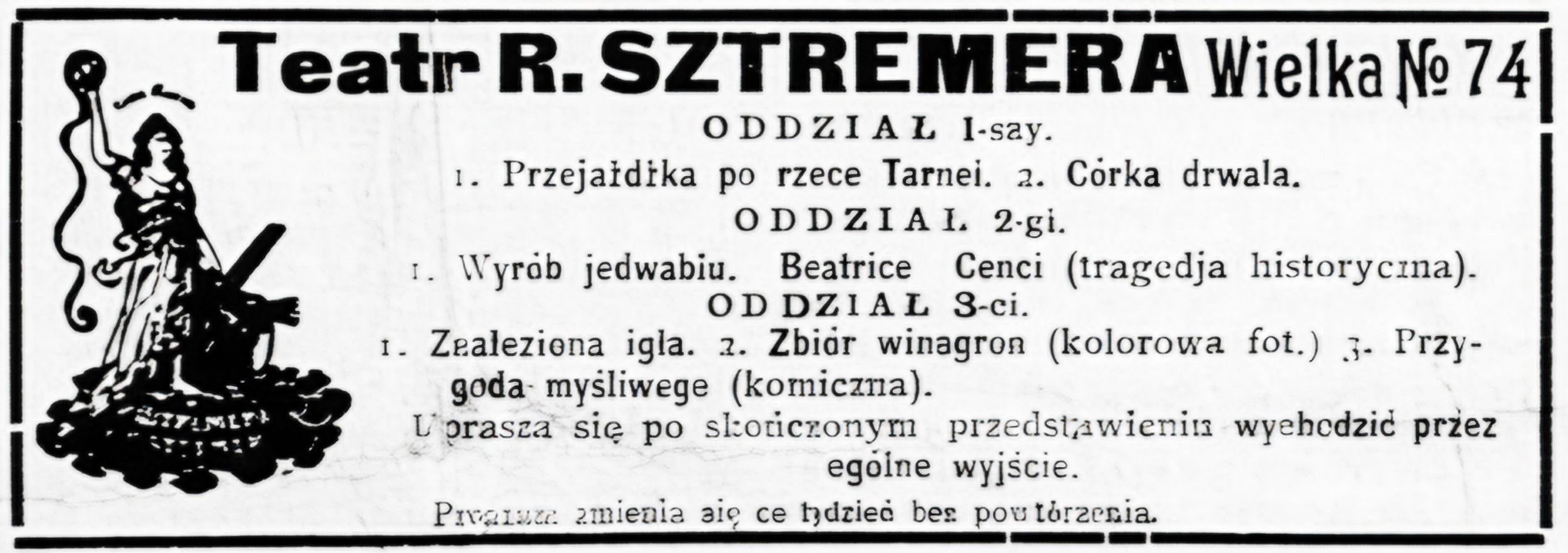
It has not been conclusively determined what the words above the figure’s head actually are because the printing on the newspaper is so poor. We believe it says Fabrique Marque, or Trade Mark.
You can see the letters, FABR, a presumed abbreviation of Fabr.
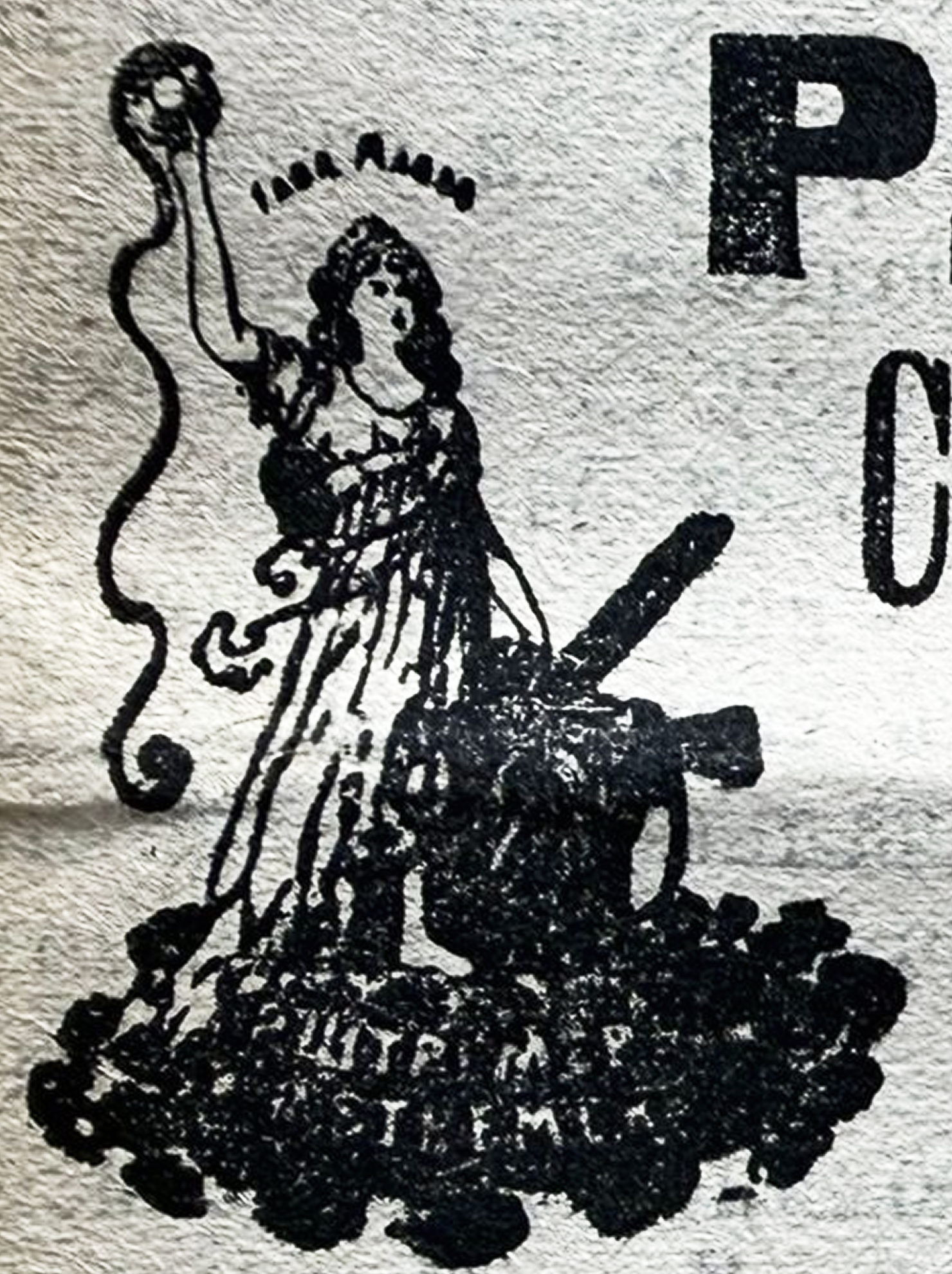
This is an AI enhanced reproduction of the figure in the ads. We asked that FABR. MARKE be added.
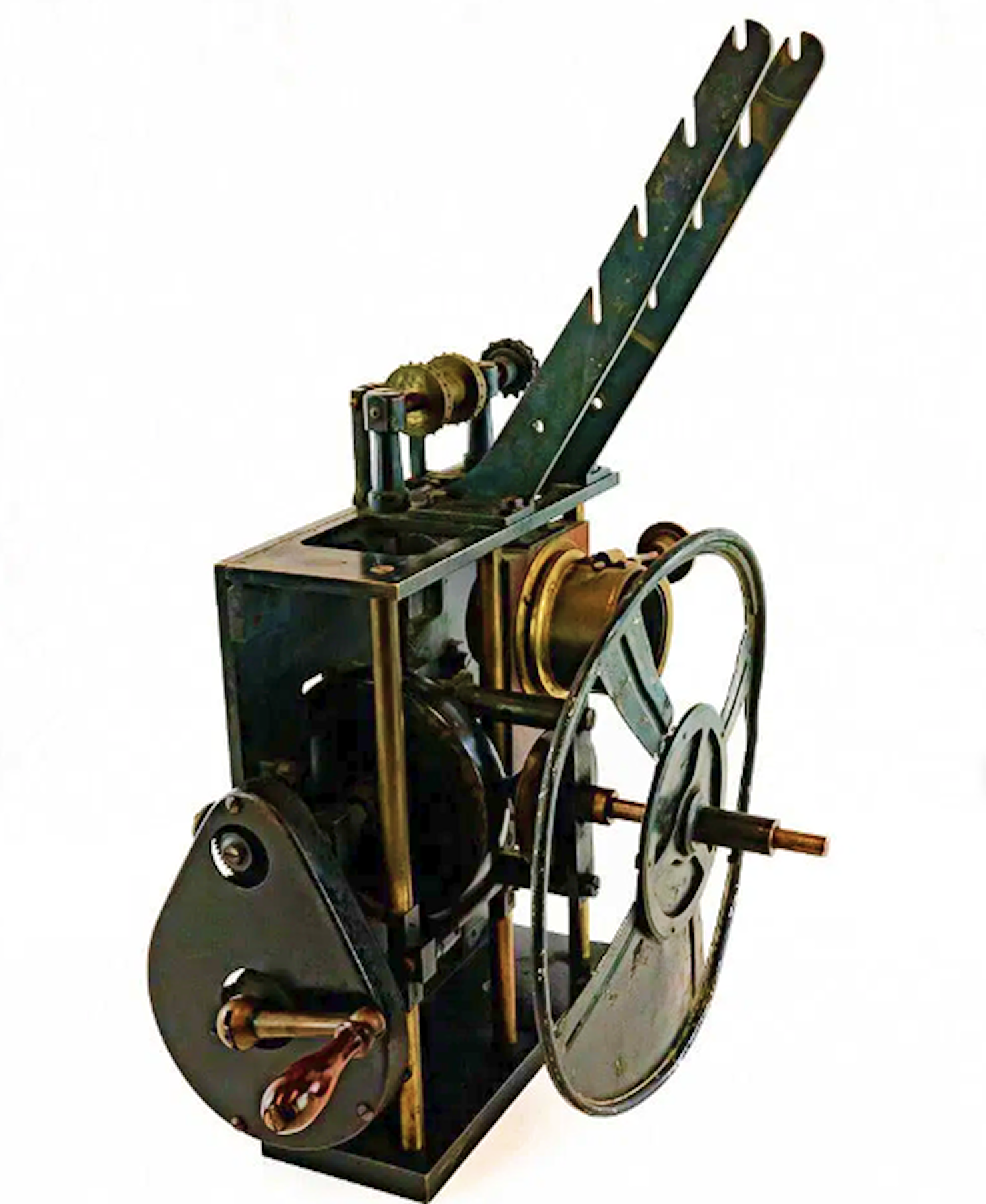
The projector in the picture appears to be a Pathe 1909 Renforce. We say that by looking at the maltese cross shutter in a ring, the film holder angling out from the top, and the thinness of the projecting box.
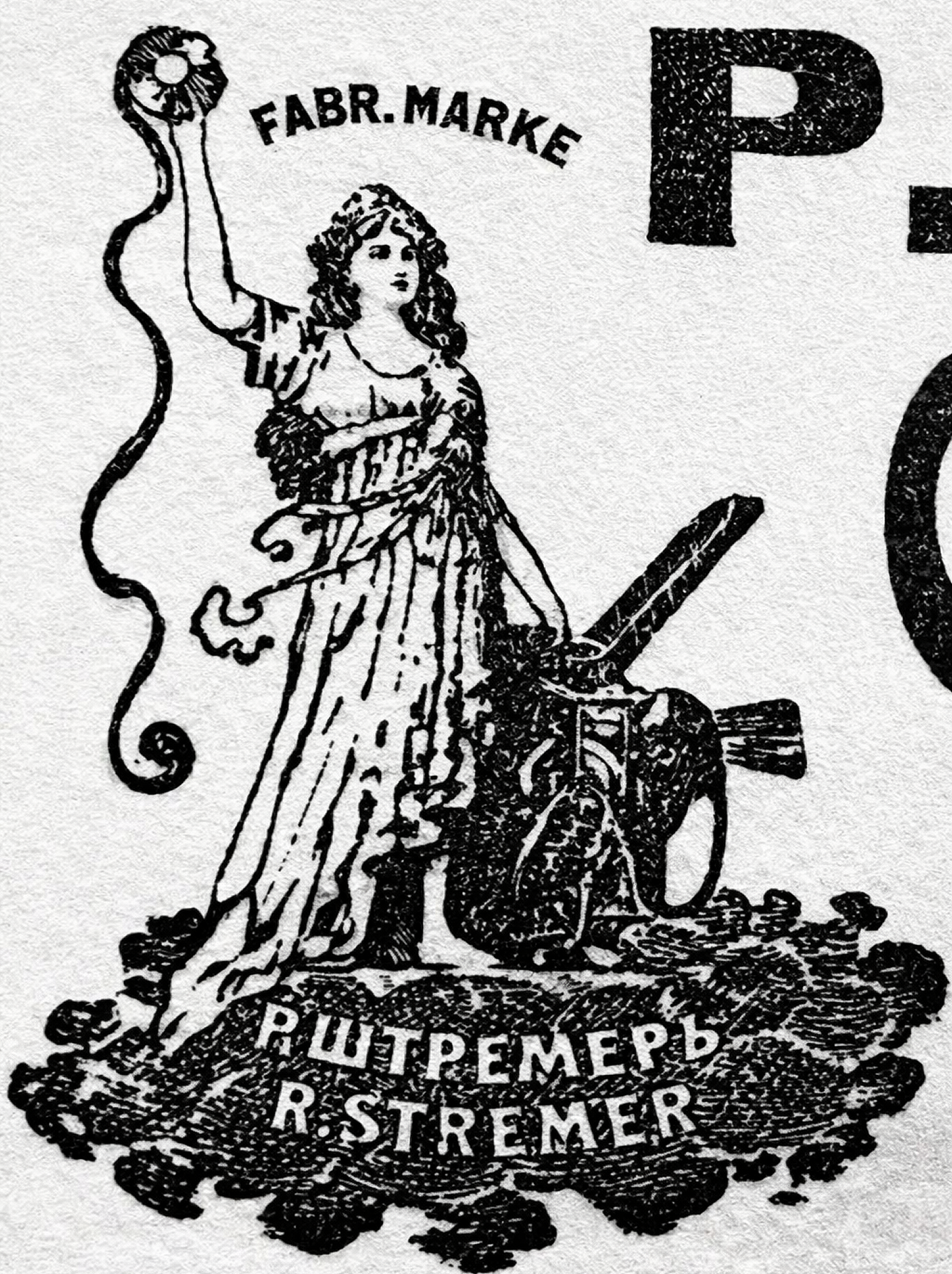
Here is a picture of a 1909 Renforce from the Live Auctioneers website. Reused with permission of Donley Auctions.
(Enlarged by AI).
1 Sine-Fono [Сине-Фоно; Cine-Phono], No. 22, 15 Aug. 1909, p. 13
2 Rigas Pilsētas Policijas Avīze [Riga City Police Paper] July 27, 1901 № 164, p. 4.
3 “Minsk Echa” [Minsk Echo]. Kurjer Litewski [Lithuanian Courier], No. 65, 19 Mar. (old calendar) and 1 Apr. (new calendar) 1908; No. 126 5 Apr. (o.c.) and 18 Apr. (n.c.) 1908, p. 3.
4 “Minsk Echa” [Minsk Echo]. Kurjer Litewski No. 101, 3 May (old calendar) and 16 May (new calendar) 1908.
5 “Minsk Echa” [Minsk Echo]. Kurjer Litewski No. 174, 31 Jul. (old calendar) and 18 Aug. (new calendar) 1908.
6 Marakou, Leanid. Haloŭnaja vulica Minska [Галоўная вуліца Мінска 1880-1940; The Main Streets of Minsk, 1880—1940] Mastackaja Litaratura [Мастацкая літаратура; Artistic Literature], 2012
7 “Minsk Echa” [Minsk Echo]. Kurjer Litewski 10 Oct. 1909, p. 3.
8 Polona. https://polona.pl/preview/8ee280bd-764d-45f7-8223-a40ce70ebeea Accessed 22 Feb. 2026.