
Changes to the Belarusian Government and the Arts
Slutsk gets a new cinema
1921
In early 1921, as the Belarusian Communist Party was reforming itself, it prepared for the first purge of Communist Party members. The website Yerusha writes that the protocols for purging were established at a party conference at the end of February 1921. Commissions were instructed to “improve party ranks” by taking measures to, among other things, see to the preservation of communist ethics in Belarusian communists. They were to discover and expel from the party “kulak-owner and bourgeois elements among the peasants and county townspeople,” as well as employees of Soviet agencies who were of a “bourgeois” intelligentsia background or had formerly belonged to since-liquidated political parties and unions.1
Historian Ivan Lubachko writes that, between August 15 and October 25, 1921, 1,495 members of the KP(b) [Belarusian Communist Party] (about 25 percent of the total membership) were removed. An official Party statement said they expelled "rascals, bureaucrats, dishonest or wavering Communists, and Mensheviks at heart". During Lenin's time, however, those expelled from the Party usually were left free.2
The Belarusian Communist Party was not alone in undergoing changes. Newspaper and archival reports indicate a massive effort to restructure art and politics. A June 3, 1921 article in the Minsk newspaper Zvezda [Star] tells us that Comrade Moise Dinershtein, Chairman of the Rabis (The Art Workers Union) (mark that name, you will hear it a lot soon) addressed a meeting of the Vserabis (the All Belarusian Union of Art Workers).3 He spoke about “the tasks of the Main Political Education Department in relation to artistic and propaganda work, in connection with its merger with the Arts Department.” 4
A short time later Slutsk welcomed a new cinema. A June 22 report from Zvezda tells of a cinema that opened on June 14 “which had never existed before.”5 Once it was open, “Slutsk workers were able to watch films projected on a screen."6

Slutsk, beginning of the XX century.
Source: https://1863x.com/slutsk-gorod-geroi
On July 24, Zvezda reported that the Department of the Arts “along with all enterprises, groups, cinemas, photographic studios, etc. previously under its jurisdiction” was transferred to the Glavpolitprosvet (Main Political Educational Directorate)7 which operated under the Narkompros (People’s Commissariat of Education). The Department of Arts included the Photo-Kino Department, which managed the cinemas.
The July 24 article also said: “In light of the current financial crisis, and by decree of the central authorities, all theatrical and related enterprises are transitioning to a self-financing model.”8 That had to be Lenin’s New Economic Policy at work. To emphasize that it meant what it said, the Department of Arts added “free theater tickets are abolished.”9 (This appears to mean live theater, not cinemas.)
On September 2, 1921, the Photo-Kino Department reported that “the former best cinemas in Minsk—such as Krasnaya zvezda [Red Star], which was formerly the Gigant [Giant] and Internatsional (formerly the Edenm [Eden]) — have become so neglected and dilapidated, with ceiling plaster having collapsed to such an extent, that unless major repairs are undertaken immediately, they will have to be closed at once.” 10
Less than a month later, on Oct. 16, 1921, Zvezda reported that “Recently, 3 cinemas have opened (Italics added), bringing a significant income.”11 Of course, it did not name them.
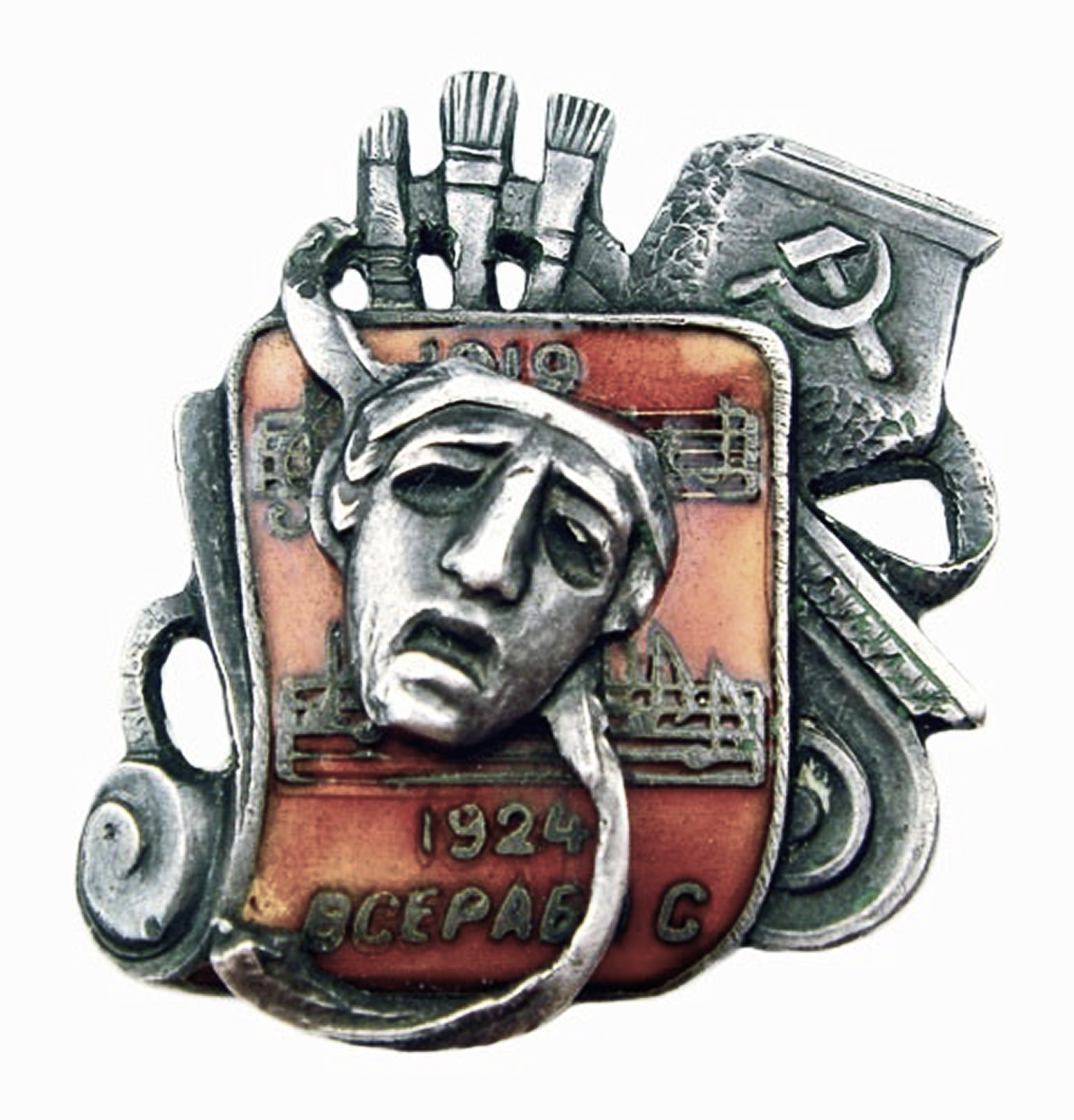
Badge Vserabis, 5th anniversary of the Union of Art Workers, 1919-1924.
Source: hhttps://znakussr.ru/shop/profsoyuzy/znak-vserabis-5-letie-soyuza-rabotnikov-iskusstv/
One way the state sought to shift the financial burden is shown in the October 25, 1921 Zvezda story, “Our Attitude to Art.”12 It called for “the burden to be removed from state shoulders” and leased to labor collectives, “leaving them under the influence of our state bodies.” This seems as though it will be up to the labor collectives to earn the profit, while the state retains the power over what can be shown. This also illustrates the continuing problem with cinema. Many Belarusian leaders believed that the cinemas should only show films supporting the country and the political system and that profit should not be a consideration.
Still, even in October 1921, the Glavpolitprosvet was planning to purchase more films. It excused the purchase by saying, “Although this measure will incur significant initial costs, it is expected to pay off within two months and subsequently generate steady income. Moreover, during this time, the cost of the batch would have been spent anyway on rental fees.”13
A November 9 story in Zvezda reports that the Red Star cinema hosted an October Revolution celebration, in which “participants shared their memories” and then saw a film about the opening of the Second Communist International Congress.14
On December 6, Zvezda reported the Spartak cinema (which had replaced the New Theater) would open that same day. It would host “a grandiose program” for Red Army soldiers.16
When the Third Congress of the Belarusian Communist Party was held in Minsk in December 1921, reported Zvezda, delegates were shown the films Golod v Povolzh'ye [Hunger in the Volga Region] and Pchelovodstvo [Beekeeping] in the Red Star theater. This is the same theater that, in September, the Photo-Kino department said was about to collapse.

The Association of Art Workers Assisting the Starving, Poster, 1921.
Source: https://postermuseum.com/collections/soviet-union-russia/products/the-association-of-artists-assisting-the-starving-poster-49/
Video of the film Famine in the Volga, 1922.
And in the "some things never change" department. The Deputy Chair of the Glavpolitprosvet issued this order on December 1, 1921.
It has been observed that ticket sellers and controllers are allowing entry through side doors without tickets.
This practice must be stopped immediately. Repeat offenders will be dismissed and prosecuted for dereliction of duty.17
1 "Igumen County Commission to Purge the Communist Party (Bolsheviks) of Belorussia." Yerusha: European Jewish Archives Portal, Rothschild Foundation Hanadiv Europe, https://www.yerusha-search.eu/viewer/metadata/JTS-2564/. Accessed 17 Sept. 2025.
2 Istoriia BSSR [История БССР; History of the BSSR], 2nd ed., Vol. 2, Minsk, 1961, p. 184; Markianov, Boris K. Bor'ba Kommunisticheskoy partii Belorussii za ukrepleniye yedinstva svoikh ryadov v 1921–1925 godakh. [Борьба Коммунистической Партии Белоруссии за укрепление единства своих рядов в 1921–1925 гг.; The struggle of the Communist Party of Belarus to strengthen the unity of its ranks in 1921–1925]. Minsk, 1961, p. 64. All cited by Lubachko, *Belorussia Under Soviet Rule, 1916–1957*. University Press of Kentucky, 1972, p. 108.
3 Natsional'nyy arkhiv Respubliki Belarus 7 Mar. 1922. [Национальный архив Республики Беларусь; National Archives of the Republic of Belarus (NARB)]. Fond 42, Opis' 1, Delo 1057, pp. 9–9b.
4 «Vserabis» [«Всерабис»; "Union of Art Workers"] Zvezda. [Звезда; Star]. 3 June 1921, no. 127 (811).
5 «Na bor'bu s temnotoy (Slutsk)» [«На борьбу с темнотой (Слуцк)»; "Fighting the Darkness (Slutsk)"]. Zvezda, 22 June 1921, no. 143 (827).
6 «Na bor'bu s temnotoy»,Zvezda 22 June 1921, no. 143 (827).
7 «Vsem Uyezdotdeleniyam rabotnikov Iskusstv» [«Всем Уездотделениям работников Искусств»; "To All County Departments of Art Workers"]. Zvezda, 24 July 1921, no. 171 (855).
8 «Vsem Uyezdotdeleniyam rabotnikov Iskusstv», Zvezda, 24 July 1921, no. 171 (855).
9 «Vsem Uyezdotdeleniyam rabotnikov Iskusstv», Zvezda, 24 July 1921, no. 171 (855).
10 «Predsedatelyu Glavpolitprosveta Dokladnaya zapiska» [«Председателю Главполитпросвета Докладная записка»; "Memorandum to the Chairman of the Main Political Enlightenment Committee"]. 21 Sept. 1921, (NARB), Fond 42 Opis' 1, Delo 107, doc. 96.
11 «S"yezd rabotnikov iskusstv» [«Съезд работников искусств»; "Congress of Art Workers"]. Zvezda, 16 Oct. 1921, no. 243 (927).
12 «Nashe otnosheniye k iskusstvu» [«Наше отношение к искусству»; "Our Attitude to Art"]. Zvezda, 25 Oct. 1921, no. 250 (944).
13 «Doklad o deyatel'nosti Khudozhestvennogo otdela za Oktyabr' mesyats 1921 goda» [«Доклад о деятельности Художественного отдела за Октябрь месяц 1921 года»; "Report on the Activities of the Art Department for the Month of October 1921]". 1921 Nov. [date uncertain] NARB, Fond. 42, Opis' 1, Delo 1048, p. 268.
14 «V teatre «Krasnaya Zvezda»» [«В театре «Красная Звезда»»”; "In the Theater 'Red Star'"]. Zvezda, 9 Nov. 1921, no. 262 (946).
15 Volozhinsky, Vladimir, «Gde v Minske byl pervyy kinoteatr i o chem byli pervyye minskiye fil'my?» [«Где в Минске был первый кинотеатр и о чем были первые минские фильмы?»; "Where Was the First Cinema in Minsk and What Were the First Minsk Films About?"], Tut.by, 17 Apr. 2013. Archived at Internet Archive. https://web.archive.org/web/20180401172506/https://news.tut.by/culture/344182.html Accessed 31 July 2025.
16 «Krasnoarmeyskoye kino» [«Красноармейское кино»; "Red Army Cinema"]. Zvezda, 6 Dec. 1921, no. 285 (969).
17 «Prikaz no.39» [“Приказ no. 39»; "Order No. 39"]. 1 Dec. 1921, NARB, Fond 42 Opis' 1, Delo 1052, p. 42.