
June and July, 1923
A Strike, Birth of Proletkino, and Reruns
The summer heat got to the cinemas in Minsk in the summer of 1923. There were two military-run movie theaters in Minsk and they went different directions in June of 1923. The Grotesk had closed as a cinema in mid-May and immediately re-opened as a self-proclaimed Lotto Club. Employees began working at the Lotto Club on May 15, but they were not paid. By June 14, according to a Zvezda newspaper report, the workers were on strike.1
On the other hand, the Spartak cinema had been turned over to the Rabis (The Union of Art Trade Workers). In a report dated July 29, 1923, the Rabis presented a glowing picture of the employment situation at the Spartak. First, a Comrade Khalfin stated that the workers were forced to ask the Mingorabis (the Minsk city branch of the Union of Art Trade Workers) to allow them to take over the Spartak because the military refused to operate it during the summer months. Khalfin said the staff was 9 people. He added the staff had been increased by two, although it is unclear if the added two people made the staff 9 or 11. Then, Khalfin said that two more people might be added to the staff and he expected the Spartak would still make a profit.2
In Vitebsk, at the end of June, the Vitgubprofsoveta (Vitebsk Provincial Council of Trade Unions) decided to “take the initiative” to follow Moscow’s lead (see here) and organize its own branch of Proletkino (A Russian film production organization, the “Workers’ Cinema”).3 The Vitebsk organization opened up its own cinema – which it named, naturally, Proletkino – at the end of November or beginning of December. The organization’s main task was to “stage films of an industrial, scientific, artistic and revolutionary nature, chronicles of outstanding events in the state, professional and economic life of the Republic,” and that met “the requirements and demands of the proletariat.”4

Logo of Proletkino.
Source: https://ru.wikipedia.org/w/index.php?curid=8679072
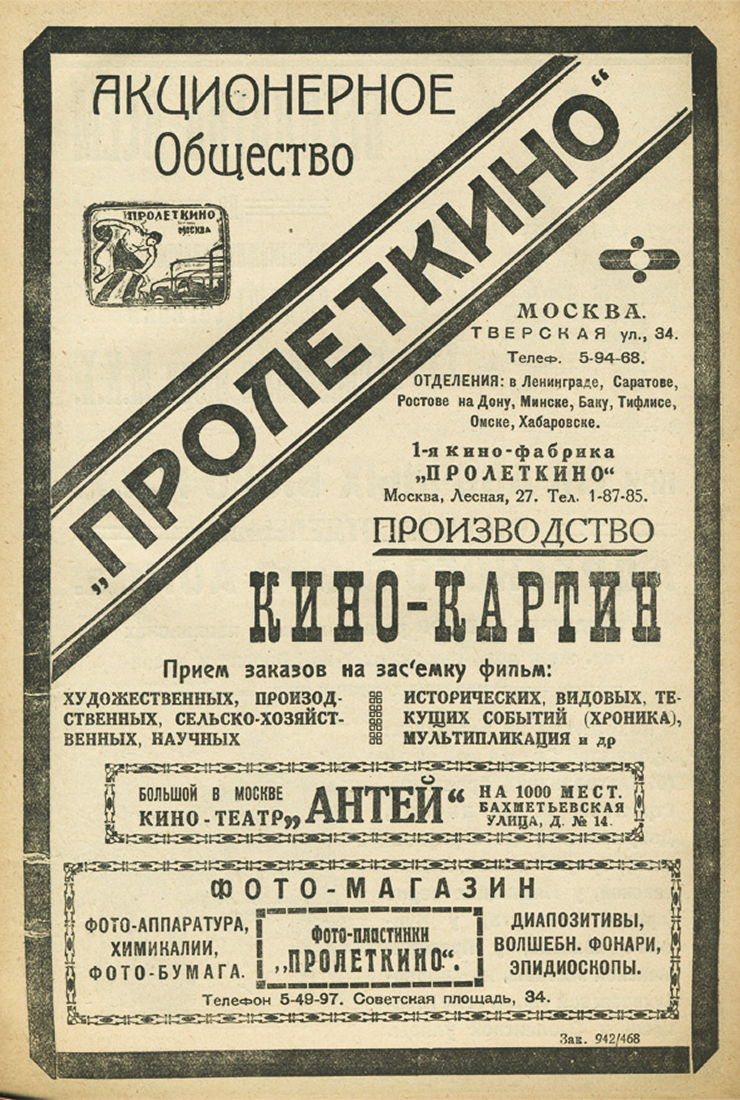
Proletkino advertisements from the "All Moscow" directory, 1926.
Source: https://zavodfoto.livejournal.com/904804.html
The first Moscow-based Proletkino features would not be out until the end of 1923, but there were several short films that debuted in June. According to film historian Jay Leyda, they were:
Pervoe maia v Moskve [May Day in Moscow]; Na boyevom postu [At the Fighting Post]; Deyatel'nost' MSPO [The Work of the MSPO]; and Ekskursiya shveynikov [Outing/Excursion of the Needle Workers].5 There is evidence that the May Day film is still around. It was shown at the Giornate del Cinema Muto film festival in Italy in 2004.6
On July 12, 1923, Moscow-based Soviet leader Leon Trotsky weighed in with an “editorial” on “church, cinema and vodka.” In short, Trotsky argued that cinema was a great replacement for church and vodka because it fought alcoholism and entertained people…and while the other two never changed, the films in cinema could be regularly changed, providing better entertainment.7
On July 14, Zvezda published a letter signed “a worker,” in which the writer complained about the films being shown in Minsk:
And our "Gigant" (cinema) has taken on some sort of monopoly regarding the East. Every week here it's: "The Harem Slave," "The Harem Pearl," "The Secrets of the Harem," and on and on. It has simply become degraded. One would rather not look.8
Zvezda, N 162
The question here, considering that Zvezda was a party organ: Was the letter a message to the Gorono (City Department of Public Education), which ran the cinema department?
One of the films mentioned in the letter was the Pearl of the Harem was a film starring famous actress Pola Negri. The original title was Sumurun, from German director Ernst Lubitsch.9 (Sumurun is the name of the main character.)10 It was released in the U.S. as One Arabian Night.
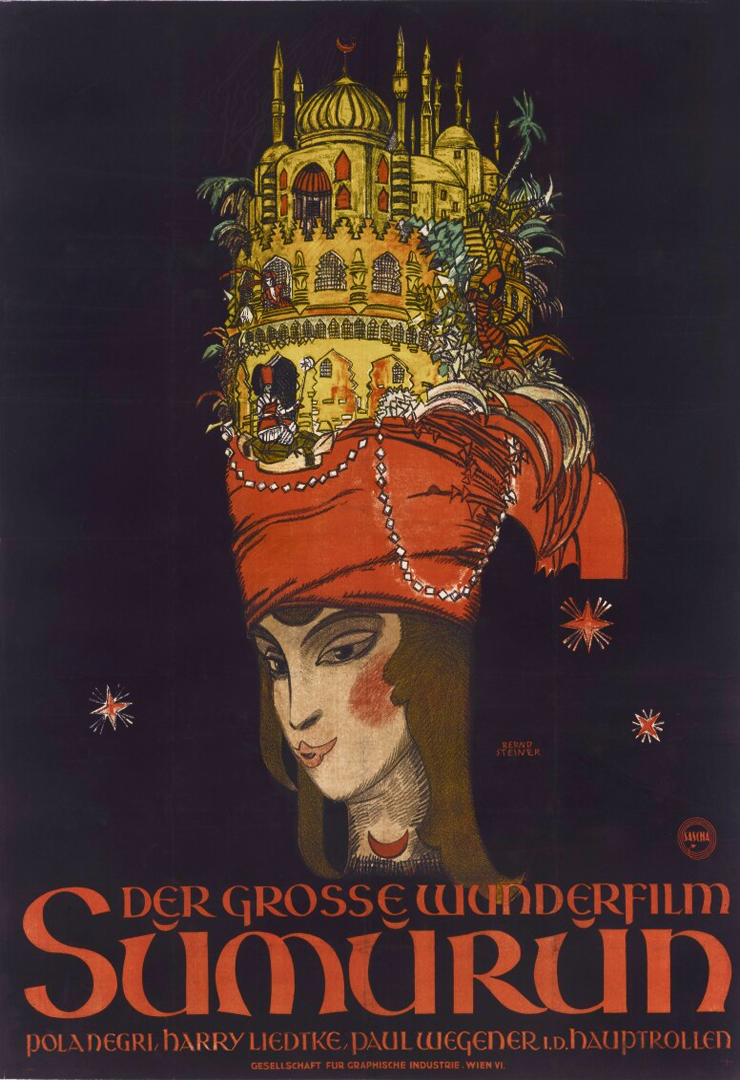
Film poster for Sumurun.
Source: https://letterboxd.com/film/sumurun/
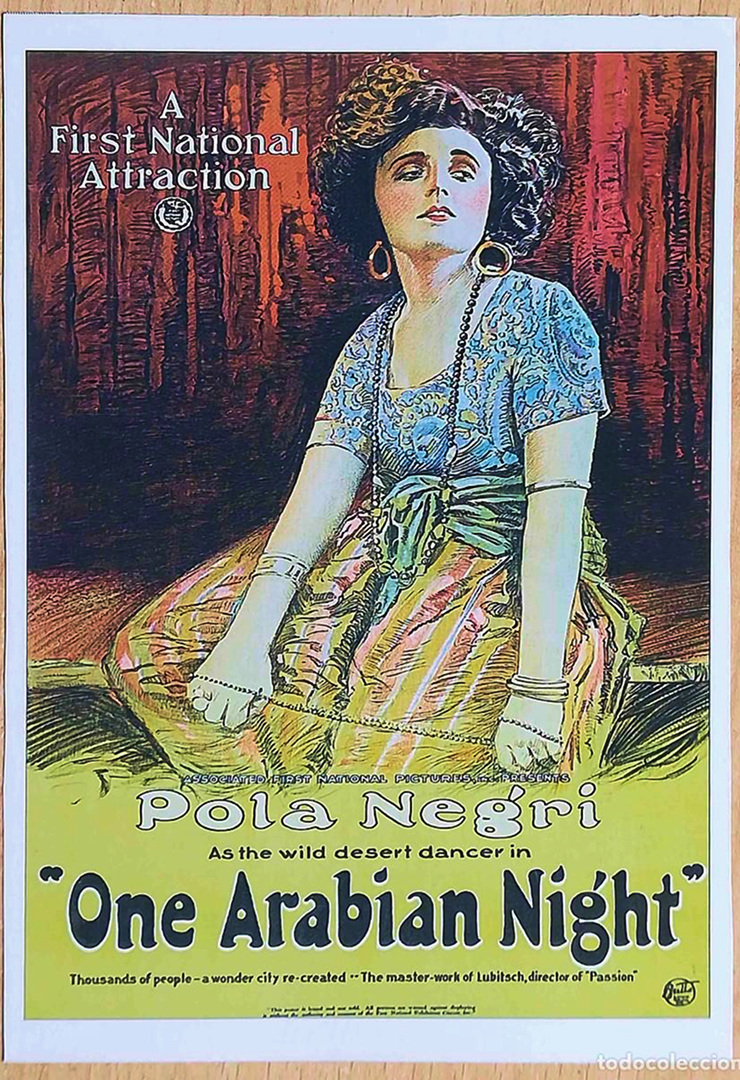
Film poster for One Arabian Night.
Source: https://www.filmtv.it/film/37075/sumurun/
1 Zabastovka v klube "Loto". Lovkiye del'tsy [Забастовка в клубе «Лото». Ловкие дельцы; Strike in Club “Lotto”. Shrewd operators], Zvezda [Звезда; Star], No. 137 (1439), 14 Jun. 1923.
2 Protokol №15 Zasedaniya Prezidiuma Mingubotdela Soyuza RABIS [Протокол №15 Заседания Президиума Мингуботдела Союза РАБИС; Minutes No. 15 of the Meeting of the Presidium of the Minsk City Department of the RABIS Union], 29 Jul. 1923. Natsionalny arkhiv Respubliki Belarus’ NARB [Национальный архив Республики Беларусь (НАРБ); National Archive of the Republic of Belarus (NARB)], Fond 307, Opis’ 2, Delo 2, p. 50.
3 Protokol №56 zasedaniya M. Prezidiuma Vitgubprofsoveta [Протокол №56 заседания М. Президиума Витгубпрофсовета; Minutes No. 56 of the Meeting of the Presidium of the Vitebsk Provincial Council of Trade Unions]. 30 Jun. 1923. NARB, Fond 265, Opis’ 1, Delo 682, p. 48.
4 Tsirkulyar № 82. vsem gubotdelam sovrabotnikov [Циркуляр № 82. Всем губотделам совработников; Circular No. 82. To all provincial departments for Soviet employees] Gosudarstvenny arkhiv Vitebskoy oblasti [Государственный архив Витебской области; State Archive of Vitebsk Oblast]. 24 Nov. 1923, Fond 3, Opis’ 1, Delo 210, p. 65.
5 Leyda, Jay. Kino: A History of the Russian and Soviet Film. George Allen & Unwin, 1960, p. 166.
6 Alanen, Antti. “Dziga Vertov III, GCM Sacile 2004,” Film Diary. 10 Oct. 2004. anttialanenfilmdiary.blogspot.com/2004/10/dziga-vertov-iii-gcm-sacile-2004.html/ Accessed 10 Jul. 2026.
7 Trotsky, Leon. “Vodka, the Church, and the Cinema.” Pravda, 12 Jul. 1923, Marxists.org, translated by Sally Ryan. www.marxists.org/archive/trotsky/women/life/23_07_12.htm./ Accessed 20 Aug. 2026. English version.
8 Vostochnaya nega [Восточная нега; Eastern Languor], Zvezda [Звезда; Star], No. 162 (1464), 14 Jul. 1923.
9 “The Pearl of the Harem.” Kinorium. https://ru.kinorium.com/10851/ Accessed 20 Aug. 2026. English version.
10 "Sumurun”. A Cinema History: A chronological review of the best films worldwide. https://www.acinemahistory.com/2014/11/sumurun-1920.html Accessed 15 Sept. 2026.