
Vitebsk as an Art Center
After the Revolution
We have spoken before of the long history of Vitebsk and the cinema. (see our first article, here). Post-October Revolution, Vitebsk became a revolutionary art center. Anyone who has been in the city is aware of its history as the birthplace of artist Marc Chagall. He was in Paris at the time of the revolution, with a friend, Anatoli Lunacharsky (yes, the same man who became head of the Commissariat of Education), but returned after the February 1917 revolution.1
In November 1918, the Communists celebrated the one-year anniversary of the Bolshevik Revolution. Of course, with the change in calendar in February 1918, the anniversary of the October Revolution was now celebrated in November, the result of changing from the old Justinian calendar to the Gregorian calendar, which was used in the West. Vitebsk historian Tatyana Kotovich writes that the celebration ran from noon on November 6, through 1 in the morning on November 9.2
Dziga Vertov, who created Kino-Nedeliya [Cinema Week], had a camera operator there, if he wasn’t there himself, to film the celebration which included a parade.
Kino-Nedeliya
By August of 1918, Chagall was back in his hometown of Vitebsk and was named as Fine Arts Commissioner of the Vitebsk region. He ended up designing decorations for the November anniversary celebration.
Unfortunately, the scenes in the newsreel do not show any of the art created by Chagall for the parade. Still, there is at least one photograph that includes his art.3
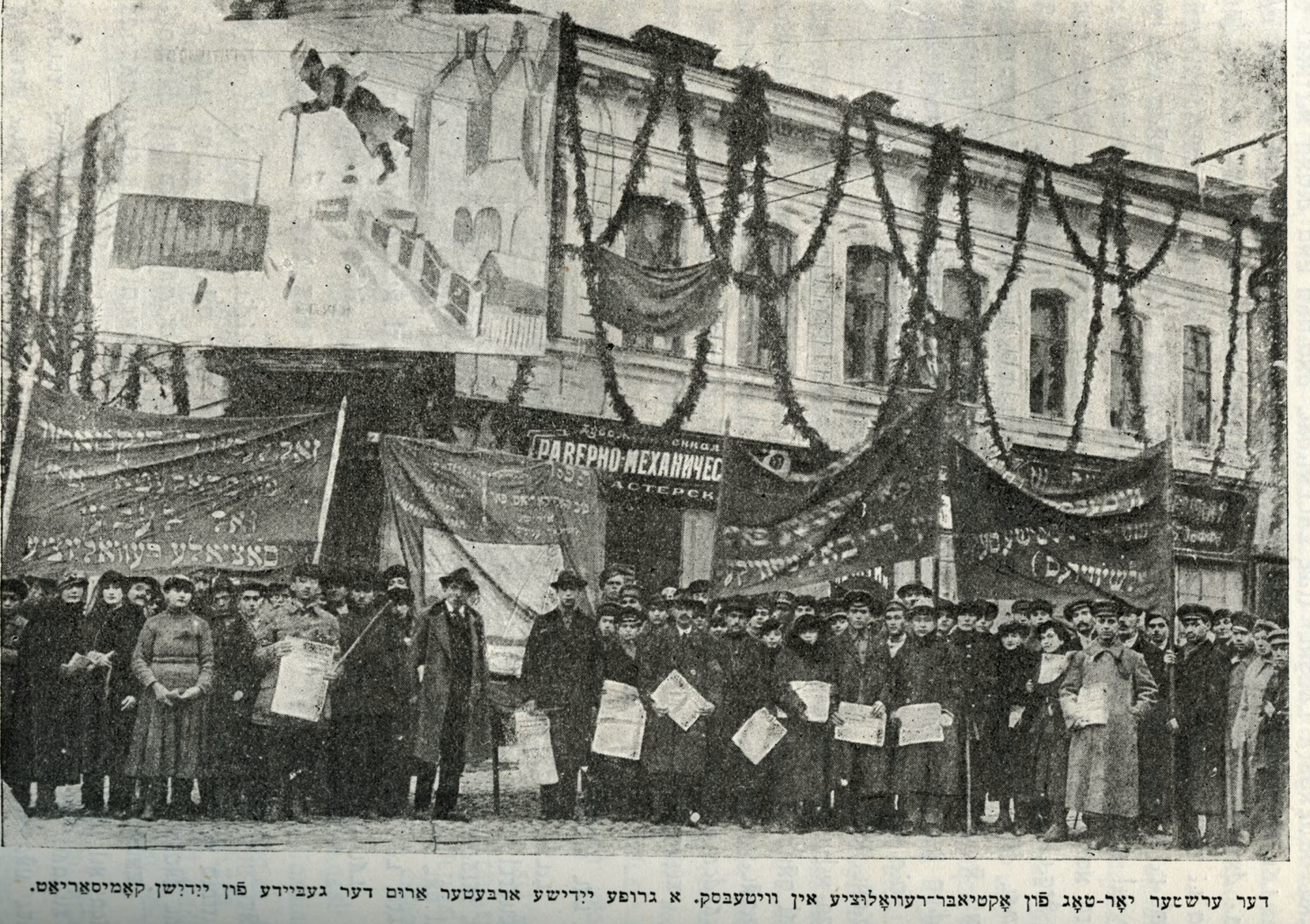
The caption of the photograph is in Yiddish. In English, it says "The first anniversary festival of the Communist Party Committee in Vitebsk. A group of Jewish workers on the street greeting the Jewish Communists."
The Chagall work is the poster on the upper left hand side, with his recognizable “flying Jew” motif.
Source: https://moviessilently.com/2024/10/13/the-queen-of-spades-1916-a-silent-film-review/
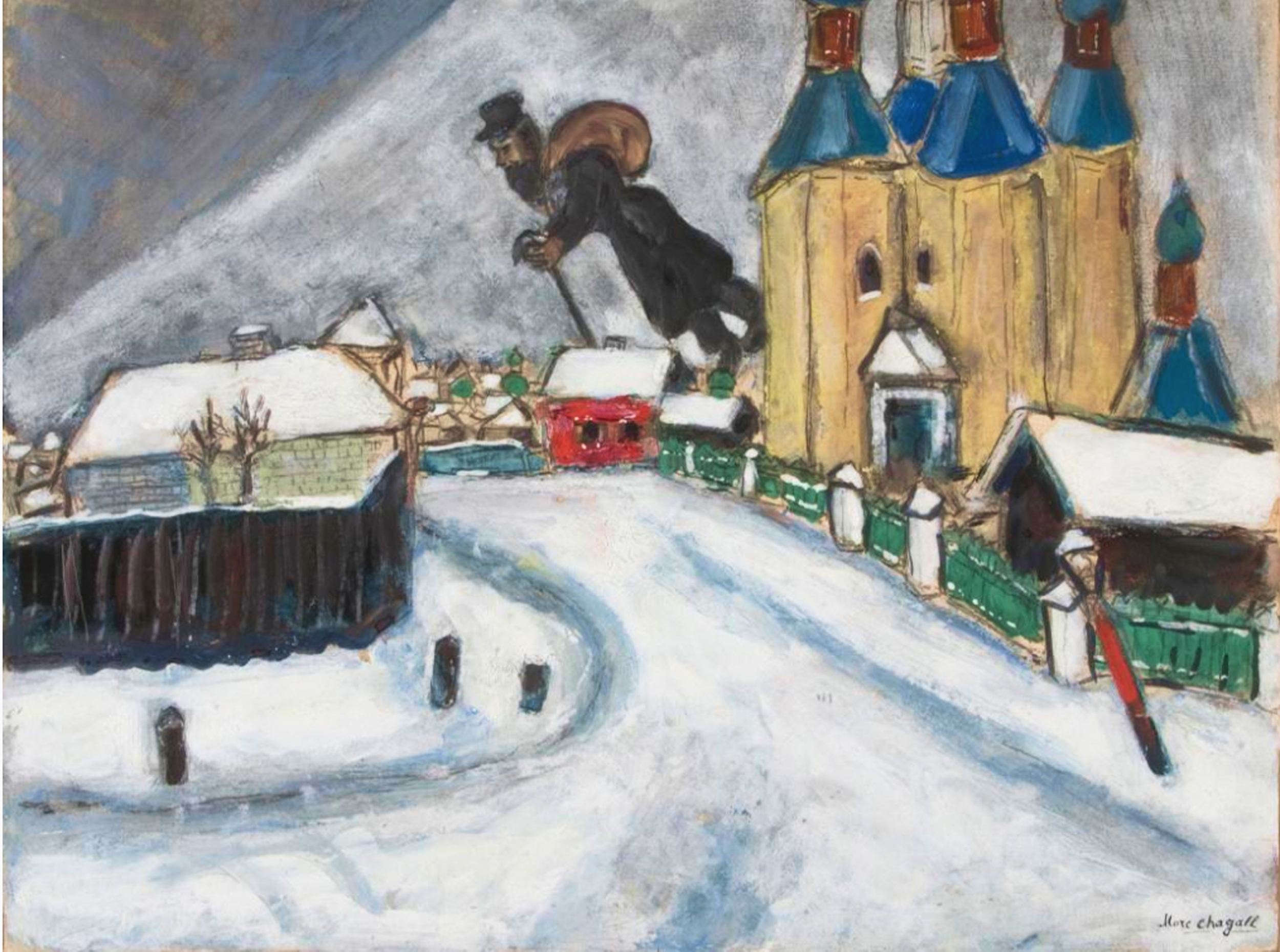
This is Chagall’s Over Vitebsk (Ca. 1914).
You can again see here the motif of the “flying Jew.”
Source: https://www.philamuseum.org/objects/59474
Chagall wrote about his feelings on being part of the celebrations, and how his art was, or was not, received by Communist authorities.
Here, like in other cities, we were preparing to celebrate the holiday; we had to hang posters and slogans in the streets. There are plenty of painters and sign makers in Vitebsk. I gathered them all, from the smallest to the oldest, and said:
— You and your children will become students of my school for a while. Close your workshops. All orders will come from the school, and you will distribute them among yourselves.
Here are a dozen samples. They need to be transferred to large banners and hung on the walls of buildings, both in the city and on the outskirts. Everything must be ready by the day of the demonstration with flags and torches.
All the masters — bearded as if selected — and all the apprentices began to redraw and color my goats and cows.
On October 25, the wind of revolution blew them up and rocked them on every corner. The workers passed by singing the Internationale. Looking at their happy faces, I was sure that they understood me. Well, the authorities, the commissars, were, it seems, not so pleased. Why, pray tell, is a cow green and a horse flies through the sky? What do they have in common with Marx and Lenin? 4
November 6, 1918. Vitebsk, Vitebsk Region, Belarus
For those not familiar with Chagall’s work, we cannot find any other pictures of the posters or banners, so we cannot show you a green cow or a flying horse. How about a green horse?
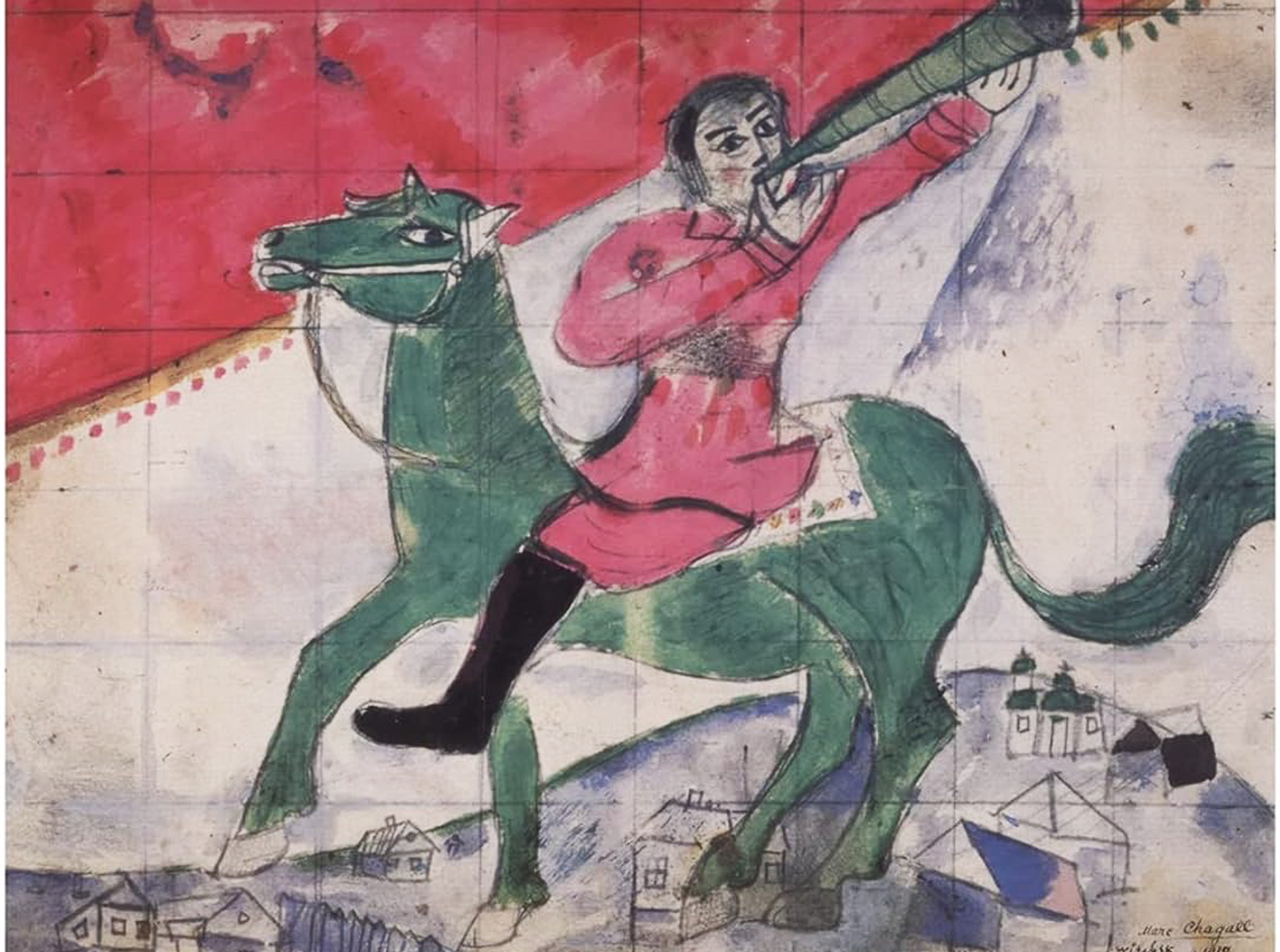
Marc Chagall’s, “The Rider”, 1918.
Source: https://www.judaicawebstore.com/-the-rider-1918-marc-chagall-poster-p4919?srsltid=AfmBOoqYgyOXwF9gkDJPZDV0KSnCtaiO3-kLeoXHUAxYTqlySWO0zVqP
1 “Biography”, Marc Chagall. https://www.marcchagall.com/en/biography Accessed 20 May 2026 (English language page).
2 Kotovich, Tat'iana V. "Krasnaia godovshchina: fil'm 1918-go goda" [Красная годовщина: фильм 1918-го года; Red Anniversary: A 1918 Film]. 95 let belorusskomu kino: istoriia, sovremennost', perspektivy: materialy Mezhdunarodnoi nauchno-prakticheskoi konferentsii [95 лет белорусскому кино: история, современность, перспективы: материалы Международной научно-практической конференции; 95 Years of Belarusian Cinema: History, Modernity, and Perspectives: Proceedings of an International Scientific-Practical Conference], compiled by A. A. Karpilova, Minsk, 11–12 Dec. 2019, [Publisher if found], 2021, pp. 70–98.
3 “Biography”.
4 “My Life”, Memoirist https://memuarist.com/ua/events/49979.htm Accessed 20 May 2026.