
Belarus in the U.S.S.R.
1923
As January 1, 1923, dawned, things were the same, but different, in the Belarusian Socialist Soviet Republic. On December 30, 1922, the SSRB signed the Dogovor Ob Obrazovanii Soyuza Sovetskikh Sotsialisticheskikh Respublik [Treaty on the Formation of the Union of Soviet Socialist Republics] as the Belarusian Soviet Socialist Republic.1 (Note the slight name change.) It was now part of the USSR.2 The agreement “empowered the USSR to represent the BSSR in the entirety of its international relations.”3
Six years of fighting (1914-1920. This includes World War I and the Civil War/Polish Border Wars) had left devastation. There was little food, little money, and little medicine. There were tens of thousands of refugees from both East and West (those who did not want to live under Polish rule. Remember, the Western border was just outside Minsk.) In responding to the Soviet appeal for worldwide help, the American Friends of Soviet Russia (among other groups), and later the American Relief Administration (the ARA, which started its work in January 1923), provided large amounts of food, shelter and medicine.
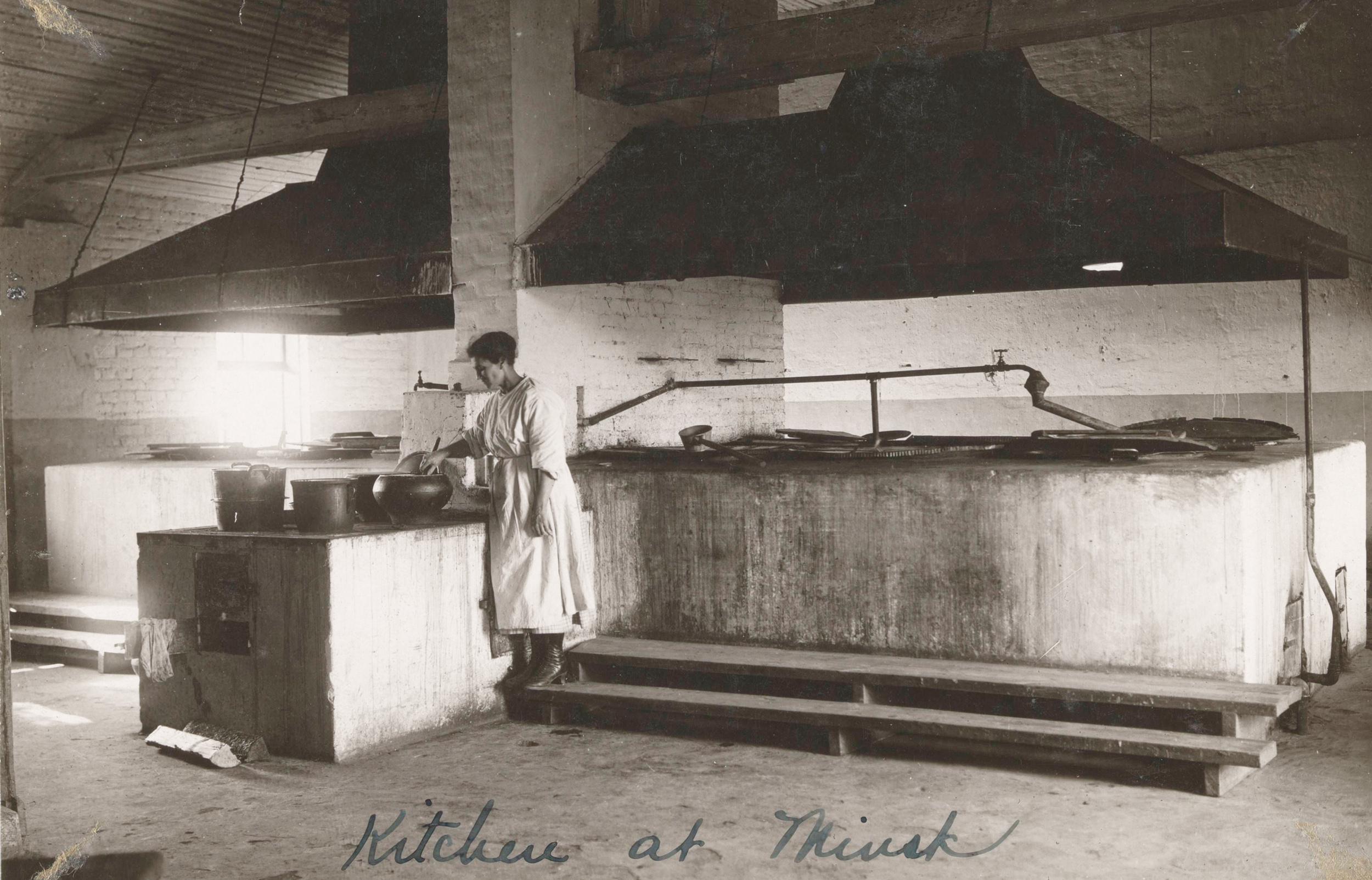
Child Feeding, Minsk.
Source: American Relief Administration Russian operational records, Hoover Institution Library & Archives. https://n2t.net/ark:/54723/h3vp83
There was also a program in which the ARA helped guide those with friends and relatives in the U.S. or Europe to get help from them. Alexander Lukashuk, in his book Adventures in Belarus with the ARA,4 wrote of it.
Do you have friends or relatives in America or Europe? If so, come to the ARA office in Minsk, where they will explain how to receive a parcel of goods for 90 rubles.
The girls demonstrated the wealth that easily turned a rabble into a respectable person. The parcel set included woolen material for one suit or dress with lining, buttons and other accessories. To this was added canvas for two pairs of underwear, flannel for two men's shirts or two women's blouses. Threads, needles, buttons and the entire bottom for sewing underwear were also included. (The parcel of goods, including delivery, cost the American senders $20. At the Minsk market, the parcel was resold for twice as much.)
The advertising campaign continued throughout Belarus. The girls worked in Minsk shop windows from 9 am to 10 pm; posters-interpreters were spread in all ARA offices, and notices were printed in the press.
The railway management promised Willoughby to hang posters at each of its 51 stations; it was possible to agree with the directors of cinemas that slides with ARA advertising would be shown before the start of the screenings; the same agreement was concluded with the local theatre troupe.
Adventures in Belarus with the ARA, p. 204-5.
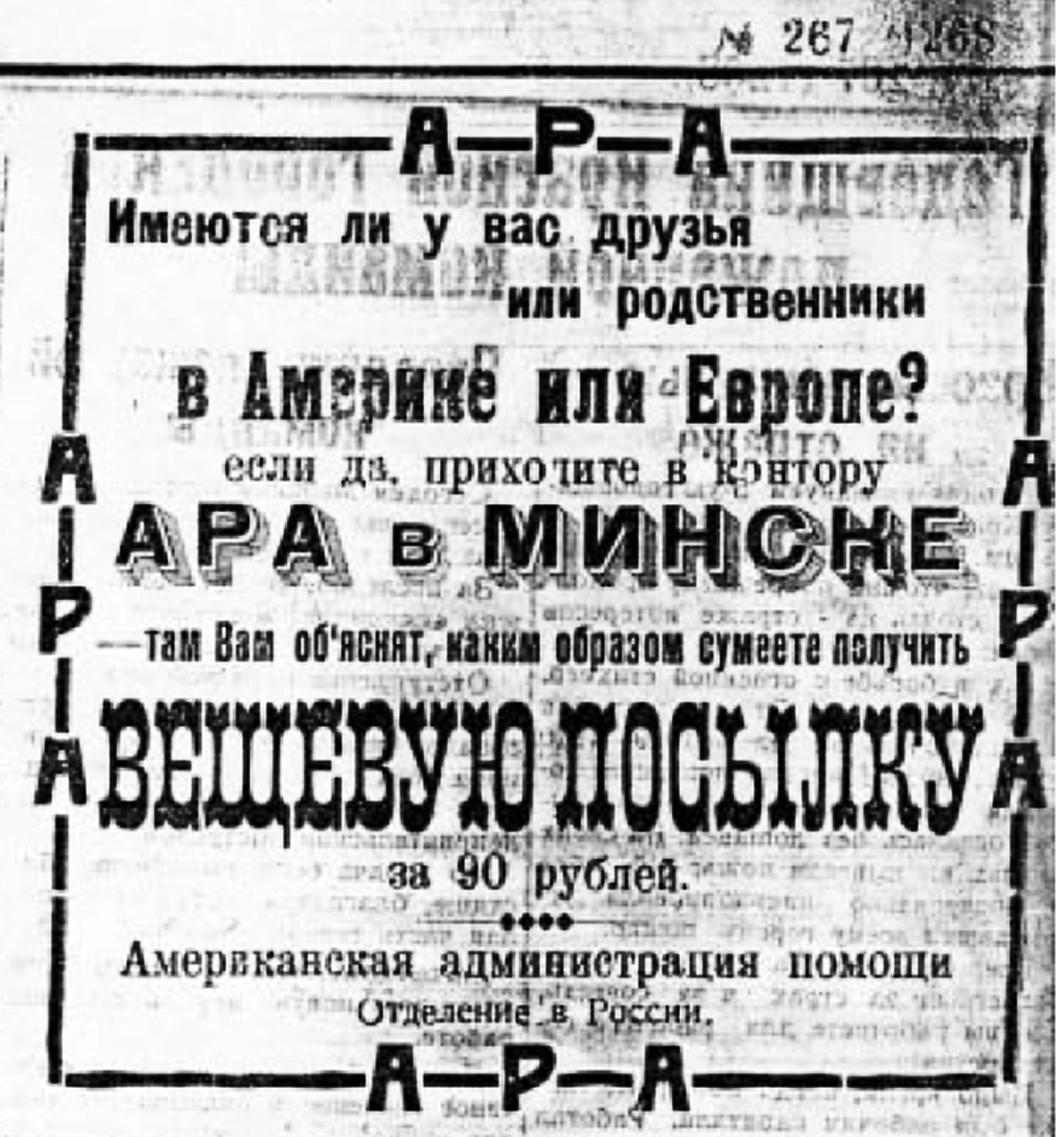
Copy of original ad, probably from Zvezda. The issue numbers, 267 and 1268, correspond to Nov. 11, 1922.
Source: Adventures of the ARA in Belarus, p. 205.
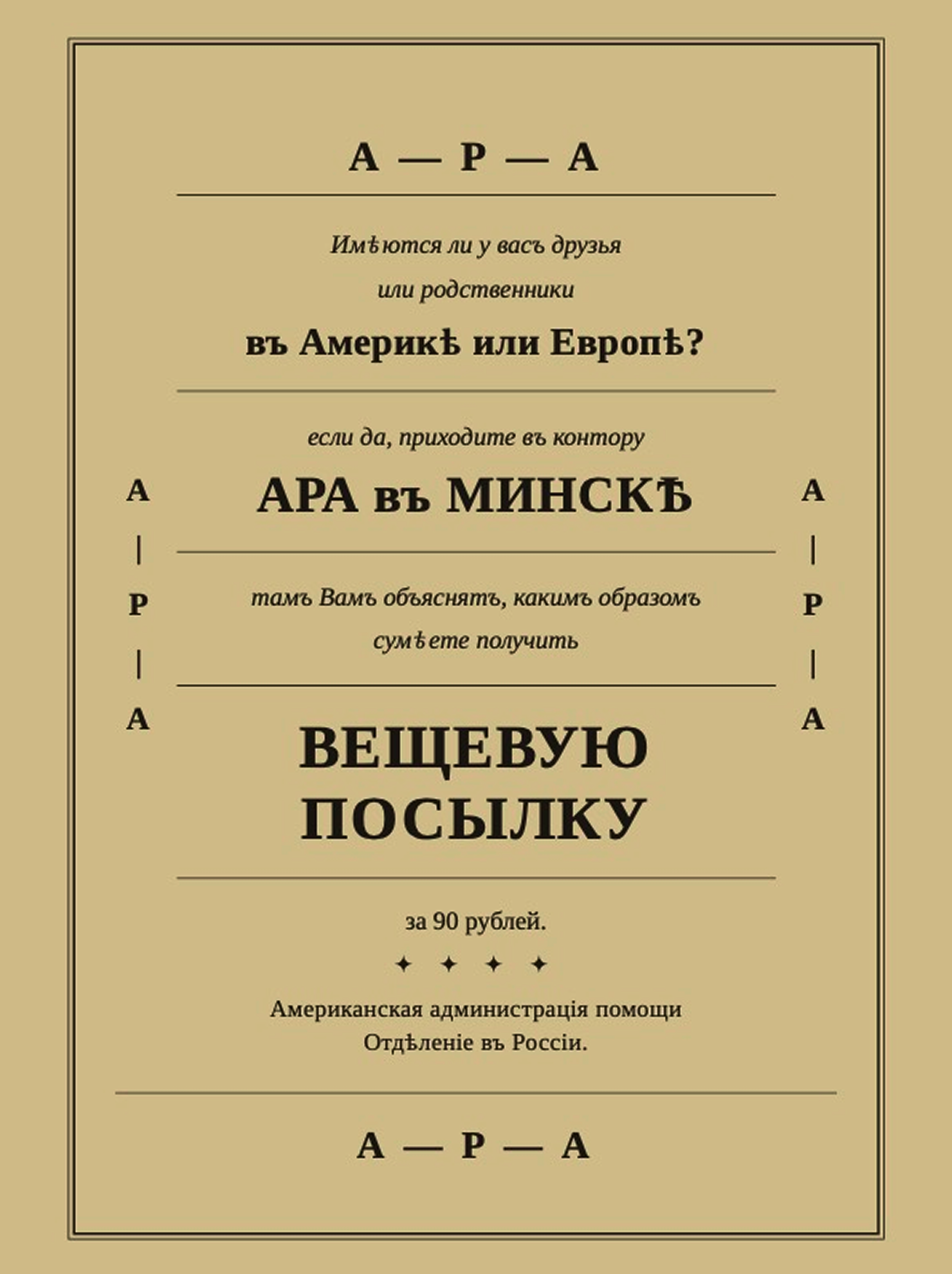
AI reproduction of the original ad.
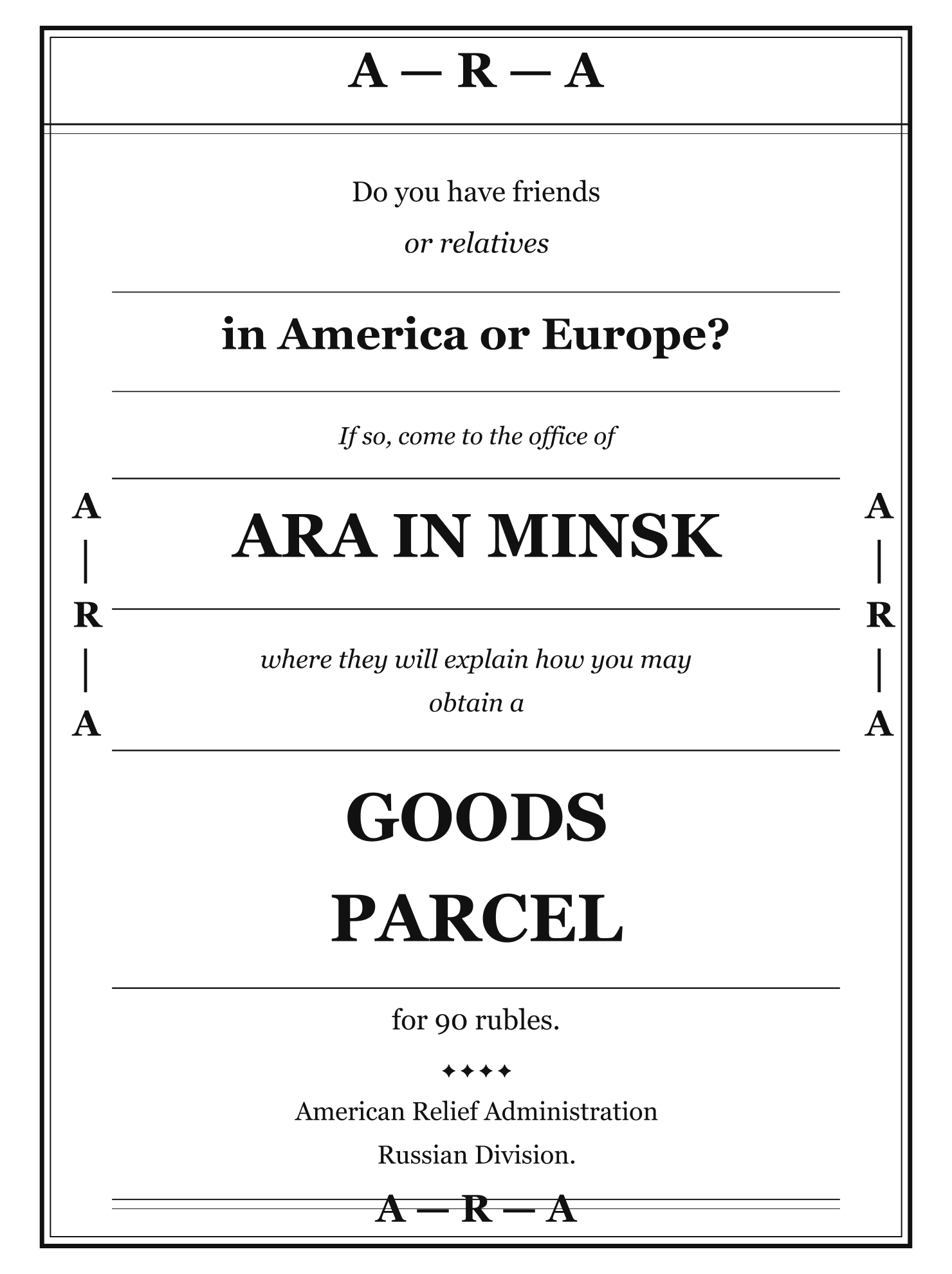
English translation of the original ad.
There is a sample footage from other areas the ARA served, but we have found none of Minsk. The particular film below is from 1923. There is a bit of arrogance in the intertitles.
America's Gift to Famine Stricken Russia
Showing advertising slides in the cinemas was not all we know of the ARA in the BSSR. There was a battle with unions. Lukashuk, in Adventures in Belarus with the ARA, described how the ARA made it a point to NOT deal with unions. Some of the locally-hired ARA employees went on strike and demanded that certain Americans leave Belarus after an incident.
The official authorities on the ground, however, remembered well the intra-party political struggle over the trade unions, which had lasted the entire previous year and had ended in a crushing defeat for part of the top party leadership. It was necessary to be careful — the Americans would leave, but the trade unions would stay.
Adventures in Belarus with the ARA, p. 209.
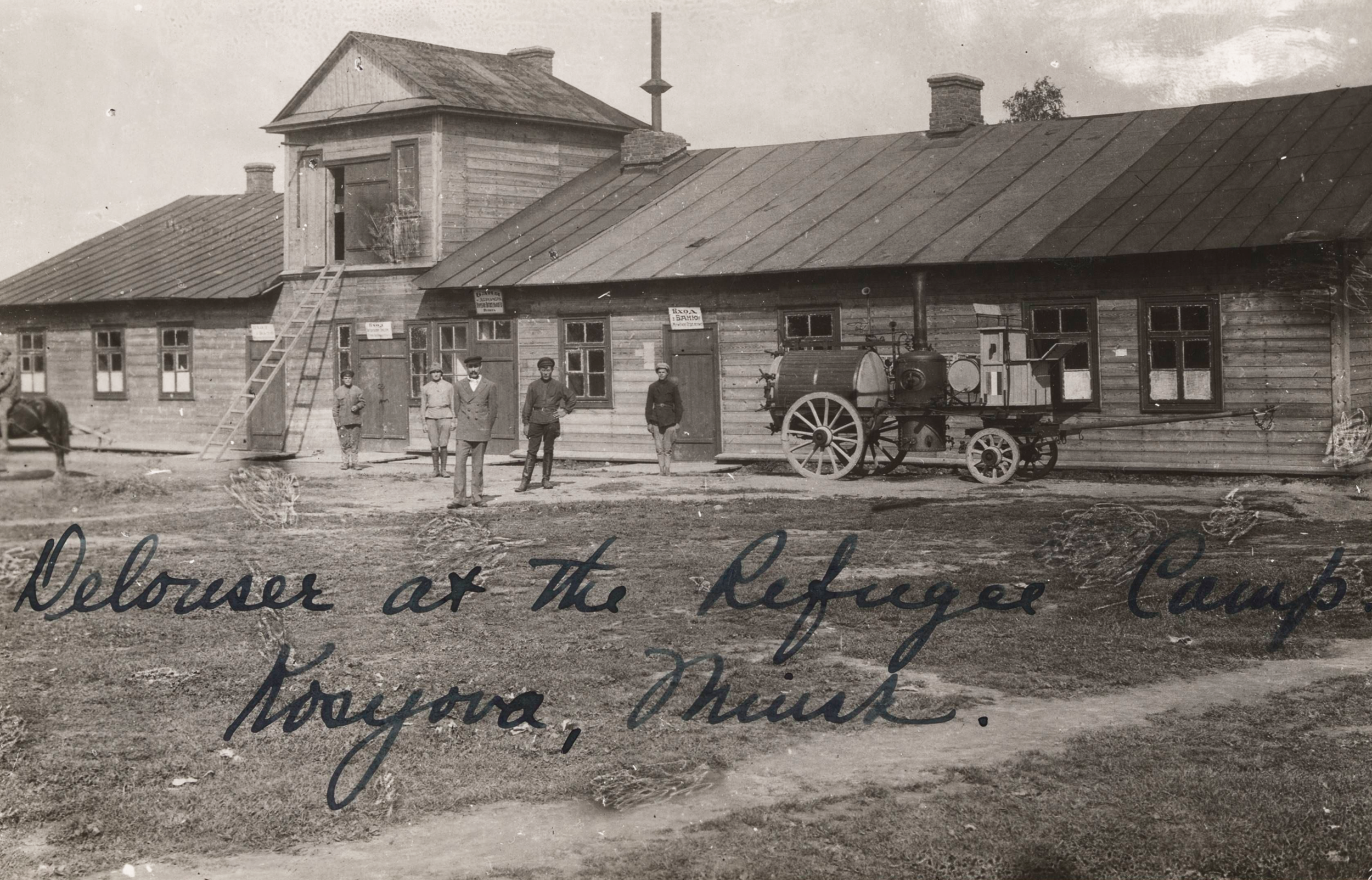
Medical relief. Delouser at the Refugee Camp. Minsk.
Source: American Relief Administration Russian operational records, Hoover Institution Library & Archives. httphttps://n2t.net/ark:/54723/h3mp8x
Those last two sentences give us some insight as to why the Belarusian Narkompros (the Commissariat of Education) might have given in after an audit by the Rabkrin (the Workers and Peasants Inspectorate) and dismantled Kinoresbel six months after it began work. (Kinoresbel was the Belarusian government run film trust that was dissolved in November 1922, less than six months after opening. (See here.)
On December 19, 1922, the Sovnarkom (Council of People's Commissars), established Goskino as a central cinema organization to control film distribution throughout Russia.5 Although any Belarusian film organization was not directly in the chain of command on paper, Belarusian authorities would follow Moscow’s lead.
There are only two mentions of film screenings in January 1923 that we could find. The Minsk-based newspaper Zvezda [Star] reported on January 12, 1923, that the Edem [Eden] was going to show the film Oktyabr'skiye torzhestva v Minske [October Celebrations in Minsk].6 This is probably the result of the filming announced in October. (See here.)
On January 19, 1923, Zvezda reported that the Krasnaya Zvezda [Red Star] cinema would show Priscilla Dean in Nishchaya iz Stambula [The Beggar of Istanbul]. As far as we know, this film was released everywhere else as The Virgin of Stamboul. Zvezda described it as “striking” for its “massive achievements in the field of cinema technology.7 The following advertisement probably did NOT make it into the U.S.S.R.
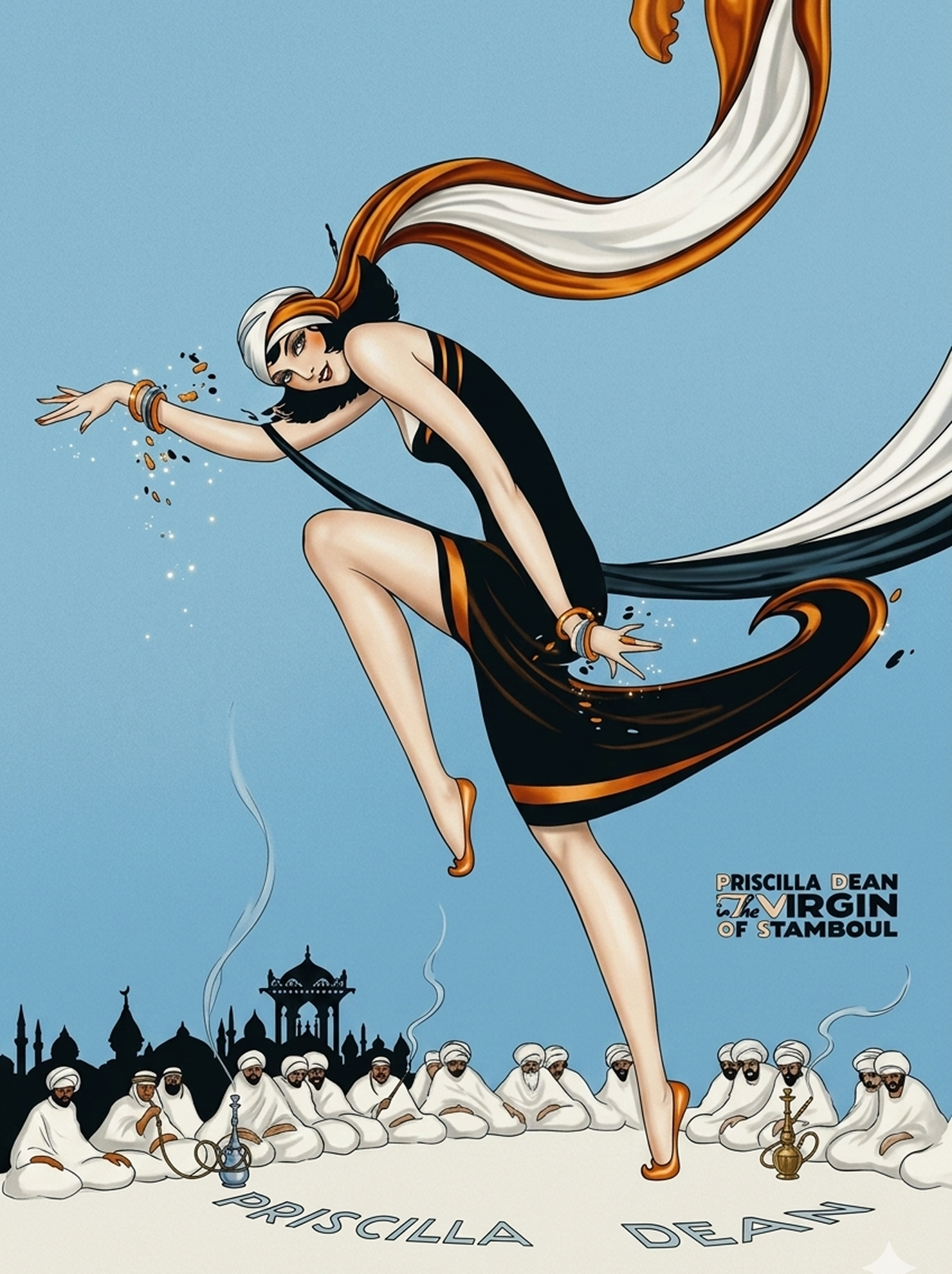
As far as we know, this page only ran once, in Moving Picture World, May 8, 1920, p. 767.
The one copy of the magazine available online, on Internet Archive, is missing that page. We slightly enhanced the print. We found an online auction site that showed the picture and its location. .
Source: https://www.worthpoint.com/worthopedia/moving-picture-world-exhibitor-1838899774
The Virgin Of Stamboul
1 Rudling, Per Anders. The Rise and Fall of Belarusian Nationalism, 1906-1931. University of Pittsburgh Press 2014. On page 5 he writes that in 1919 it was the Savetskaia Satsyialystychnaia Respublika Belarus [Belarusian Soviet Socialist Republic], and “from 1922” was the Belorusskaya Savetskaia Satsyialystychnaia Respublika [Belarusian Soviet Socialist Republic]. On page 131 Rudling writes that the abbreviation SSRB was changed to BSSR on December 30, 1922.
2 Dogovor Ob Obrazovanii Soyuza Sovetskikh Sotsialisticheskikh Respublik. 30 dekabrya 1922 g. [Договор об образовании Союза Советских Социалистических Республик. 30 dekabrya 1922 g; Treaty on the Creation of the Union of Soviet Socialist Republics. December 30, 1922]. Elektronnaya biblioteka istoricheskikh dokumentov [Электронная библиотека исторических документов; Electronic Library of Historical Documents] The Treaty lists Belarus as Belaruskaia Savetskaia Satsyialystychnaia Respublik. https://docs.historyrussia.org/ru/nodes/342350-dogovor-ob-obrazovanii-soyuza-sovetskih-sotsialisticheskih-respublik-30-dekabrya-1922-g. Accessed 19 June 2026.
3 “The Law of Treaties”, Ministry of Foreign Affairs of the Republic of Belarus. https://mfa.gov.by/en/policy/international_law/treaties Accessed 28 Jun 2026.
4 Lukashuk, Alexander. Pryhody Ara u Bielarusi [Прыгоды Ары ў Беларусі; Adventures of the ARA in Belarus]. Radio Free Europe/Radio Liberty 2005, p. 204.
5 Taylor, Richard. The Politics of Soviet Cinema, 1917–1929. Cambridge University Press, 1979; repr. 2008, p. 71.
6 "Minsk na ekrane" [«Минск на экране»; Minsk on the Screen], Zvezda [Звезда; Star], No. 9 (1320) 12 Jan. 1923.
7 “Nishchaya iz Stambula” [«Нищая из Стамбула»: The Beggar of Istanbul] Zvezda no. 15 (1316) 19 Jan. 1923.