
Antisemitism and Goskino
Other Factors Related to the Audit
There are still two issues regarding the RKI Audit of Kinoresbel to be discussed. First, is how Moscow’s changes affected Kinoresbel’s operations. In short, Kinoresbel was following Moscow’s lead. The second is whether antisemitism was a motivation for the audit.
Moscow’s Changes
Historian Vance Kepley, Jr., wrote about the situation in Moscow after the civil war. Belarusians can imagine a version of this happening in Minsk. To summarize, the decree of 1919 which “nationalized” the cinema encouraged studio heads (there were no studios we know of in Minsk) and theater owners to close up and remove usable assets.
If the theater owners were facing financial problems, they could just let the government take over the theaters…and the debts. The government then assumed responsibility for failed movie theatres, many of which were soon vandalized by city residents scavenging for wood and any other any usable materials during the worst privations of the Civil War.
Such conditions combined to make the ultimate task of rebuilding the exhibition infrastructure all the more daunting.1
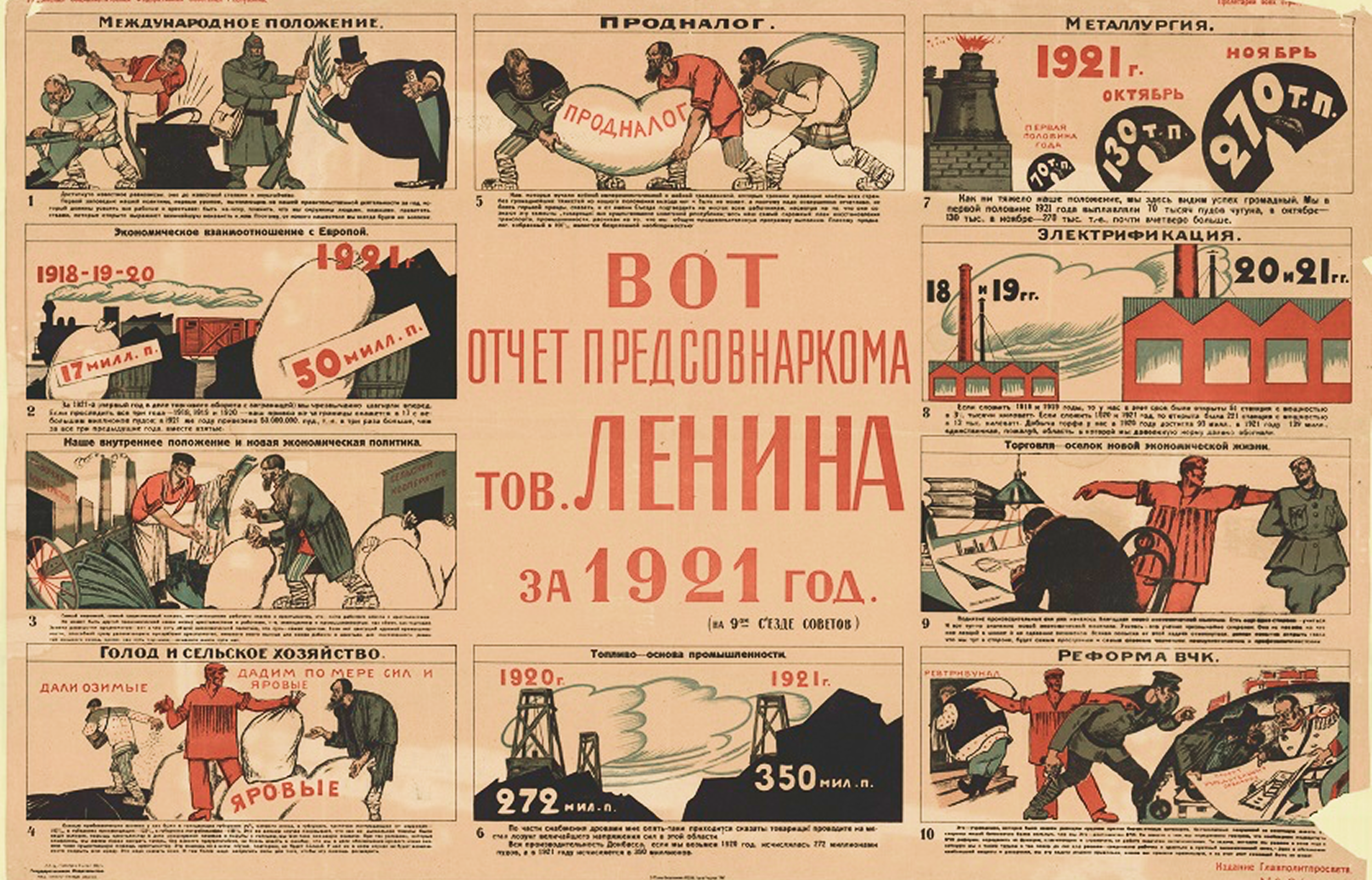
M. Cheremnykh. NEP-era poster “Here is the report of the Pre-Council Comrade Lenin for 1921".
Source: https://ls.pushkininstitute.ru/lsslovar/?title=Медиатека:Плакаты_времен_НЭПа
The NEP had started to revive the fortunes of the urban middle-class, the group which promised to have the disposable income to spend on movies. As the head of the Narkompros in Moscow, Anatoli Lunacharsky would eventually concede, the rehabilitation of urban commercial exhibition would benefit the entire film industry and support efforts to extend cinema to workers and peasants.
The Bolshevik government never had the resources to run those theatres in the first place and looked to others to assume the responsibility. Trade unions, city governments, film companies, and private individuals were among the entities which took over operation of commercial houses under NEP.2
Vance Kepley, Jr.
This, we think, supports the Narkompros response to the audit as “premature.” Kinoresbel did not have enough time to take control.
The Question of Anti-semitism
There is one last question that hangs over the audit of Kinoresbel in 1922. It is the same question that hangs over the inspection of the Photo-Kino Department in 1921. Were the authorities targeting Jews? The question has to be asked because the majority, if not the only people who seem to have suffered consequences in these two investigations were Jews.
The consequences themselves may be an indicator of intentions, but they are not determinative of them. There was evidence that Abram Liftshitz (Jewish) followed shady procedures when he was head of the Photo-Kino Department, although he presented much, if not all, of his dealings to authorities.3
Shlomo Schnittman (also Jewish) presented his contract to authorities for approval. And they accomplished their jobs, which was to navigate the post war mess to obtain films for the heaters over which the Photo-Kino Department had jurisdiction.
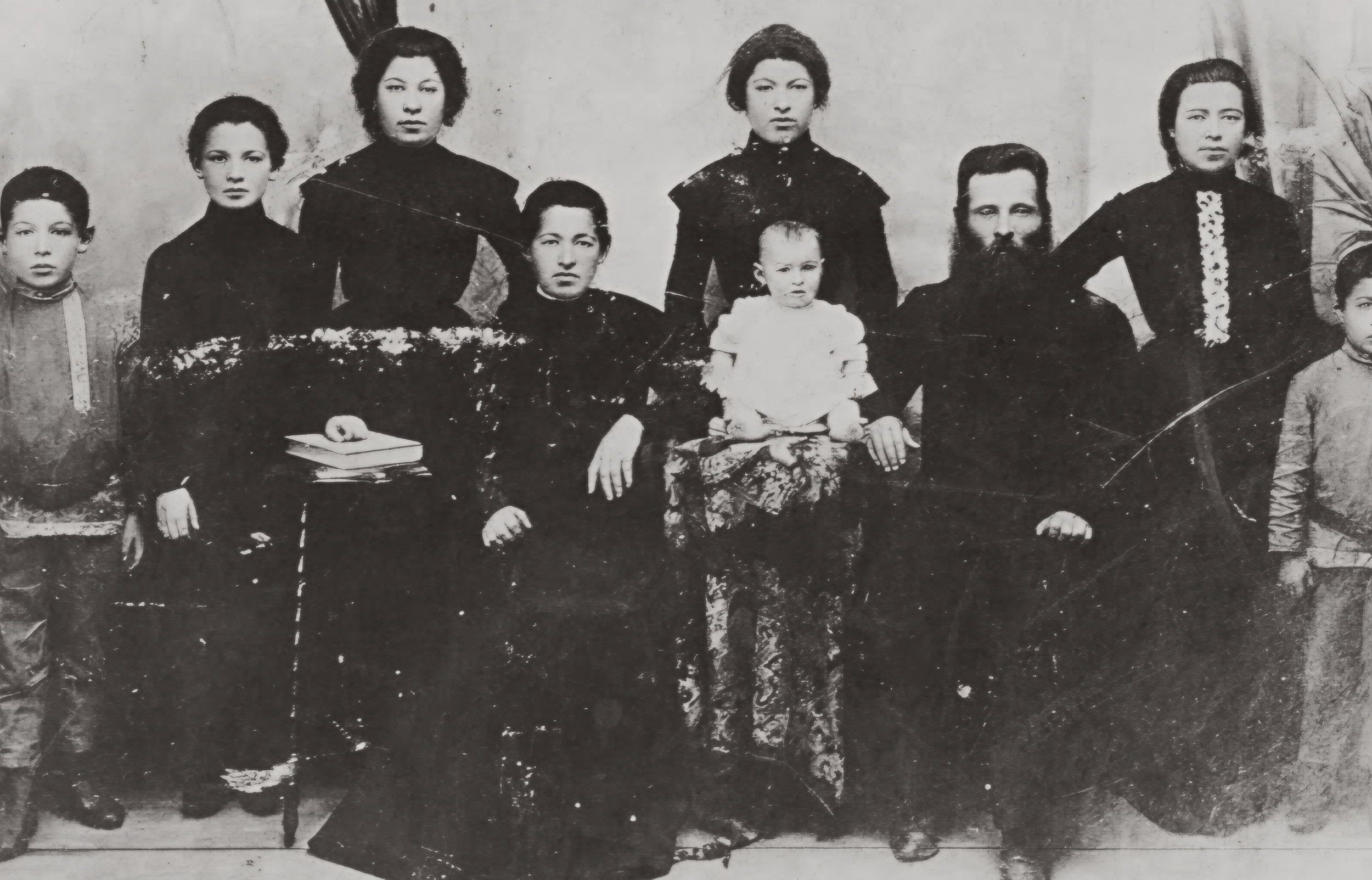
Jewish family. City of Mozyr, Belarus. Early XXth century.
Source: https://mozyrxxvek.blogspot.com/2013/10/blog-post_29.html
Nesterovich (not Jewish), the deputy head of the Photo-Kino Department, was deeply enmeshed within the Schnittman family (the daughter considered him her fiancé/husband) but was found to be a “pawn” in the scheme, not a participant.
In the case of Kinoresbel, the accompanying notes of Saikovsky and Shtein, shown above, made it clear that the audit team was aiming to get Dinershtein and Rakhlin (both Jews) fired.
Other notes indicate that at least one colleague, Gromov (not Jewish), spoke highly of Rakhlin, to wit: “I know him very little as a person, as a chief, he, in my deep conviction, was a fully trained and experienced leader. Our seats were next to each other.” 4
This statement could be an indicator that the audit was not based on Dinershtein and Rakhlin’s ethnicity, but something else. That something else was either personal, or, possibly, plans for Kinoresbel and the movie theaters. Statements by employees (see them here) indicated that because of the financial problems facing Kinoresbel, Dinershtein and Rakhlin may have been planning to either reduce pay or the number of employees in order to make the cinemas profitable.
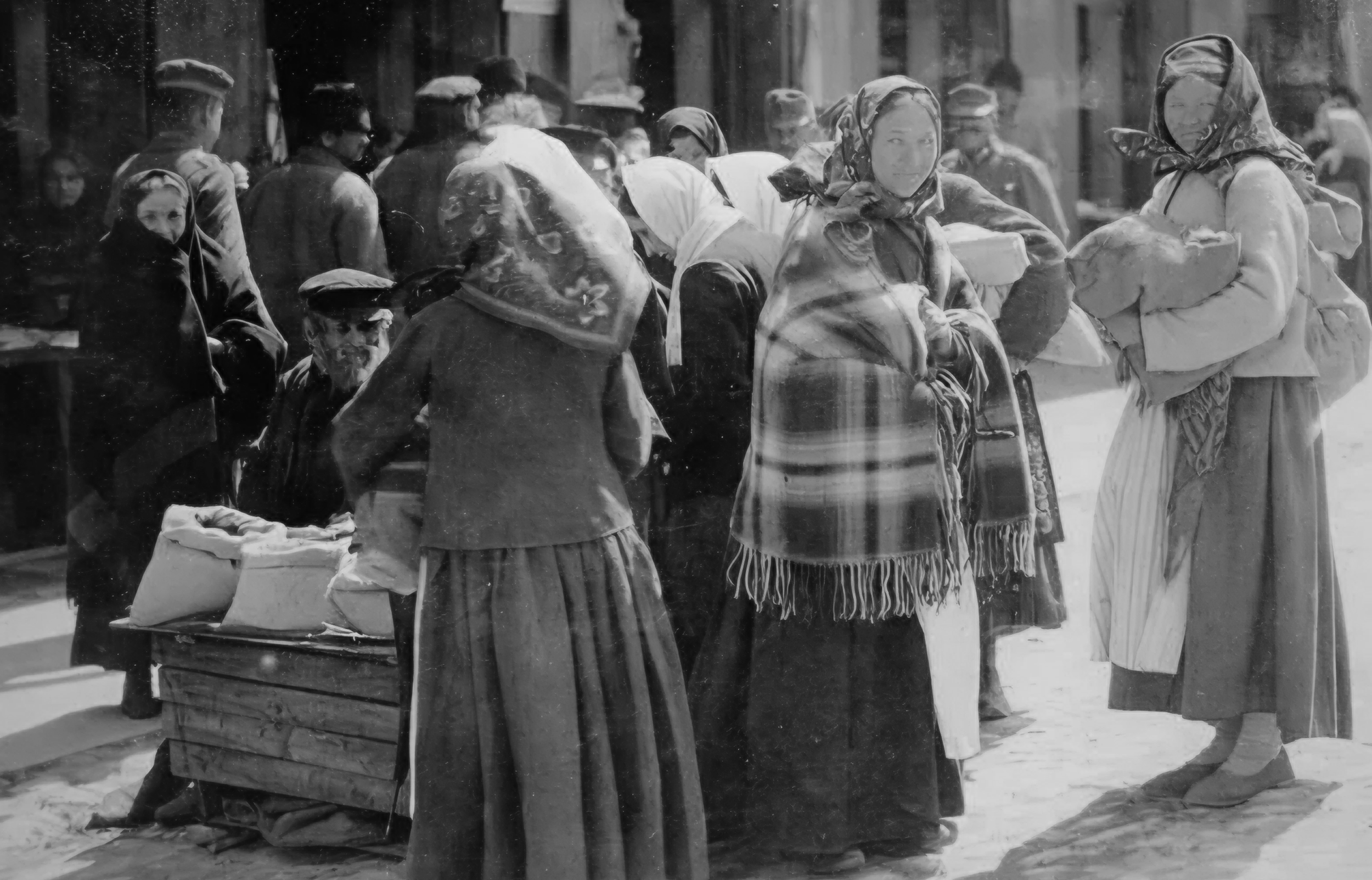
Jews at the marketplace of Slonim, Belarus. 1920.
Source: https://www.chabad.org/library/article_cdo/aid/7155106/jewish/12-Facts-About-the-Jews-of-Belarus.htm
That might have been enough to have the Workers and Peasants Inspectorate to call for the audit. Likewise, the audit could have been a back door play by Balitsky, the Deputy Head of the Narkompros [People’s Commissariat of Education], to get the cinemas into the hands of the City Education Department (the Goronov), which he wanted in the first place (see more here).
These two theories are only speculation, but they are solid enough to be alternates to any claims that the enemies were after Dintershtein and Rakhlin purely because of their ethnic backgrounds.
1 Kepley , Vance Jr. “’Cinefication’: Soviet Film Exhibition in the 1920s. Film History, Vol. 6, No. 2, Exhbition (summer 1994) p. 262-277. Indiana University Press. https://www.jstor.org/stable/3814971/ Accessed 3 Dec. 2020, citing Lebedev, N.A., Kino, - ego kratkaia istoriia, ego vozmozhnosti, ego stroitel'stvo v sovetskom gosudarstve [Кино - его краткая история, его возможности, его строительство в советском государстве; Cinema – its brief history, its capabilities, its construction in the Soviet state] State Publishing House 1924, 95-101; Gak, A.M. “Kinoorganizatsiia Petrograda v 1918-1925” [Киноорганизация Петрограда в 1918-1925 гг.; Film Organization in Petrograd, 1918–1925] Iz istorii kino 4 (1961): 64-68.
2 Kepley, Vance Jr. “’Cinefication’ citing I.N. Vladimirtseva and A.M. Sandler, eds , Istoriia sovetskogo kino, 1917-67 [История советского кино, 1917-6; History of Soviet Cinema, 1917–67] 4 vols. (Moscow: Iskusstvo, 1969-76) 1: 23; Economic Review of the Soviet Union 5, no. 1 (1930): 8.
3 «Докладная записка» [Memorandum] 2 Sept. 1921. Natsional’nyi arkhiv Respubliki Belarus’ [Национальный архив Республики Беларусь (НАРБ); National Archives of the Republic of Belarus (NARB)], Fond 42 Opis' 1 Delo 107 p. 96-96b.
4 «Pokazaniya po sushchestvu dela (Gromov)» [«Показания по существу дела (Громов)»; Testimony on the Merits of the Case (Gromov)] Undated. NARB Fond 14 Opis' 1 Delo 20 p. 121b-122b.