
The Minsk City Government Takes Over the Cinemas
1923, Part I
In January 1923, the Minsk cinemas did not advertise much in the Minsk-based Zvezda [Star] newspaper. Apparently, though, the movie business was alive and well.
On February 4, 1923, Zvezda reported that "80 000 verst pod vodoyu" (20,000 Leagues Under the Sea), an American film made in 1916, had completed its run at the Krasnaya Zvezda [Red Star]. Zvezda noted that it was impossible not to consider the picture with “satisfaction.”1
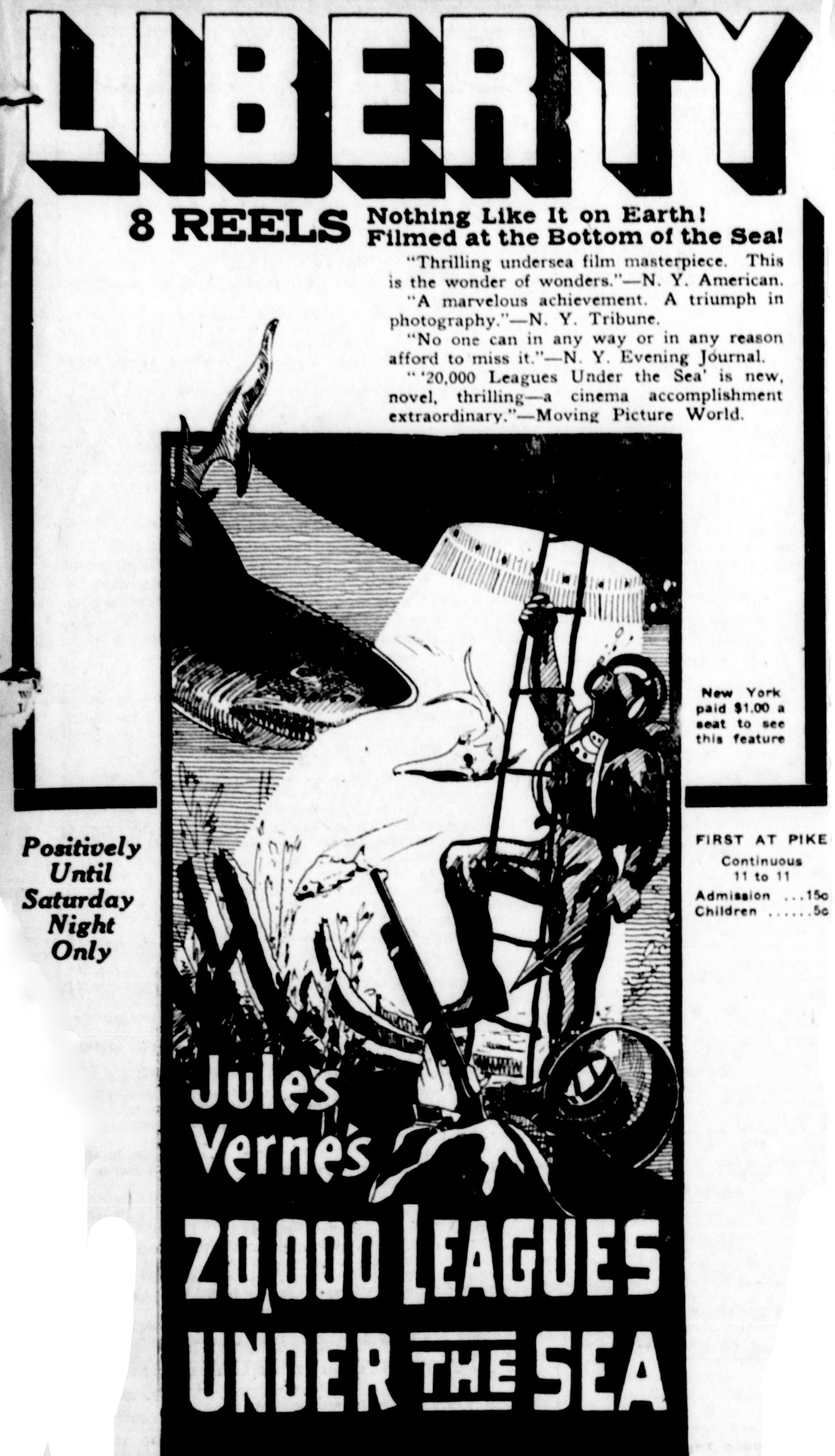
20,000 Leagues, newspaper ad, 1917.
Source: Universal Film Manufacturing Company, Public domain, via Wikimedia Commons.
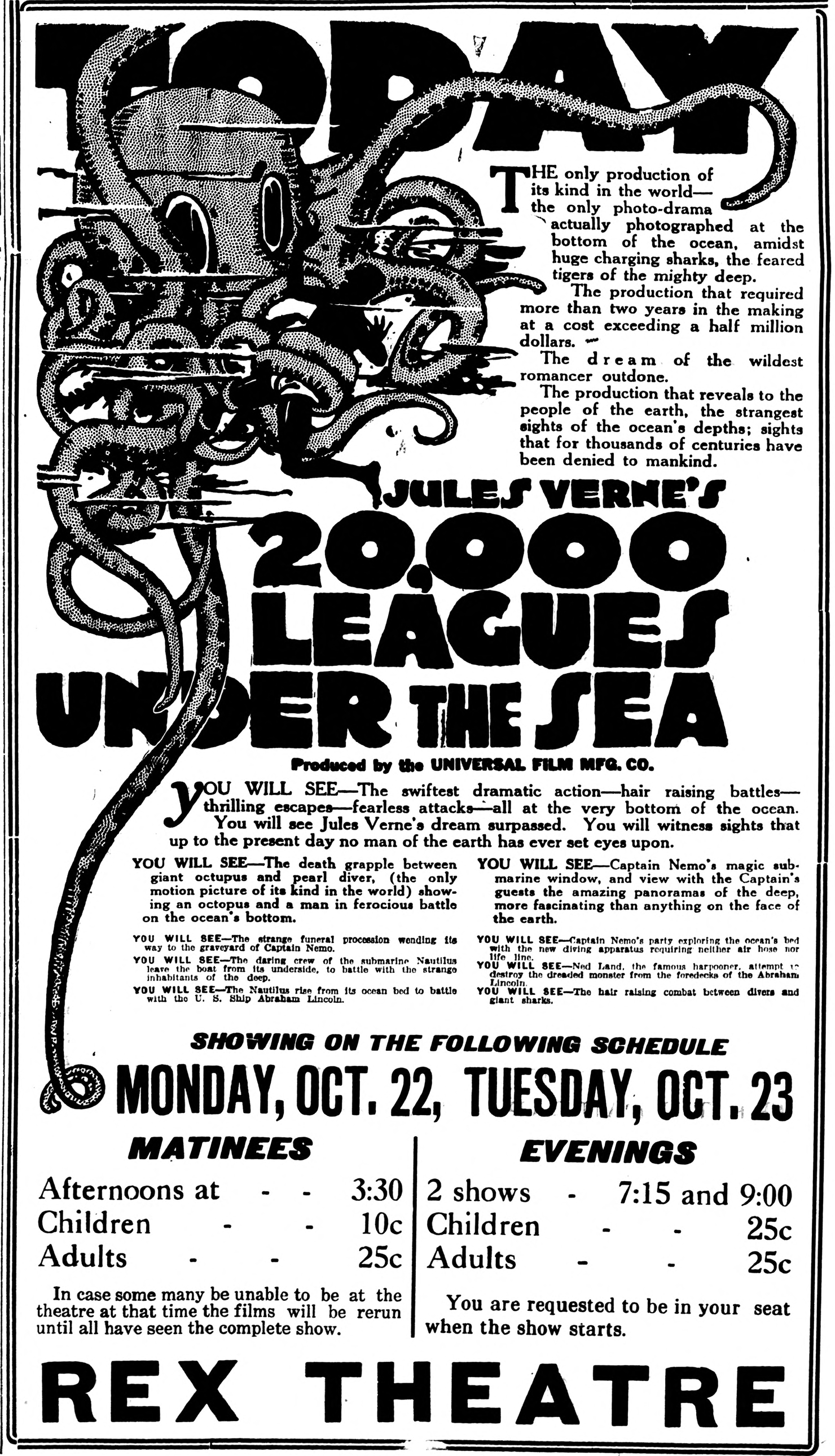
20,000 Leagues, newspaper ad, 1917.
Source: Universal Film Manufacturing Company, Public domain, via Wikimedia Commons.
20,000 Leagues Under the Sea.
By mid-February, it seems most of the Minsk cinemas were operating and advertising. The Illyuziya [Illusion], re-named the Proletariy [Proletarian], was closed, but it was the exception. The former Gigant [Giant] had been operating as the Red Star for quite some time. The Edem [Eden] was open as the Internatsional [Internationale].
In the summer of 1922, the Kul'tura [Culture] (formerly the Modern [Modern]), was shut down by Kinoresbel (the short-lived government organization that controlled the cinemas from June – November 1922).2 The Lyuks [Lux] had been shut down in 1921 and was still shut down as of December of 1922.3 But the Rabis (the Art Workers Union) claimed control of it in January 1923.4
By this time the Soviet Red Army ran two cinemas, the Grotesk [Grotesque] and the Spartak [Spartacus].5 The Grotesk seems to have been located in the section of Rakovschick House that had housed the cinema of erly Belarusian film mogul Richard Stremer in 19096 (See here). The Spartak was the new name the Red Army gave the Novyy teatr [New Theater].7
Comparing two military-run theaters to the Rabis cinema highlighted a problem with the Lenin New Economic Program (NEP), which called for cinemas to earn their own way.
The Grotesk and Spartak got good, if not the best, movies with which to draw paying customers. The International and Kultura also got popular older films. Given the deference the Red Army was given by the government, we can theorize that it got preference in deciding which films to show. Zvezda advertisements on Feb. 8, 1923, indicate the Grotesk and Spartak cinemas showing older movies with beautiful, well-known stars. The Grotesk screened the Italian film Princessa Fedora [Princess Fedora] (1916), starring Francesca Bertini.8
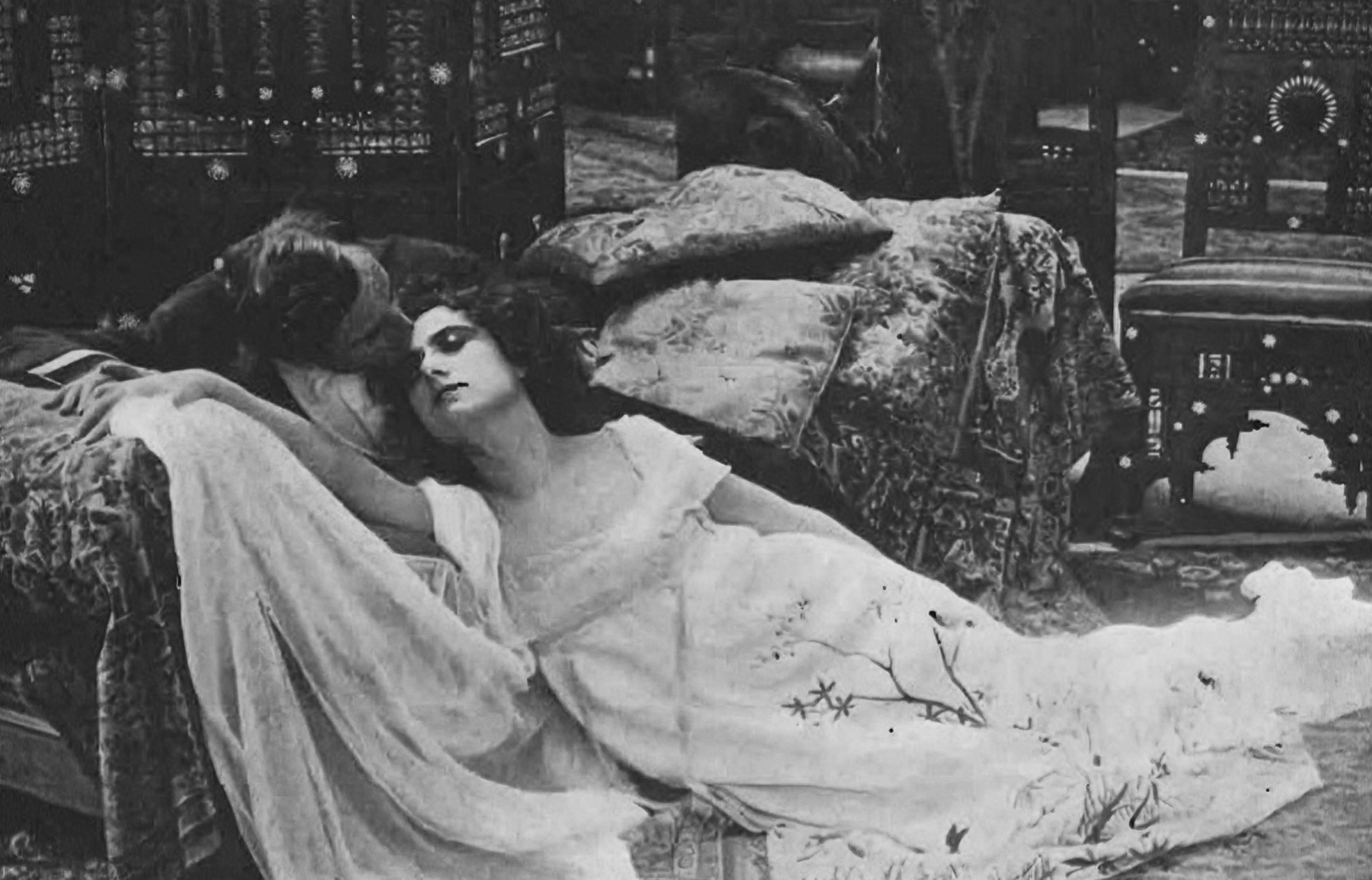
Fedora with Francesca Bertini.
Source: Public domain, via Wikimedia Commons.
Fedora, 1916.
The Spartak showed the relatively recent German film Die Abenteuer der schönen Dorette [The Adventures of Beautiful Dorette] (1921) with Hella Moja. The Russian-language title was Prekrasnaya Doretta [Beautiful Dorette].9

Hella Moja, the star of Beautiful Dorette.
Source: https://www.imdb.com/name/nm0596251/?ref_=mv_close
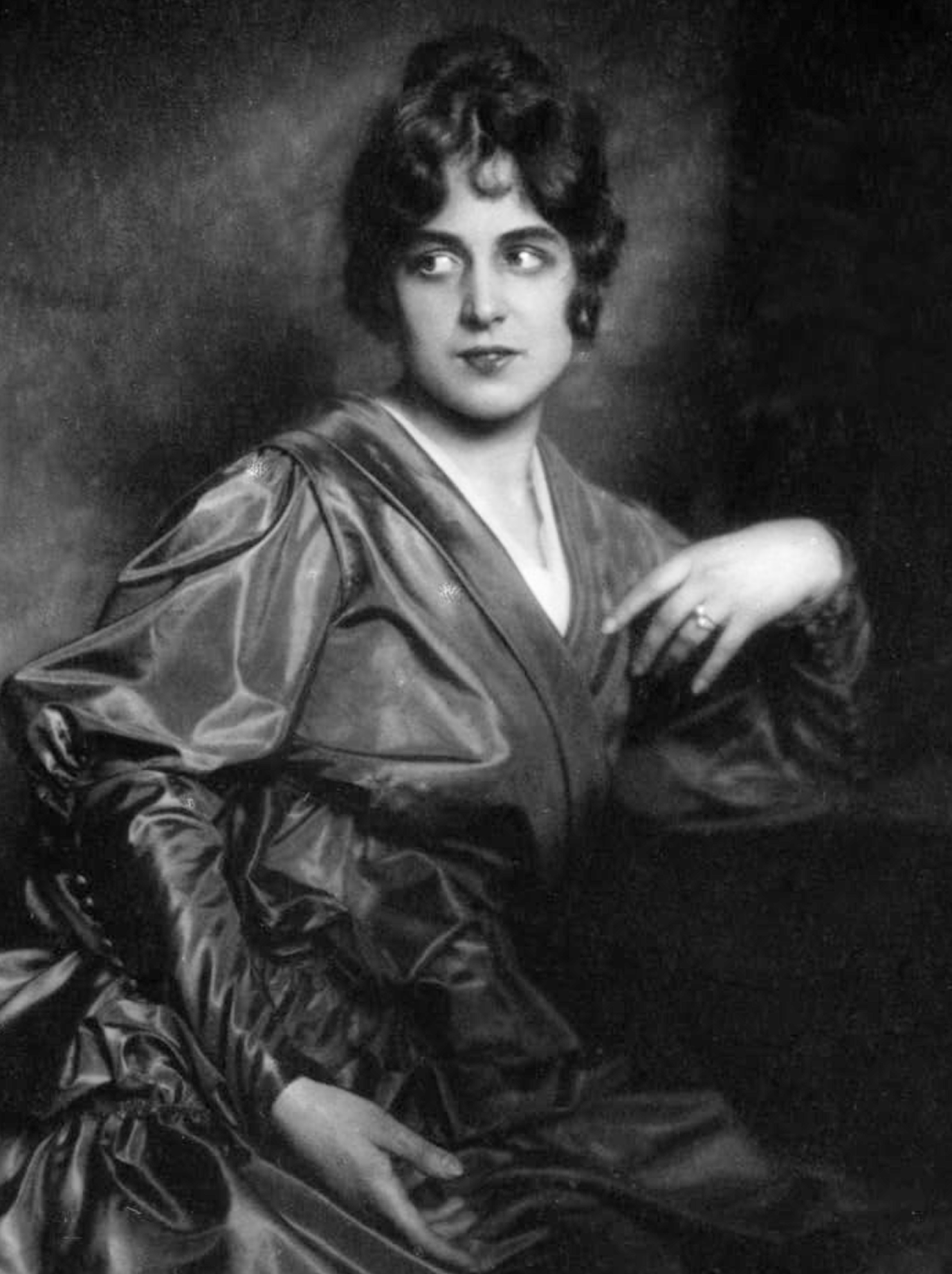
Hella Moja, the star of Beautiful Dorette.
Source: https://www.imdb.com/name/nm0596251/?ref_=mv_close
Comparing the films (with beautiful stars) shown at the Grotesk and Spartak and those shown by the Rabis also demonstrates how the Lenin edict on films, which stressed the necessity of establishing an undetermined ratio between entertainment and “scientific” films,10 could slow progress in the battle to make cinema financially healthy.
On February 16 the Rabis (the Art Workers Union) debuted its new theater, the Krasnyy Stroitel' [Red Builder], which was once the Lyuks [Lux]. It screened Yevrei v Rumynii [Jews in Romania]. This was almost certainly agitprop, which meant the Rabis would have probably charged little or nothing in order to draw an audience.11
This was almost certainly agitprop, which meant the Rabis would have probably charged little or nothing in order to draw an audience. (see here).
The Red Army could show popular films with beautiful women and charge high prices. Perhaps it also showed unadvertised “scientific” films on the bill to fulfill Lenin’s edict. No matter the ticket cost, the crowds probably still came to escape the everyday difficulties of a rebuilding nation and city. It is difficult to imagine that the Red Builder showing the problems of Jews in Romania drew audiences equal to those that Francesca Bertini, Hella Moja, and the fantasies that their movies could inspire.
But new, Soviet-made, movies, would soon be made. On December 24, 1922, Moscow-based Izvestia had announced the creation of a cooperative society, “Proletarian Cinema,” better known as Proletkino.” 12
1 Bykhovsky, B. Nashe Kino: “80 000 verst pod vodoyu” [Наше Кино: 80 000 верст под водою; Our Cinema: 80,000 Miles Under Water] Zvezda [Звезда; Star], no. 28 (1329) 4 Feb. 1923.
2 Rezolyutsiya Obshchego Sobraniya Rabochikh I Sluzhashchikh Kinoteatrov, Prinadlezhashchikh «Kinoresbel» [Резолюция Общего собрания рабочих и служащих кинотеатров, принадлежащих «Киноресбел»; Resolution from the General Meeting of Workers and Employees of Cinemas Owned by "Kinoresbel"], 29 June 1922, Natsional’nyi arkhiv Respubliki Belarus [Национальный архив Республики Беларусь: National Archives of Belarus NARB], Fond 101, Opis’ 1, Delo 1740, pp. 172–172b.
3 Otchet Minskogo gorodskogo ispolnitelnogo komiteta Soveta rabochikh i krasnoarmeyskikh deputatov [Отчет Минского Городского Исполнительного Комитета Совета Рабочих и Красноармейских Депутатов; Report of the Minsk City Executive Committee of the Soviet of Workers and Red Army Deputies], June 1923, Gosudarstvennyy arkhiv Minskoy oblasti [Государственный архив Минской области; State Archives of Minsk Region GAMn], Fond 6, Opis’ 1, Delo 27a, pp. 72–72b.
4 V Statotdel Sovprofbela [В статотдел Совпрофбела; To the statistical Department of Sovprofbel], 19 Jan. 1923, NARB, Fond 307, Opis’ 1, Delo 15. p. 559.
5 V Minskiy gorodskoy ispolnitel'nyy komitet [В Минский городской исполнительный комитет; To the Minsk City Executive Committee], Oct. 1922, GAMn, Fond 322, Opis’ 1, Delo 89, p. 284.
6 This explanation takes more than one document. First, there is a report by the Fire Inspector for the City of Minsk which states plainly that there was a cinema in the Comintern Theater, which was located in Rakovshchick House. Doklad v Minskom gorodskom ispolnitel'nom komitete [Доклад в Минском городском исполнительном комитете; Report in the Minsk City Executive Committee], 8 Mar. 1922, GAMn, fond 411, opis’ 2, delo 276, p. 004. The administrator of the Comintern Theater said the change to cinema was ordered by the military. Protokol zaprosa [Протокол запроса; Inquiry Protocol] undated GAMn, Fond 411, Opis’ 2, Delo 276, pp. 005–007.
7 “Krasnoarmeyskoye Kino” [Красноармейское кино; Red Army Cinema], Zvezda no. 285 (969), 6 Dec 1921.
8 Zvezda no.31 (1333), 8 Feb. 1923.
9 Zvezda.
10 Lenin, V. I. “Directives on the Film Business,” Dictated 17 Jan. 1922. Lenin Collected Works Progress Publishers 1971, Vol. 42, pp 388-89. Marxists Internet Archive, https://www.marxists.org/archive/lenin/works/1922/jan/17.htm. Accessed 16 Feb. 2026. English page.
11 Zvezda no. 38 (1440) 16 Feb. 1923.
12 Proizvodstvennoye kino [Производственное кино; Industrial Cinema]. Izvestiya [Известия; The News], 24 Dec. 1924.