
More Cinema Fights in Vitebsk
And a Lot of Movies
The battle over control of the Odeon/Empire movie theater (described in the previous article) was not the only fight over the cinemas in Vitebsk. By early April 1922, the Soyuz Metallistov [Union of Metal Workers] had a club called the Parizhskaya Kommuna [Paris Commune], and opened its own cinema there, which it called the Gigant [Giant]. The Vitebsk Gubpolitprosvet [The Provincial Political Education Department], no doubt with encouragement from the Pravleniye Khudozhestvennykh Predpriyatiy [The Board of Artistic Enterprises], headed by Abram Galkin, took a dim view of the matter. The Vitebsk Narkompros (The People’s Commissariat of Public Education), the Ugono (City Board of Public Education), the Board of Artistic Enterprises, and the City of Vitebsk wrote a complaint to the Gubpolitprosvet.
In the complaint, the group called the Giant “run-down” and a target for speculative suppliers, which raised the cost of films and reduced revenue to the city.1 In response, the Gubpolitprosvet did not shut down the Giant, but restricted its choice of films. In April of 1922, the Gubpolitprosvet ruled that the Giant could only run films that were approved by Moscow. The document says only that the Metal Workers would need either to get their films from MONO (probably the Moskovskiy otdel Narkomprosa obrazovaniya, or the Moscow Department of the Narkompros (the People’s Commissariat of Education)), or written permission from it before they could show them.2
In May of 1922, the Vitebsk Gubpolitprosvet gave control of its three cinemas, the Khudozhestvenniy [Artistic], the Spartak, and the Illuyzia [Illusion].3 One of the Elin-Zadorozny films in the agreement was a picture about Joan of Arc called The Maid of Orleans.4 There were several films about Joan of Arc. We’re guessing this one was the most recently produced, the 1916 Cecil B. DeMille film released in the U.S. as Joan the Woman.2
In May of 1922, the Vitebsk Gubpolitprosvet gave control of its three cinemas, the Khudozhestvenniy [Artistic], the Spartak, and the Illuyzia [Illusion].3 One of the Yelin-Zadoroozhny films mentioned in the archival document describing the agreement was a picture about Joan of Arc called Orleanskaya Deva [Maid of Orleans]. There were several films about Joan of Arc. We’re guessing this one was the most recently produced, the 1916 Cecil B. DeMille film released in the U.S. as Joan the Woman.
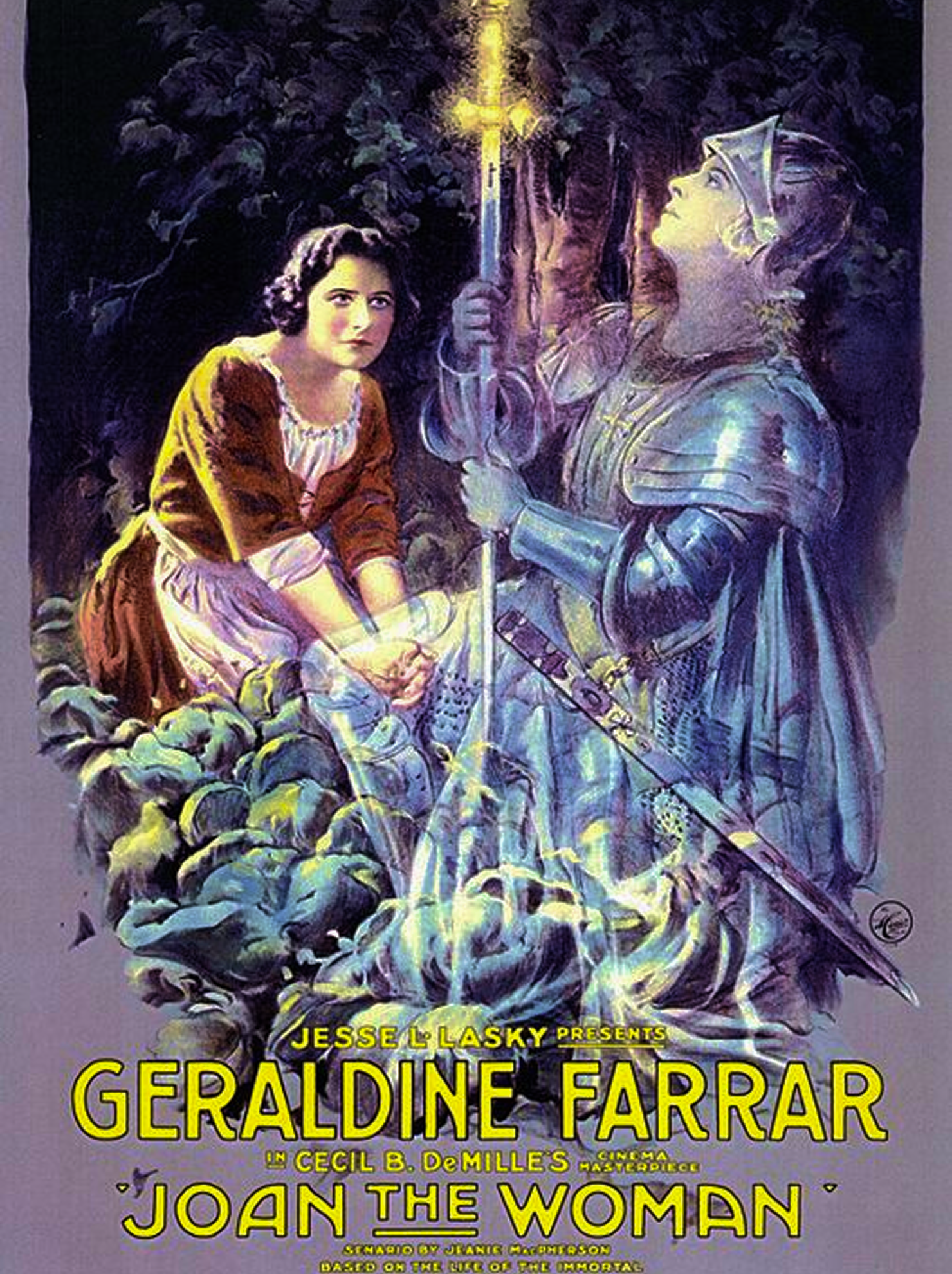
Joan the Woman, poster 1916.
Source: http://www.impawards.com/1917/joan_the_woman.html
Public domain, via Wikimedia Commons.
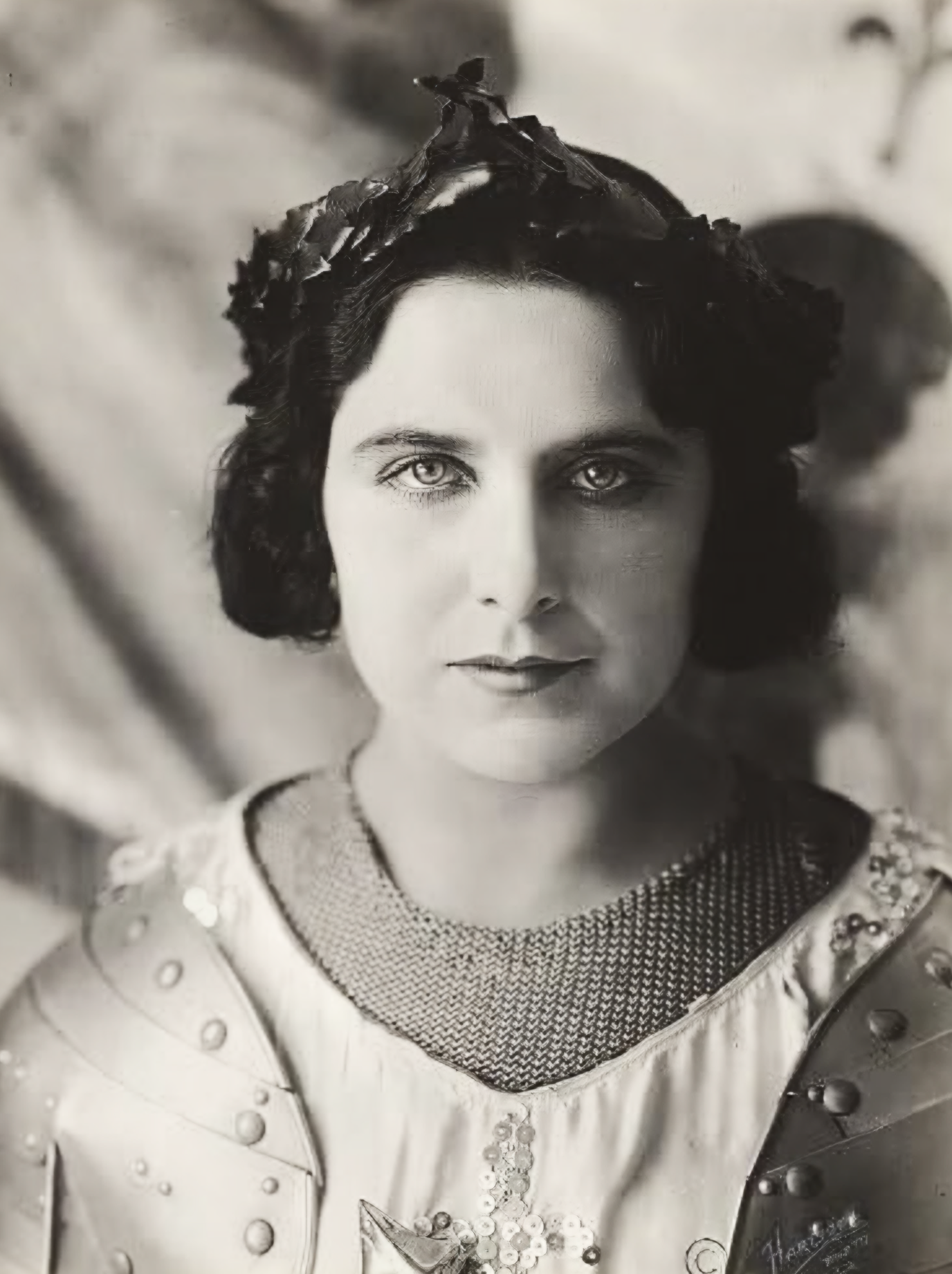
Geraldine Farrar, actress of Joan the Woman.
Source: Hartsook Studios, Public domain, via Wikimedia Commons.
Semyon Elin and Jacob Zadorozhny had formed the first ever private film distribution company in Soviet Russia in October 1921.5 They were known in Minsk as they had played a role in both the December 1921 ouster of Abram Lifshitz as the head of the Minsk Photo-Kino Department and in Shlomo Schnittman’s loss of contracts with the Photo-Kino Department. Lifshitz and Schnittman were both also arrested (see here)
Moise Dinershtein, who was then the Chair of the Rabis (the Art Workers Union) and would soon become the head of the first state film organization in Belarus (Kinoresbel), was interrogated in regards to the Lifshitz and Schnittman cases. He testified that Zadorozhny was a moshennik [swindler or scammer].6
Elin and Zarodozhny had, among their other films to show, old favorite Otets Sergiy [Father Sergius] (here), the popular D.W. Griffith film Neterpimost' [Intolerance] (Kinoresbel said it had a contract to show the film (See here) and something called Smert' vo imya zhizni [Death in the Name of Life], about which we can uncover nothing.
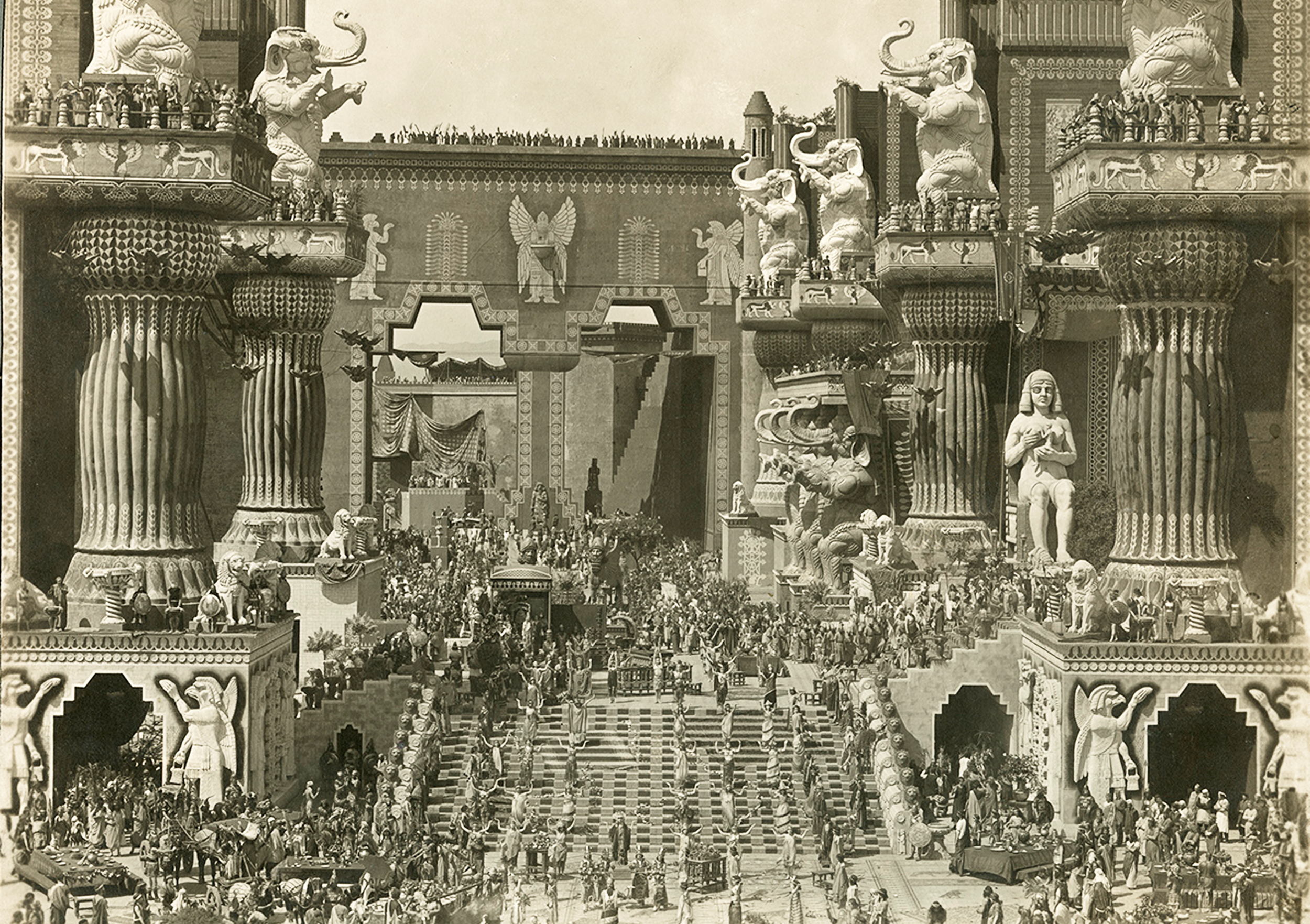
A still from Griffith’s Intolerance.
Source: Wisconsin Center for Film and Theater Research, Public domain, via Wikimedia Commons.
The popularity of cinema attracted a new player in Vitebsk. The Soyuz rabotnikov iskusstv, or Sorabis (The Union of Art Workers), wanted to get in on the chance to make a profit from films. It asked for permission to open a cinema, but, on September 8, 1922, the Gubpolitprosvet turned it down. The Gubpolitprosvet said it was “inexpedient” from an economic and artistic point of view to open another cinema.
We referred in a previous article to a one year report prepared by the Board of Artistic Enterprises in which it listed its actions and accomplishments (see here). The Board did not list the films shown until reporting on “the winter season,” which appears to mean the end of 1921 and the early months of 1922. The films from Russia included Dev’i gore [The Maiden’s Mountains (or The Virgin’s Mountains or The Virgin Hills, 1919].
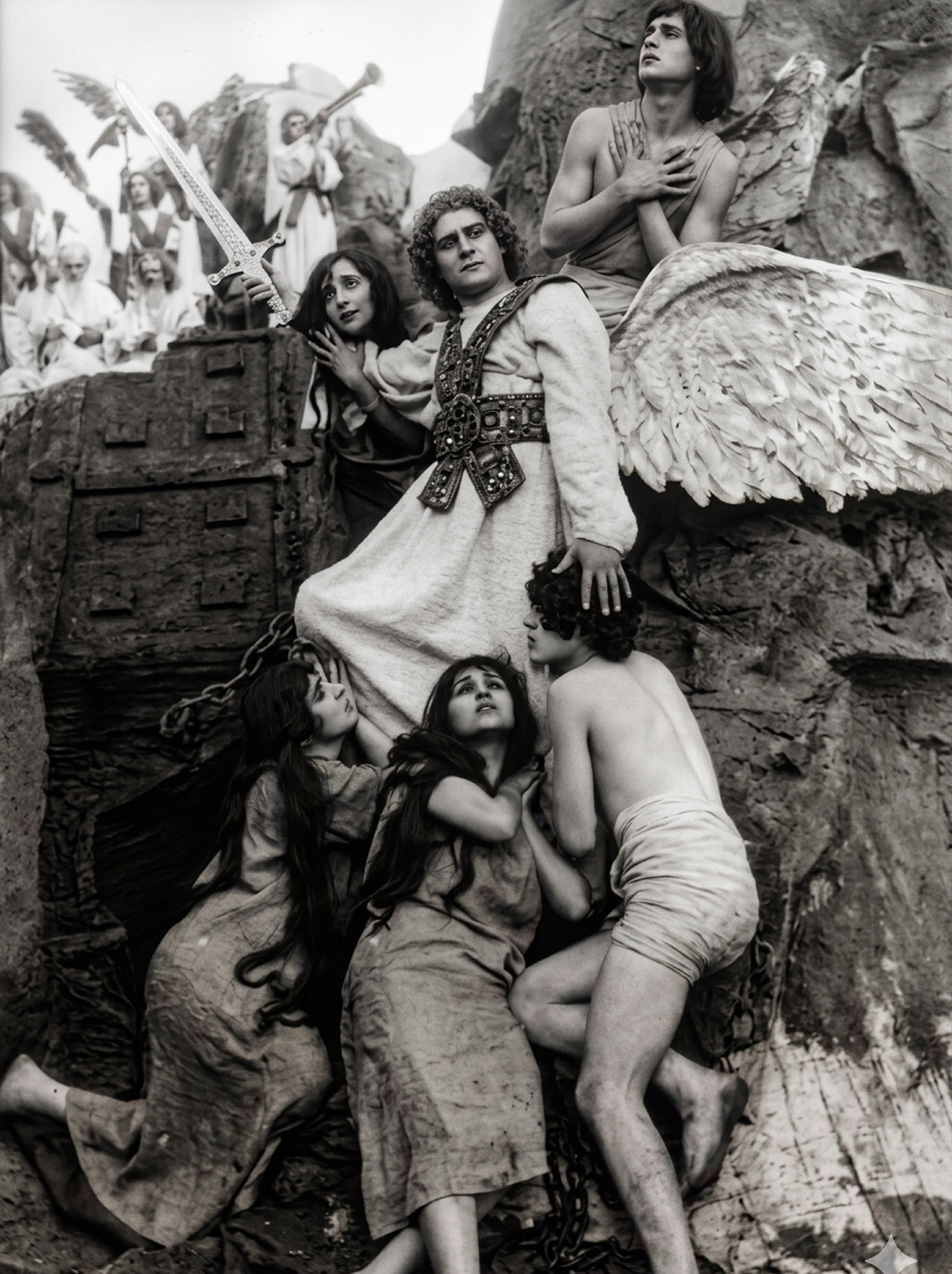
Still from The Maiden’s Mountains, 1919.
Source: https://arzamas.academy/materials/632
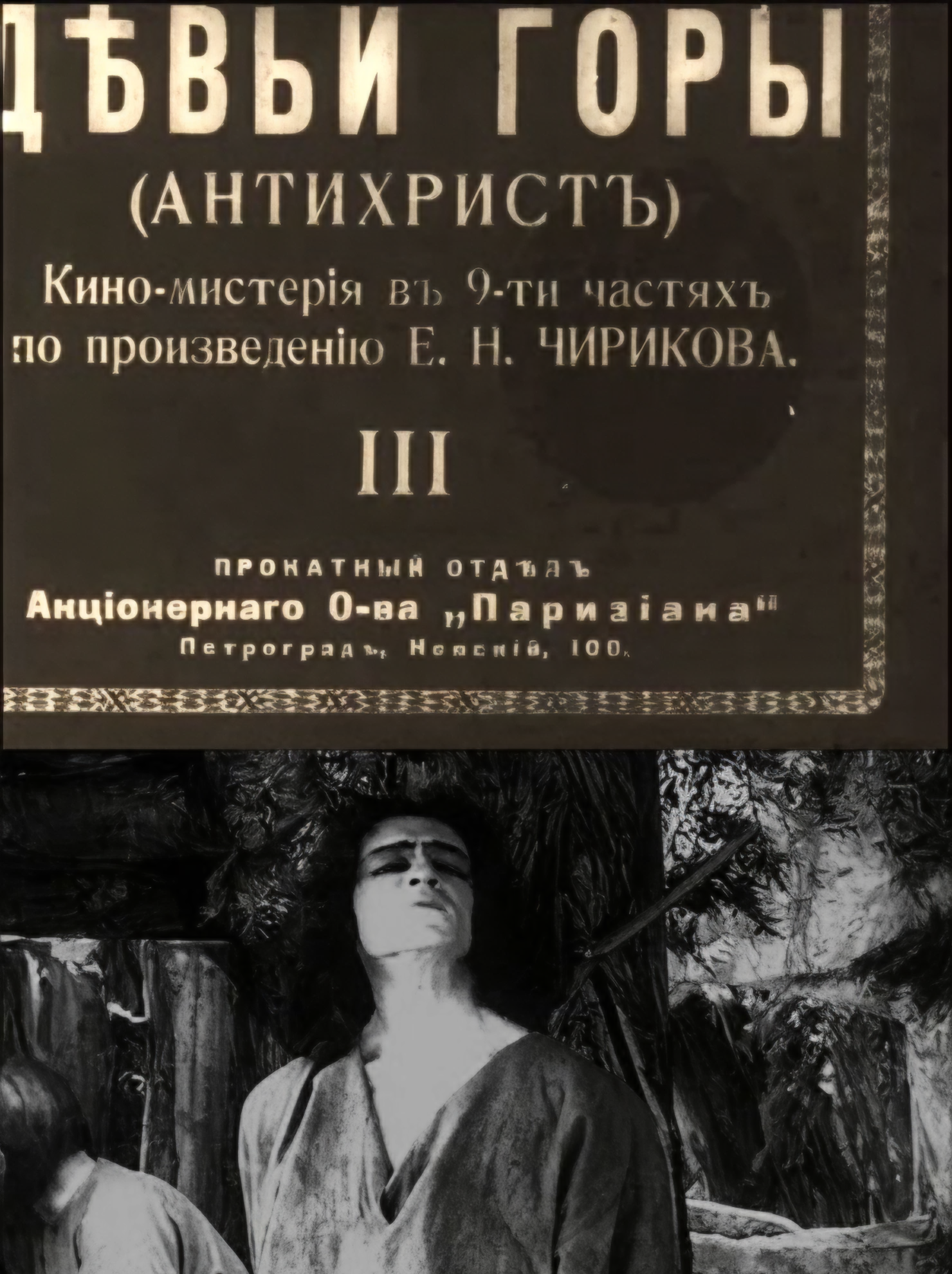
Still and credits from The Maiden’s Mountains, 1919.
Source: https://www.kino-teatr.ru/kino/movie/empire/9639/foto/606461/
M.I. Volotsky
On an only slightly happier note, Vitebsk apparently also got to see a favorite Russian actor, Ivan Mozzhukhin, in Pikovaya Dama [The Queen of Spades] (1916).
The Queen of Spades, 1916.
The report from the Board of Artistic Enterprises also many pre-revolutionary imports, one of which was Spartak [Spartacus]. We presume the one shown in Vitebsk was the 1913 Italian version. We present it here with English intertitles.
Spartacus, 1913.
The movie had been shown across the Russian Empire in 1914. Here is a 1914 advertisement in Sine-Fono [Cine-Phono] from the film rental company Khudozhestvo [Art]. It describes Spartacus as “The Best Film” and “Sensational!”
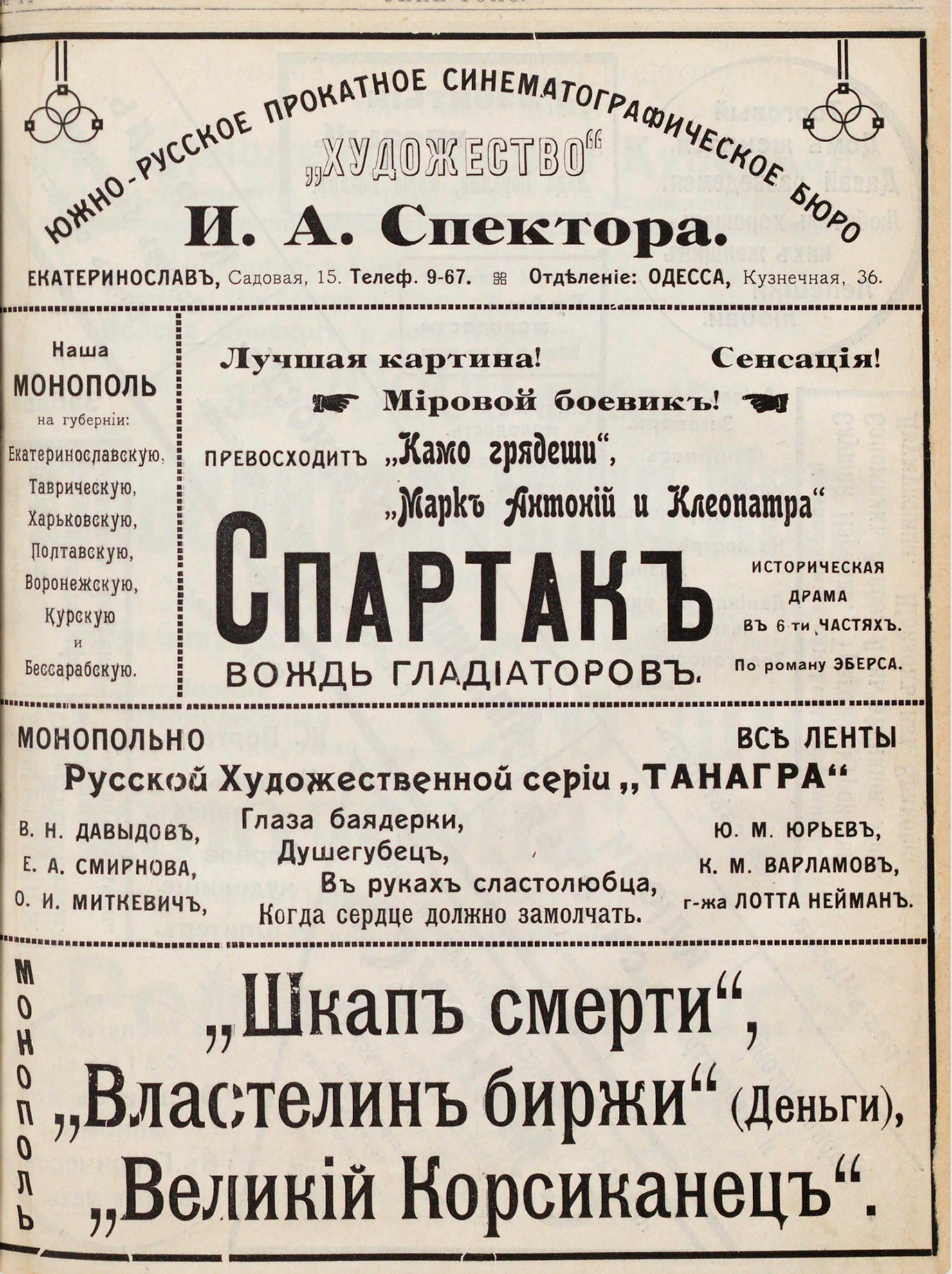
Spartak ads.
Source: Sine-Fono [Сине-Фоно; Cine-Phono] , No. 11, page 79, 1 Mar. 1914.
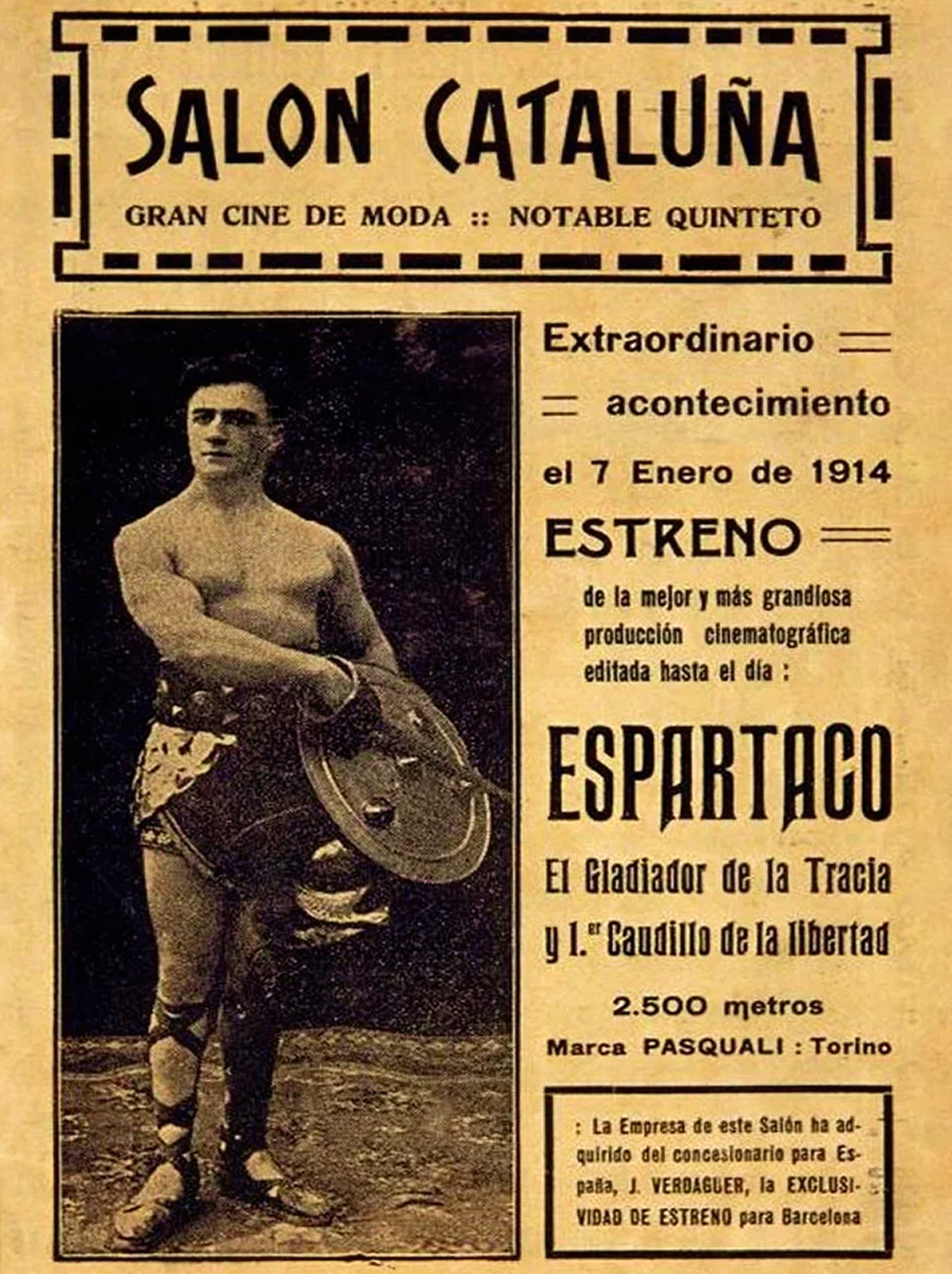
Spartak, Italian poster, 1913.
Source: https://www.kinopoisk.ru/film/166339/posters/page/1/
The report noted that two live theaters in Vitebsk both “ended their seasons in deficit, but thanks to the profit from cinemas in general,” the winter season for live stage and cinema “ended almost without a deficit.”9
The profit from cinemas, however, would soon become a double-edged sword.
1 V Gubpolitprosvet [В Губполитпросвет; In the Provincial Political Education Committee], 21 Apr. 1922. Gosudarstvennyi Arkhiv Vitebskoi oblasti [Государственный архив Витебской области); State Archive of Vitebsk Region (GAVt)], Fond 1319, Opis’ 1, Delo 4, p. 291-291b.
2 V Gubpolitprosvet.
3 V Vitebskii Gubpolitprosvet [В Витебский Губполитпросвет; In the Vitebsk Provincial Political Education Committee], 22 Mar. 1922. GAVt, Fond 1319, Ppis’ 1, File, 4, p. 417.
4 V Vitebskii Gubpolitprosvet
5 Mislavsky, V.N. Faktograficheskaya istoriya kino v Ukraine 1896-1930, Tom 2 [Фактографическая история кино в Украине 1896-1930 Том 2; A Factual History of Cinema in Ukraine, 1896–1930, Volume 2]. Kharkiv, Dim Reklamy [House of Advertising] 2016, p. 137-139.
6 Pokazaniya po sushchestvuyushchim delam [Показания по существу дела: Testimony on the merits of the case], 29 Dec. 1921. Natsional’nyi arkhiv Respubliki Belarus [Национальный архив Республики Беларусь: National Archives of Belarus (NARB)], fond. 14, opis’ 1, file 20, doc. 119b-120b.
7 V Sorabise [В Сорабисе; In the Union of Art Workers], 15 Sept. 1922. GAVt, fond 1319, opis’ 1, delo 4, doc. 432.
8 Volotsky, M.I. Mertsayushcheye kino: Ranniye gody rossiyskogo kinematografa [Мерцающее кино: Ранние годы российского кинематографа; Flickering Cinema The Early Years of Russian Cinematography]. 1995, Federal Book Publishing Program p. 64.
9 Otchet Po pravleniyu Khudozhestvennykh Predpriyatiy za operatsionnyy period s Oktyabrya mesyatsa 1921 g. po 1 Sentyabrya 1922 g. [Отчёт по Правлению Художественных Предприятий за операционный период с октября месяца 1921 г. по 1 сентября 1922 г.; Report of the Board of Artistic Enterprises for the Operational Period from October 1921 to September 1, 1922], 21 Oct. 1922. GAVt, Fond 1319, Opis’ 1, Delo 4, p. 504.